
Recently I’ve been thinking about how much of me is me and how much is just my culture talking. Last week (see PSWeek260827) I wrote about some perceptual tests that claim to reveal subtle differences between cultures, but I concluded they’re not very useful.
This week, I look at the “how much is me” question from a heavily-discussed 1989 book about the settling of America.

I inherited my last name from William Sprague, who in 1629 was a passenger on the Lion’s Whelp, that sailed into Massachusetts Bay at the very forefront of the Puritan migration—an eleven-year window that brought twenty-one thousand people to America, after which the traffic essentially stopped. After ten generations of mixing, William contributes less than a thousandth (210) of my genome. But DNA travels in chunks, so after all that time it’s roughly a coin flip whether he contributed anything at all—except for the one piece that doesn’t get lost in the shuffle, the Y chromosome, which came with the surname. It’s intriguing to wonder what else he did give me. I speak English because he did, for example, and I eat wheat bread instead of rice.
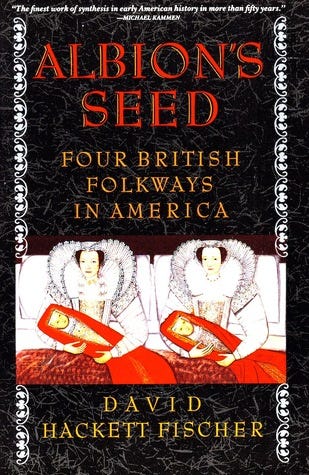
Historian David Hackett Fischer gave a detailed account of that legacy in his 1989 book Albion’s Seed. Instead of personality traits, which may or may not have a genetic basis and are hard to pin down in any case, he looks at broad social habits, which he calls folkways (a term he borrowed from sociologist William Graham Sumner): how a community marries, raises its children, spends its time, and answers an insult.
His claim is that America was settled in waves, where people of similar cultural backgrounds clumped into specific geographic regions: Puritans in New England, royalist gentry (”Cavaliers”) and their indentured servants in Virginia, Quakers in Philadelphia and the Delaware Valley, “Backcountry” Scots-Irish in Appalachia. Despite the passage of time and the whirlwind of mixing since then, today’s institutions and the cultural artifacts they support are recognizable descendants of those original settlers.
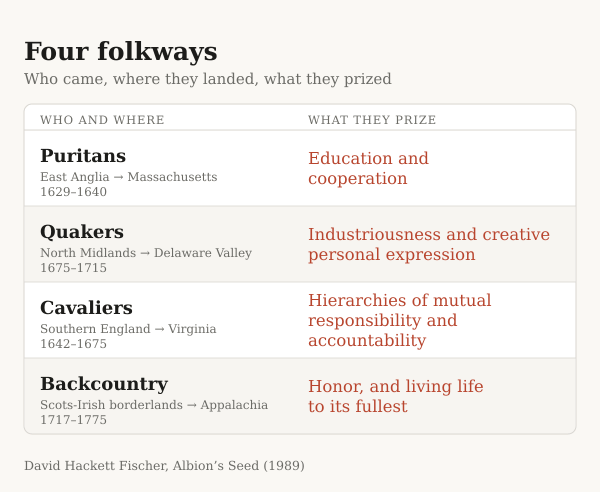
Scott Alexander wrote a lengthy review of the book that concludes with what he admits is speculation: that today’s politics are the four folkways merged into two—Puritan plus Quaker into a Blue Tribe of education, moral reform, and conscience; Cavalier plus Borderer into a Red Tribe of honor, hierarchy, and independence. If true, it would explain why many political arguments seem unwinnable: you’re not disagreeing about a policy, you’re repeating a centuries-old disagreement about the purpose of a good life.
As a personal scientist, I find the overall idea interesting but as much as possible I’d prefer to see claims that can be quantified. That’s why the best part Fischer’s research is the charts in the back, which squish high-level claims into specifiable variables that you can compare against your own family and its values. For example, instead of “what do you believe about family” he asks how many people did the average household actually contain.
Here are a few of my takeaways (and I emphasize, these are my personal interpretations, not necessarily consistent with the book):
1. Pregnant brides
Your own personal experiences with family and marriage will affect you in countless ways that are difficult to measure. So Fischer instead asks quantifiable questions:
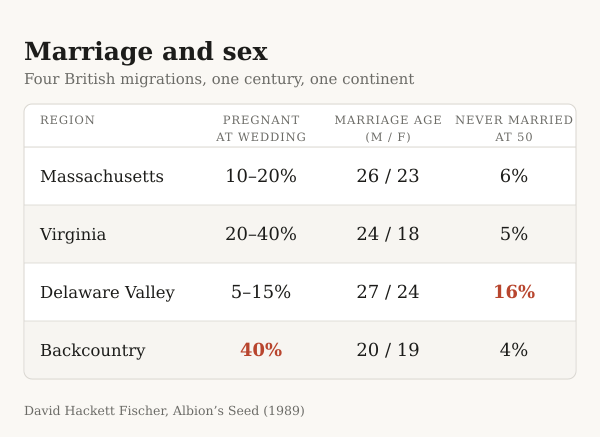
What’s interesting is the large spread in the same century, on the same continent, among people who all thought of themselves as English Christians.
If you think of these quantifiable facts as a rough proxy for attitudes about sex and marriage, you can almost see current differences for how important it is to be married, what’s an appropriate age, an expectations about children. Indeed, my family and I probably look most similar to the Massachusetts answers above (we marry and have kids slightly on the later side).
(Side note about that backcountry number: the wedding itself is listed in Fischer’s table under the heading “abduction ritual.”)
2. How to discipline kids
How strict should parents be toward misbehaving kids? Fischer dug through historical accounts to find how each folkway disciplines a child’s “will”.
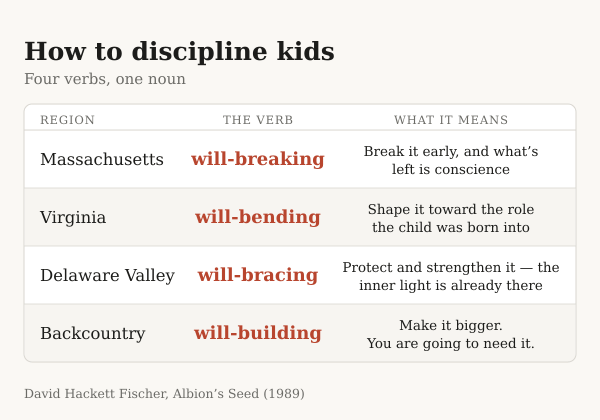
We all know parents who seem either especially lax or strict with their kids, but despite even extreme differences, most parents I know think of themselves as “normal”. In other words, compared the way they themselves were raised—their folkways—they don’t feel like outliers.
Here again, I probably relate more to the Massachusetts idea: we expect our kids to be well-behaved, regardless of “the role they were born into”.
3. Honor
Fischer also looked at how people respond to an insult. Here I am definitely on the Massachusetts side, as unfortunately my elementary school tormenters discovered! (All you bullies in “The Pack”, you know I haven’t forgotten you!).
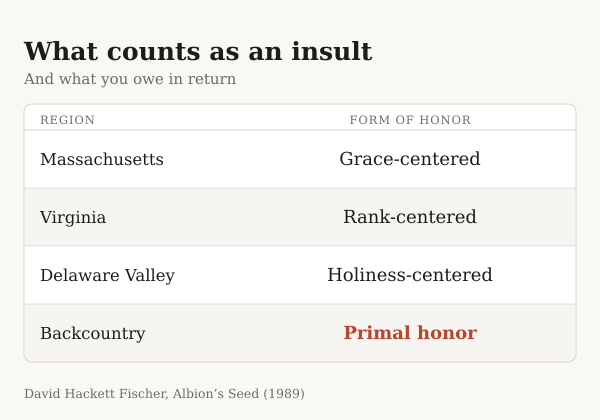
Primal honor means your standing is a physical fact about you that other people can damage, and that you are obliged to defend. Fischer traces it to a millennium of clan warfare on the Anglo-Scottish border, where there was no functioning state and a reputation for retaliation was the only property insurance available. Roughly 250,000 people carried that intuition to Appalachia between 1717 and 1775 — by far the largest of the four migrations.
Interestingly, Richard Nisbett’s group at Michigan — the same lab we discussed in PSWeek260827’s perceptual tasks — built an experiment for it.
Cohen, Nisbett, Bowdle and Schwarz (1996) recruited white male undergraduates at the University of Michigan, sorted by where they grew up, and told them the study concerned “limited response time conditions,” but in reality was a simulation of how they respond to insults. In a series of experiments, the researchers showed that southerners had significantly higher stress hormones than northerners exposed to the same obnoxious behavior.
Interesting result, but as far as I can tell from Ulrich Schimmack’s audit, the hallway experiment has never been independently replicated—which, from our previous posts, shouldn’t surprise you.
Anyway, it’ll be hard for me to do a cortisol test the next time somebody cuts me off in traffic, but having grown up in the north, my guess is that I’ll probably fit the stereotype.
4. What time is for
Finally, what about my interest in personal science? Back in PSWeek260528 we discussed my ActivityWatch logs—a minute-by-minute breakdown of how I spend my computer time. But did I think of that myself, or am I somehow echoing my long-ago ancestors’ own ideas about time?
Fischer looked at the vocabulary of each of the founding communities to discern their attitudes toward work. Here are the words each group used to describe time:
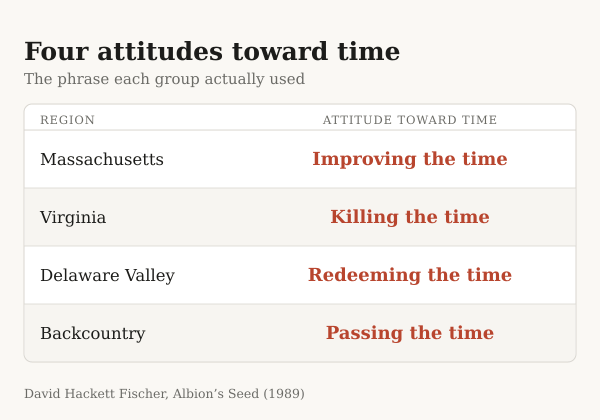
Is my interest in personal science a legacy of the classic Puritan attitude of my ancestors, four hundred years and ten generations after the Lion’s Whelp? My friends who “kill” or “pass” the time on TikTok or backpacking or whatever—how much of their attitude is inherited from their own ancestors’ sense of a life well-lived?
But I’m pretty sure William would be proud of me.
Personal Science Weekly Readings
Speaking of stressing out over a perceived slight, somebody filed a Class-action lawsuit against Oura over its claim of 95% sleep-staging accuracy.
Much as I agree with the complaint—see PSWeek251218 for how inaccurate I find consumer sleep products in general—I don’t want to live in a society where we need lawyers to tell us whether a product is worth testing. I’ll make up my own mind, please.
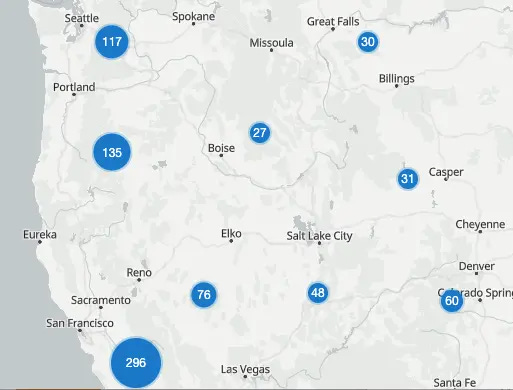
I don’t understand why data centers have been getting so much publicity. If they follow local laws, why treat them any differently than any other business? In fact, they’ve been around for decades, many of them operating quietly in your neighborhood right now, says @LoganDobson, who points out there are dozens in Manhattan.
If you want to find the ones near you, use Data Center Map. Here are the ones on the West Coast. (Zoom into the map to see the exact address for each)
About Personal Science
You don’t always need numbers in order to think scientifically. Just follow the motto of the Royal Society Nullius in verba—take no one’s word for it, including ours. If you have other topics you’d like to discuss, please let us know.
Heritable vs cultural personality traits and value systems in USA are hard to measure. It is a fascinating question. The waves of immigration (1820 to 1860 Irish and German, then Northern European ŵave 1860-1890, and the southern European, Eastern European wave 1890-1919, then Southern hemisphere and Asian wave 1965-present) were substantially greater, in popultion percentage, and likely have a greater cultural impact than the first European settlers. My uneducated hunch is that religion and a representative government have shaped cultural values in USA society more than origin of immigration. But, It is hard to discount tangible traits, why are Midwesterners gernerally so nice?