
Ask me an open-ended question about a scene and I’ll give you what seems to me to be an obvious answer. But how much of what I think is “obvious” is really just my culture talking?
This week we look at some interesting cross-cultural studies that claim to show how personality and instinct differ across families and ethnicities.
Long-time readers know I spent a large part of my life in Asia (see PSWeek251016), the consequences of a lifelong interest in languages and their effect on thinking. One idea that always intrigued me is how much my own preconceptions about the world are caused by my own cultural upbringing. If I had been born elsewhere, how much of me would still be me?
Psychologists and social scientists have studied this too, and now that LLMs are making it easier to research (and potentially replicate) the results of those studies, I’ve been revisiting some of these questions for myself. Here are a few examples.
1. The aquarium
Masuda and Nisbett (2001) showed Japanese and American students 20-second animated underwater vignettes and asked them what they’d seen. A big bright fish moves across a field of rocks, plants, bubbles, small fish.
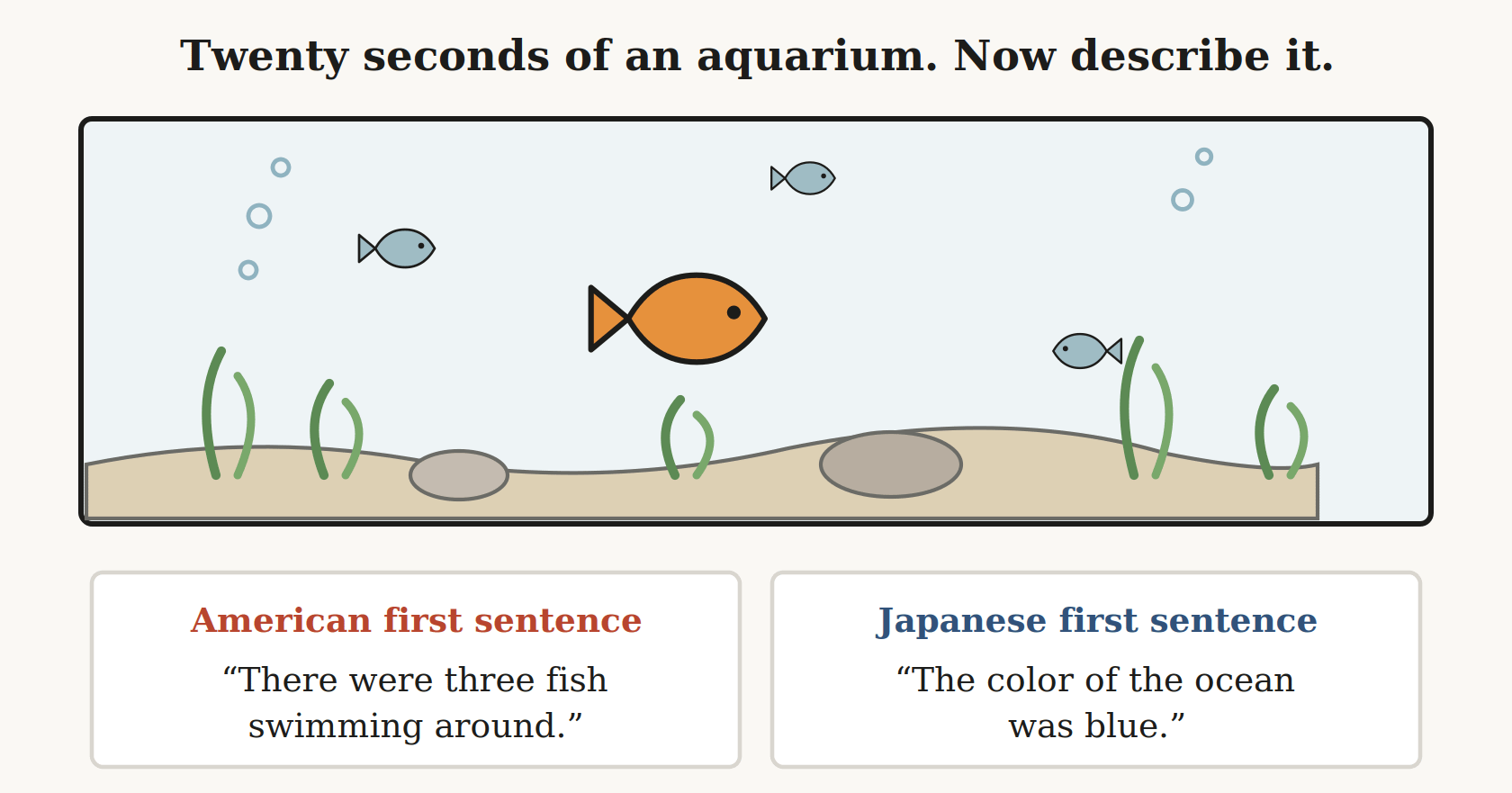
The experiment simply looks at the first sentence that pops in your head. Americans overwhelmingly say something about fish. Japanese participants open with the scene as a whole — water color, the floor of the scene, inert objects — and made 65% more observations about the background overall.
Now repeat, but this time when shown the fish again, either against its original background or a novel one, the Japanese recognized it more accurately in its original setting; for Americans the background barely mattered. They hadn’t encoded a fish. They’d encoded a fish-in-that-place. (see more at the Masuda Lab).
2. Cow, chicken, grass
Which two go together?
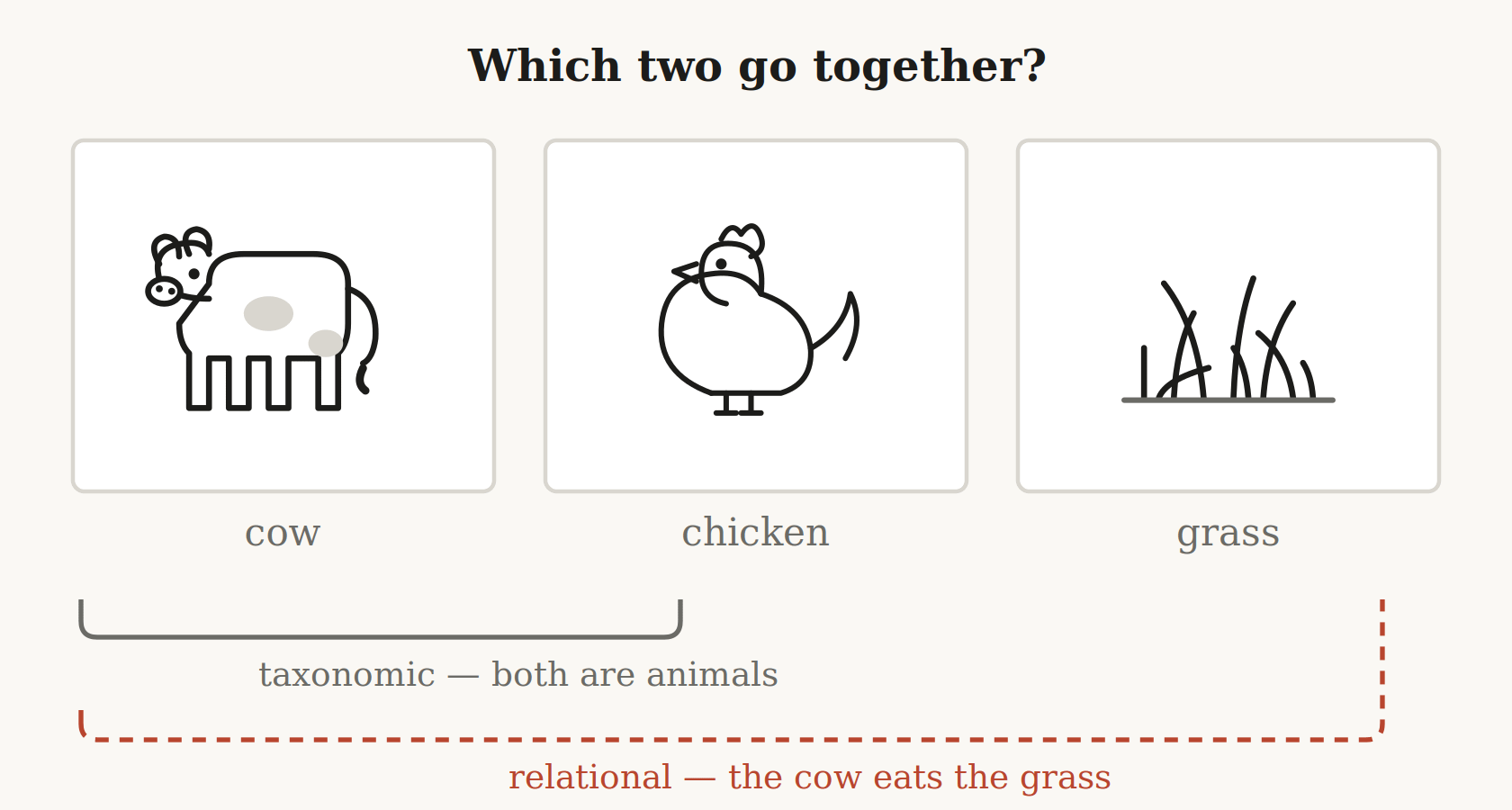
Westerners tend to pair cow-and-chicken: both animals, a taxonomic rule. East Asians more often pair cow-and-grass: the cow eats the grass, a relationship. Neither is wrong. The point is that one of them felt obvious to you and you didn’t experience it as a choice.
3. Where do you put lunch?
Mandarin locates time on a vertical axis where English uses a horizontal one: 上个月 (shàng gè yuè, “upper month”) is last month, 下个月 (xià gè yuè, “lower month”) is next month — and of course 上午/下午 for morning and afternoon. Does that reach past vocabulary into how time is actually laid out in the head? Or is it dead metaphor, the way nobody hears a “deadline” as a line?
Fuhrman et al. (2011) tested this: Participants saw the middle frame of a temporal sequence — a half-peeled banana — then a second frame, and pressed a key to say whether it came earlier or later. In one block the two keys sat side by side; in another, one above the other.
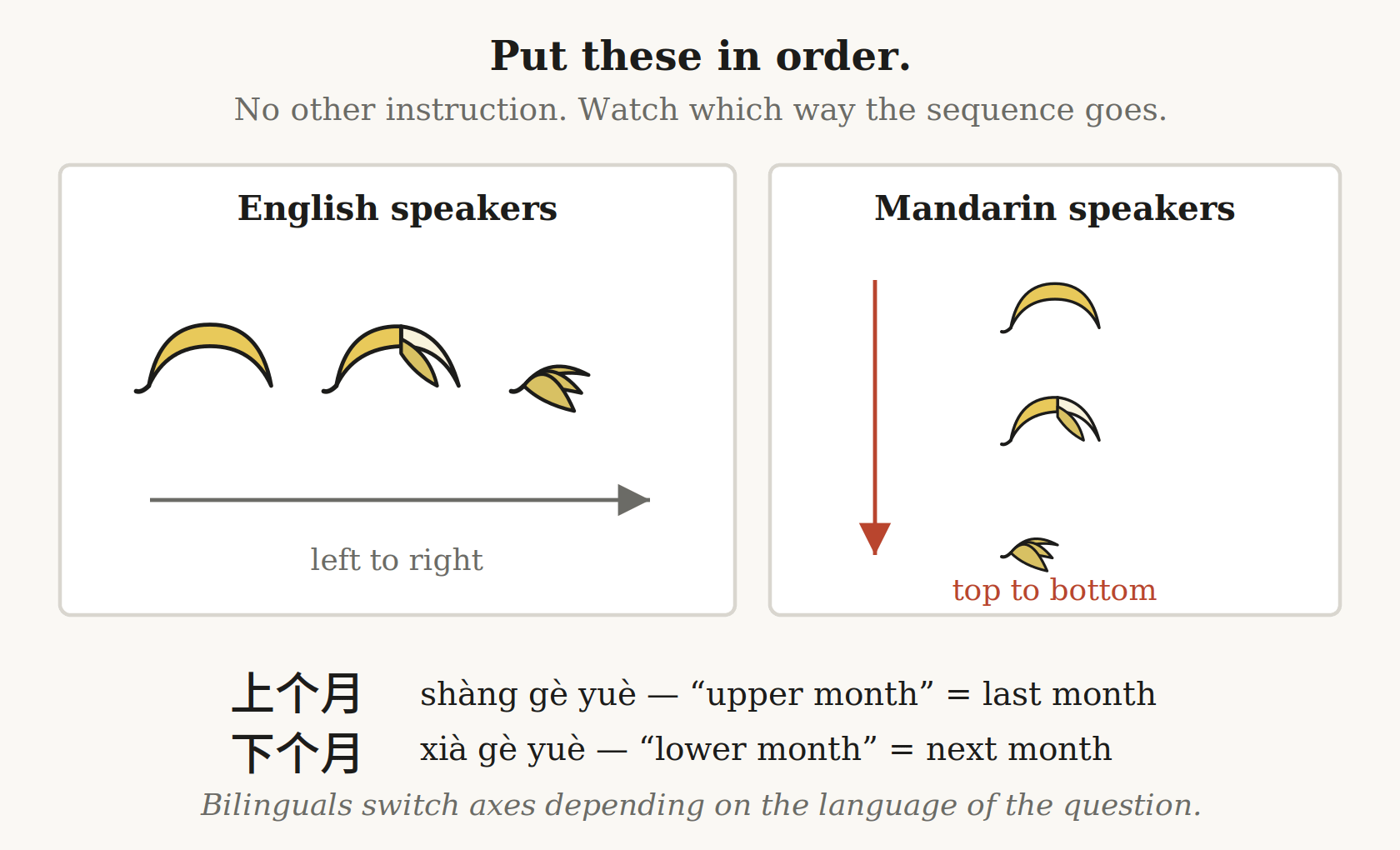
Mandarin speakers were reliably faster on the vertical layout. Nobody was asked to arrange anything, and no spatial word appeared in the instructions.
To faithfully replicate this I suppose you should use a millisecond timer, but there's a crude home substitute: hand someone three photos — green banana, half-peeled, empty peel — and say "put these in order." Nothing else. Watch whether the sequence goes across or down. Try it on native English and then native Mandarin speakers.
But, but…
The heyday of these sorts of studies came between 2001 and 2011— the pre-registration dark ages, before the 2011 Bem precognition paper and the 2015 Open Science Collaboration replication project made everyone more skeptical of the “pop science” literature. So the obvious question: do these findings hold up?
tldr; not really.
Over the years, I’ve tried these tests on my Asian and American friends with, frankly, mixed results. Back when I was less sensitive to the Replication Crisis in the social sciences (see PSWeek251203 ) I tended not to worry too much about the failures. The overall idea — that some cultures are more group-oriented and some are more individualistic — is such a tidy stereotype that who wants to ruin the cocktail party with rigorous testing. You can explain away the anomalies with comments like “Oh, you probably lived in America too long” or “Hmm, maybe that Japanese girlfriend affected you more than you think”.
The professionals vs personal science
But I’m just a humble personal scientist. What do the professionals say?
The eye-tracking evidence is a mess. Although Nisbett’s lab continued studies throughout the 2000s, other labs had a hard time replicating. (e.g. Rayner 2008). More sophisticated studies, using eye-tracking techniques developed for computer UX research, seem to show maybe some affinity for faces that look like yours. Okay, maybe true but hardly proof of a ‘foreground/background’ perception difference.
The horizontal/vertical time differences in the banana figure above has been replicated, sort of. A group of researchers from one Chinese lab continue to publish confirmations of their own findings, though I couldn’t find other independent examples. To me this smells like null publication bias—labs that tried to do similar experiments gave up and didn’t bother to report their failure.
In my experience, to really understand a culture you have to go very deep into the nuances of how the people think. It would be nice to have a simple test that could help quantify how deeply you’ve attained that level of insight. Unfortunately, I think people and cultures are simply too complicated for that.
Personal Science Weekly Readings
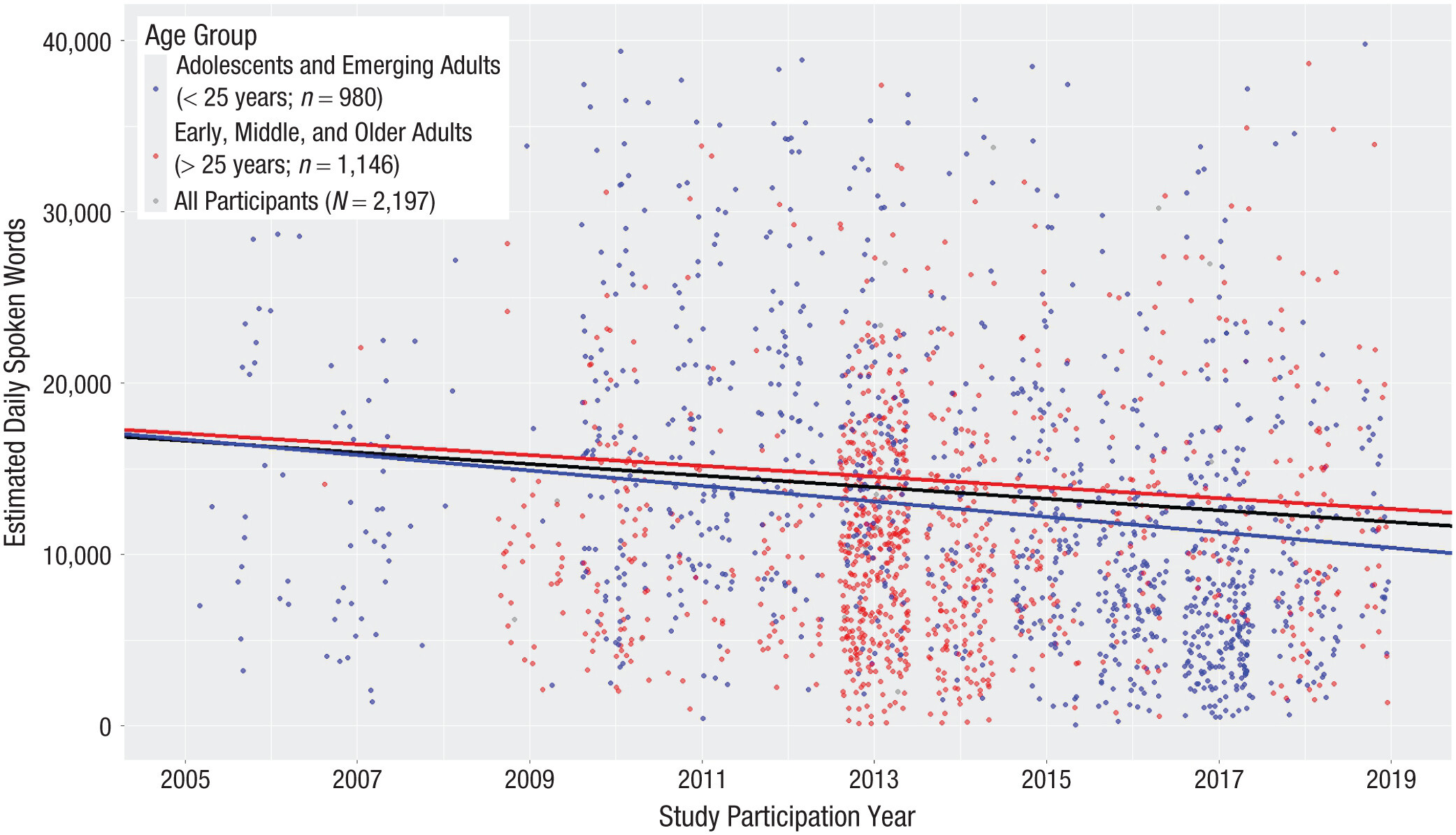
Speaking of replication, University of Arizona psychologist Matthias R. Mehl has over the years re-run experiments involving everyday speaking patterns, work which led to the debunking of that popular myth that women talk more than men. While digging through his multi-year dataset, he noticed something different: that people are talking less than they used to. In fact, since 2005, our daily count has been dropping by about 300 words per year.
I’m a sucker for examples of professional scientists’ mistakes and Mark Manson’s Intellectuals are F*cking Idiots is a recent good summary: a far-left university professor who was so enthusiastic about communism that he visited Pol Pot’s regime in Cambodia, where he was killed for being insufficiently supportive of the leader. Studies about behavior scientists, whose whole job is to predict these things, were unable to do better than a coin flip. And of course the lesson of Robert McNamara, praised in the 1960s as the smartest man alive, whose complex mathematical models convinced him to continue doubling down on the Vietnam War.
ChatGPT as second opinion. UCSF’s Robert Wachter ran a hard case past ChatGPT — his own labs and clinician notes — and reports that it found the relevant data and weighed it with enough nuance to compare favorably to two experts. But I liked his conclusion, borrowed from Joe Biden: don’t compare it to the Almighty, compare it to the alternative. For most people most of the time, the alternative isn’t a doctor. It’s nothing.
About Personal Science
Personal scientists take nobody’s word for it — nullius in verba. The whole point of the cultural-cognition literature is that some of what you “see” was installed before you had any say in the matter. You can’t step outside your own defaults to check them.
We publish every Thursday for people who use science for personal rather than professional reasons. If you’ve tried any of these tests on your own friends and gotten a result — including a boring one — let us know.
Did you notice differences in mathematical reasoning and when people employed it? I think there is often an avoidance inn the west.