
Substack’s new “Scan for AI text” feature is intended to help readers discern whether a real human was behind the post or not.
This week: what AI-generated text means for reading, writing and Personal Science Week.
What’s the point of writing?
When Quantified Self co-founder Gary Wolf recently asked on Substack whether he should write an essay about timestamps, my first thought was, well, sure. But why should he write the article and not Claude? If I really want to know about timestamps, does it matter how I learn? I trust Gary’s judgement, so if he signs his name to a post, do I really mind if he used an LLM to generate the text?
You don’t care who wrote your car manual, as long as it’s accurate and well-written. If you need help fixing your dishwasher, you don’t care who or how the YouTube got made—you just want easy-to-follow and concise instructions. Why would a timestamp tutorial be any different?
Detecting AI-generated writing
Professional writers are, understandably, terrified—in the way blacksmiths and buggy whip artisans were once terrified.
No doubt that was the motivation behind Substack’s recent introduction, with algorithm company Pangram, of the feature “Scan for AI Text” that estimates how much of a post was written by a human vs an AI. Just click the three little dots at the top of the post and select it from the menu item
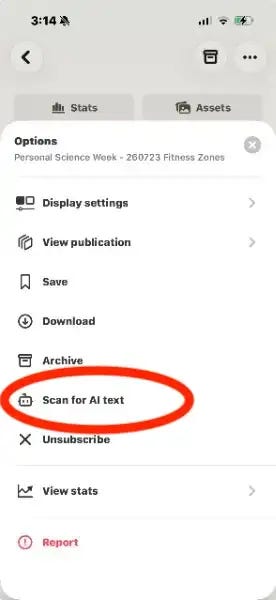
Pangram’s algorithm is actually quite sophisticated. Instead of simply looking for examples of what most of us have learned to recognize as AI-generated text, Pangram tries to classify writing by the author’s “voice”.
It works for the same reason that you and I can reliably tell the difference between a passage from the Iliad and an article in Sports Illustrated, even if we know nothing about either: the styles are so obviously different in each. Similarly, with enough careful training, a computer classifier can learn to tell differences between any author, whether human or otherwise. These classifiers can be good enough that they can distinguish between different LLMs as well—even when you tell the LLM to radically change its style.
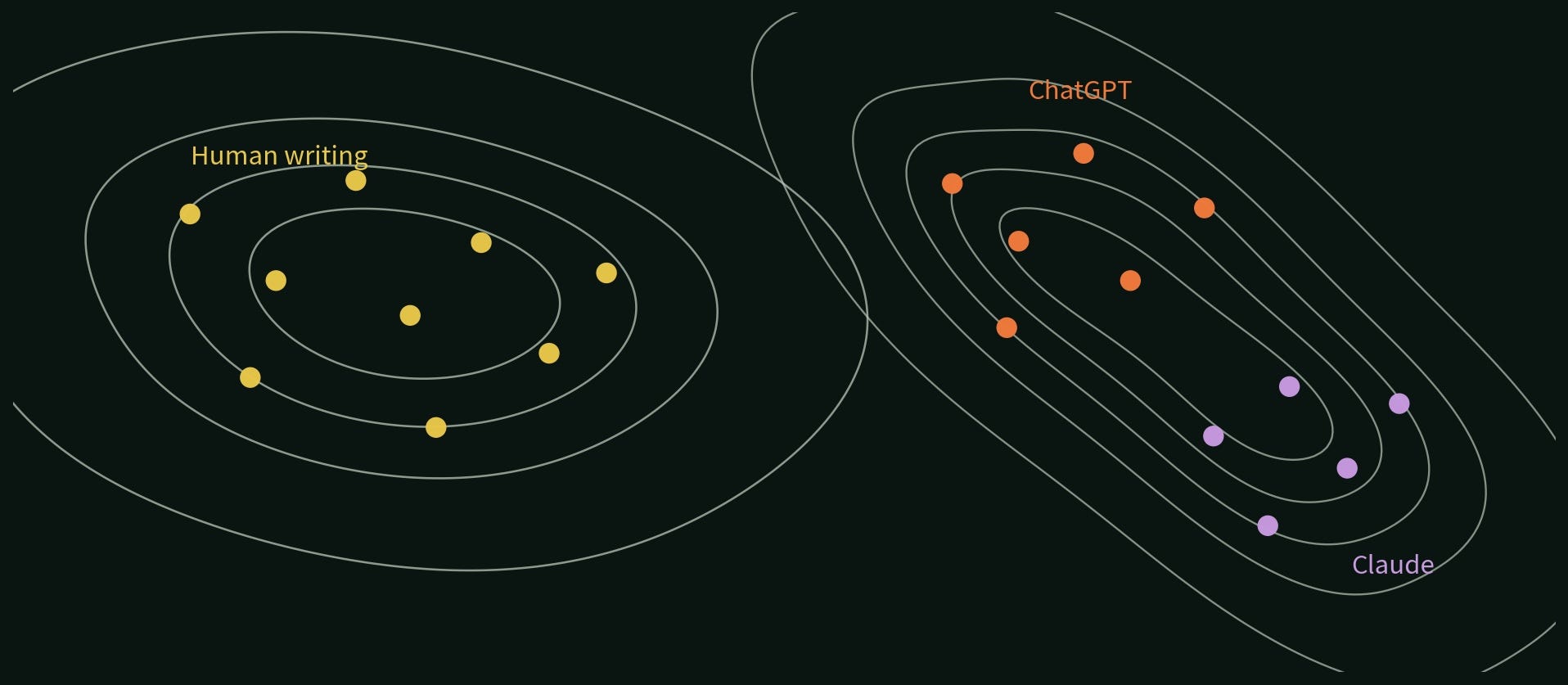
You might think this is a ‘cat and mouse’ game where the LLMs and the detectors go back and forth trying to outdo each other, but it won’t be that simple. As LLMs get upgraded, they tend to inherit the styles of their predecessors, and any text with an identifiable style will be pegged by a Pangram-type classifier.
In fact, Arvind Narayanan used Claude Code to access the Pangram API and then iteratively modify his posts until they came back 100% human-authored. But he says now Pangram seems to have strengthened their detector and that tactic no longer works.
What about me?
Personal scientists don’t care about general statistics or claims that something works in general. We care about what works for us. So here’s what Pangram says about my recent post PSWeek260723
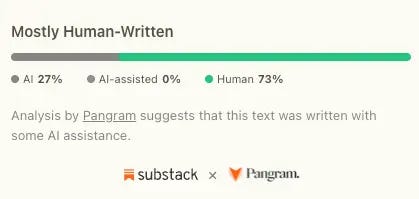
Which I think is probably about right. Most of everything I do these days is run through an LLM one way or another, and my writing is no different (See PSWeek260402 for details). A series of Claude “routers” and skills let me quickly pull up a summary of whatever I’ve encountered in the past. For example, when I look for “timestamps” I’m reminded of something I wrote back in PSWeek250206 along with a bunch of other related rules I’ve accumulated for various tracking purposes over the years.
So yes, after I’ve settled on an idea for a post, I’ll ask my Claude project to pull together anything related while I work interactively to understand the personal science consequences. Once I’m happy with the final version, I ask another Claude to do a critical review and fact-check.
Interestingly, I don’t think Claude saves me all that much time in the writing; the real time saver is in the analysis, which pre-LLM would have taken weeks—if I’d even bothered to do it at all. When I ran the Pangram algorithm against several other Substack writers I like, I found several that were mostly or even 100% AI-written. At first I thought it would be nice to show you some named examples, but you know what? I don’t care. Some of these “AI-assisted” posts are from people who are not native English speakers. Some are from busy doctors who otherwise wouldn’t have time to write a thoughtful well-researched post. But all of them—all the people I subscribe to—are real people who take responsibility for what they write. In each case, I learned something that would have been more difficult to learn otherwise. Isn’t that what matters?
Sure, there are some people who will tell their Chatbot to “write 100 different Substack posts about timestamps”, maybe assign pseudonymous author names to each of them and “flood the zone” in search of clicks and eyeballs. Maybe they’ll all be well-researched with plenty of accurate citations and workable examples.
But then what’s the point? If I really want to know about timestamps, I could have my own Claude write one.
I’m not a professional writer, nor do I aspire to be one. I write because (1) the act of expressing a thought coherently is the best way to internalize it for myself, i.e. to “decide what I really think” and (2) the discipline of forcing myself to publish something publicly every week is a good way to keep me focused. As Steve Jobs used to say “Real artists ship”.
The hard part is thinking that timestamps are important enough to write about in the first place. Claude will never replace that.
Personal Science Weekly Readings
Speaking of AI writing, this How I use AI (and How I Don’t) is a well-written explainer for how one professional writer, Jeremy Caplan writes his excellent Wonder Tools Newsletter. tldr; “I’m responsible for everything I write”, he says.
If you feel like you’re good at spotting AI faces, try this BBC Quiz that will present you with pairs like these and ask you to click on the “real” one:

And speaking of great personal science, Jane Cook How to survive boiling water is a well-written account of an experiment at an MIT dorm involving a carton of milk that has been sitting unrefrigerated since 1994. It’s a long story of fermentation and a new experiment where the author did PCR-testing on a commercial probiotic tea to see whether the microbes actually survive boiling (spoiler: they do, but it’s unclear whether that matters).
Finally, another plug encouraging you to subscribe to Wondertools, which always turns up things like this from a recent video discussion with writer A.J. Jacobs: a wine aroma training kit with dozens of individual scents (including, um, horse sweat). A.J. spends a few minutes each morning trying to identify them — smell being, as he puts it, our least-trained sense. $400 on Amazon, or roughly $30 to build your own.

About Personal Science
This newsletter is a weekly summary of ideas and techniques that we hope will help others who want to get better at personal science. If you have additional thoughts or topics you’d like to discuss, please let us know.
This stuff is so much on my mind right now. And I think back on the walk we took all around Lake Merritt and talked about the flood tide of AI material and "where we stand on the river bank." The flood is still rising! Of course, I put my entire book manuscript through pangram and received a 99% human rating. Then I became very curious about the nature of that 1%! A deep, deep cave of obscure research from which I hope to extract a long, probably borderline insane essay. I think that we really care a lot about the nature of the new medium that we are (intentionally and unintentionally) inventing. The way we care and what that care drives us to do is it's so hard to put into words. And the waters continue to rise...
Why do ais write in a different style from humans if they were trained on human writing?