
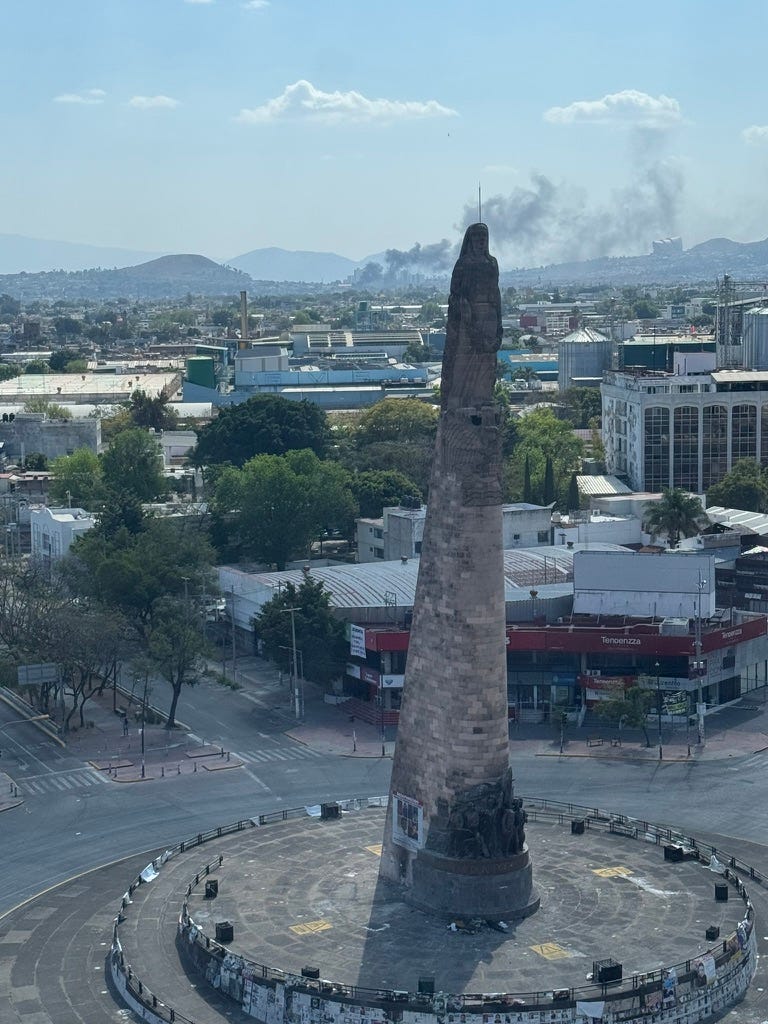
I started writing this on Sunday afternoon from the 11th floor of an Airbnb in Guadalajara, Mexico. From my window I can see pillars of smoke rising to the south — one of them in the direction of the airport. The street below, which two days ago was full of well-dressed families and teenagers celebrating quinceañeras, is nearly empty. The few people out are burly and somewhat scruffy-looking men. No women — which, if you’ve spent time in places where things go wrong, you know is never a good sign.
I didn’t learn about any of this from Google News or the New York Times. After a quiet Sunday morning, we’d prepared a full itinerary for the day: the ceramics museum in Tlaquepaque, lunch at Casa Fuerte, folk art shopping. But after hopping in an Uber, the driver handed me his phone. On the screen was a Google Translate message warning of cartel activity at our proposed destination. Do we really want to go? he asked. I did my own quick online check to confirm. Uh no, we decided as we had him turn around and bring us back.
That’s how information works in a crisis. Not a push notification from Google News. A driver showing you his phone.
Finding What’s Actually Happening
What had happened: earlier that morning, the Mexican Army killed Nemesio “El Mencho” Oseguera Cervantes, leader of the Jalisco New Generation Cartel, in an operation near Tapalpa — about two hours south. The cartel retaliated with coordinated arson and roadblocks (narcobloqueos) across Jalisco and several other states. The governor declared Código Rojo (Code Red). Schools closed. The U.S. Embassy told Americans to shelter in place.
But “shelter in place” doesn’t answer the questions I actually needed answered: am I safe at this location? Where can I get food? How long will this last?
For that, I did what any personal scientist would do: I cast a wide net and filtered hard. Repeated queries to X and Grok pulled up a stream of real-time posts — some from people clearly on the ground in Guadalajara, others from armchair analysts thousands of miles away. I wanted specific, observed detail that tells you something.
Being open-minded means following every lead. On X I found posts speculating about conspiracies — Navy SEALs had supposedly been spotted doing a joint training exercise last week in Campeche. Coincidence? Being skeptical means noticing that the same source got other verifiable details wrong. Open-minded enough to read it; skeptical enough not to share it. That’s the line.
As Arnold Kling puts it: “We decide what to believe by deciding who to believe.” In normal life, we outsource that decision to institutions — the Times, the CDC, Wikipedia. In a crisis, the institutions can’t tell you what you need to know, and the question of who gets very local, very fast. The Uber driver. The street vendor who sold us chorizo because the grocery chains were all shuttered. Our own eyes can see the smoke in the distance, the empty streets, the boarded shops.
Meanwhile, plenty of dramatic images circulated online — some real, some apparently AI-generated, many impossible to verify from my apartment. But I found that the most reliable signals came from tools nobody thinks of as "news." The Uber app showed "no rides available" to the airport. Rappi — Mexico's version of DoorDash — showed "no stores available." These aren't editorialized, they can't be faked, and they told me more about actual conditions on the ground than any headline. When your delivery app becomes your intelligence source, you know the institutions have hit their limits.
Travel Is Not Tourism
I’ve written before (PSWeek250529) about how travel doesn’t automatically “open the mind.” Philosopher Agnes Collard argues in her Case Against Travel (archive) that “Tourism is what we call travelling when other people are doing it.” Even Seneca, writing to Lucilius two thousand years ago, warned that changing your location doesn’t change your mind — you travel with yourself. A Columbia University study found that people who travel broadly (many countries briefly) actually show small decreases in moral behavior, while those with depth experiences don’t.
Someone once told me the test for real travel: (1) use public transit, (2) visit a grocery store, (3) spend time at a local person’s house. The idea is that these force you past the curated surface and into how people actually live.
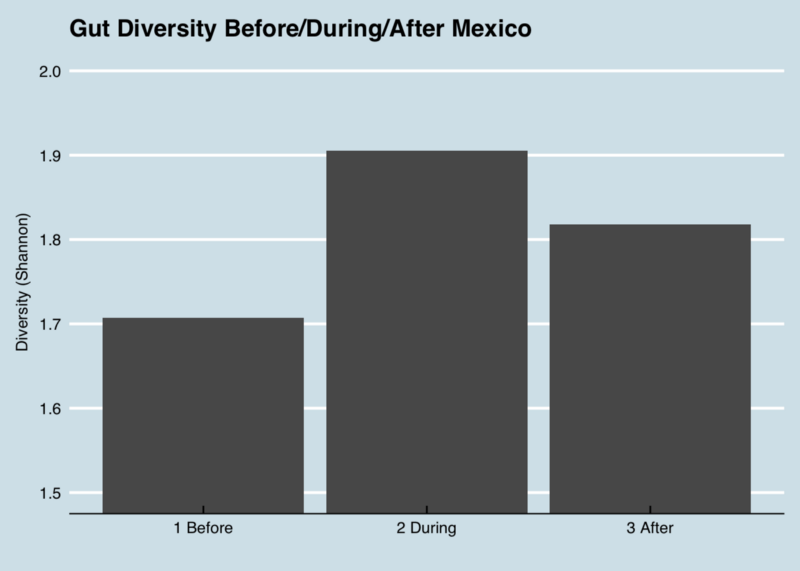
I’d add a fourth: travel with a purpose. My trip to Mexico back in 2018 wasn’t tourism — I was tracking my microbiome while eating chapulines and drinking pulque, testing whether foreign travel changes your gut in measurable ways (it does: Proteobacteria spike, diversity increases, everything bounces back in a few weeks). That kind of intentional observation is the opposite of what Collard criticizes. You’re not collecting experiences like souvenirs. You’re running an experiment.
A crisis, it turns out, is another kind of purpose — one you didn’t choose. When the metro shuts down and the grocery chains close and you’re buying chorizo from a street vendor because it’s the only food available, you are no longer a tourist. You’re navigating the same reality as five million locals. And the personal science mindset — skeptical, observational, trusting your own data — turns out to be exactly what you need when the information environment itself becomes unreliable. The question isn’t “what does the New York Times say?” It’s “what do I actually see?”
It’s now Thursday morning and I’m headed back to the US today. The situation here has become more stable and I don’t expect any more problems. But I’ll be paying attention.
Personal Science Weekly Readings
The MIST (Misinformation Susceptibility Test) lets you test your own ability to distinguish real from fake headlines. I scored in the 36th percentile — not because I’m gullible, but because I was too skeptical.
Stanford STORM is a free, open-source tool that generates Wikipedia-style articles with citations on any topic — think of it as deep research you can run yourself. To test how well early crisis information holds up, I asked it to analyze how accurate early COVID-19 predictions turned out to be.

Eric Topol questions the VO2 max craze, arguing that the widely-cited study linking it to longevity has serious methodological problems. As someone whose Apple Watch VO2 max readings bounce around enough to be essentially meaningless, I found this a reassuring counter-argument to Peter Attia’s claims that it’s the single most important metric for overall health and longevity.
And speaking of longevity, among the items found at the compound of that dead cartel leader El Mencho was Tationil Plus 3000mg — an intravenous glutathione injection made by Swiss Healthcare Pharmaceutical Ltd. You can't get the injectable kind in the US, but apparently it's quite popular in Latin America, where it's promoted for two purposes: skin-whitening (it inhibits tyrosinase, reducing melanin production) and longevity. Unfortunately if he was hoping it would help him live longer, it doesn't seem to have worked.
About Personal Science
Personal scientists think for themselves, approaching health and life decisions with open-minded skepticism. We collect our own data when possible, remain curious about mechanisms, and remember that averages don’t define individuals — your information environment in a crisis might be completely different from mine, and that’s exactly what makes personal science valuable.
We publish each Thursday for anyone interested in applying scientific thinking to everyday life. If you have questions, experiences to share, or topics you’d like us to explore, please let us know.
Sounds like a trip you won't forget anytime soon 😬
The tourist hanging out at the all-inclusive resort may have just as much of a purpose as you have, just a different one... What you have in common is that you're both outsiders with no local (family/friend/coworker) connections.
Piecing together what's going on can be an interesting challenge. See e.g. how people using the Whataburger app to know what areas had power after a major hurricane in 2024, or all the "Open Source Intelligence" based on satellite images or other sources. Investors call this kind of information "alpha".
Great points, glad you got on your way safely. Did you find any particular bacteria associated with pulque? I didn't see any obvious changes when testing after my trip to Mexico, but I didn't look for exact species that might show a pattern.