
A chest strap is the most accurate way to get heart rate information, but it’s awkward to put on and can be uncomfortable, especially compared to a watch or a ring. Maybe an arm band would be a nice compromise?
This week I tested them all while sleeping. Short answer: they’re all the same if you just care about heart rate, but only the chest strap is reliable for HRV.
Is there an easier way?
I’ve been doing a bunch of testing lately related to heart rate, and to get the most precise answers possible I know I should be using my trusty Polar H10 chest strap. At around $100, it’s cheaper than just about any other tracking device, and way more accurate.
The only downside is … the strap: putting it on, taking it off, and the discomfort rubbing against the skin. Serious athletes wear it while biking or in the gym—and it’s fine for short periods like that—but I keep wondering if there’s an alternative that’s just as good.
So this week I decided to test against:
My trusty Apple Watch, which I wear anyway
A smart ring, which like the Watch is less intrusive.
An armband, which is easier to put on
No, I didn’t do an exhaustive, ready-for-peer-review test, but the nice thing about personal science is that I just need the results to be good enough for me.
Takeaways
Full details (and a much prettier writeup, with fancy charts and more) are in my Claude Artifact so look there if you care about the details, but here’s what I learned:
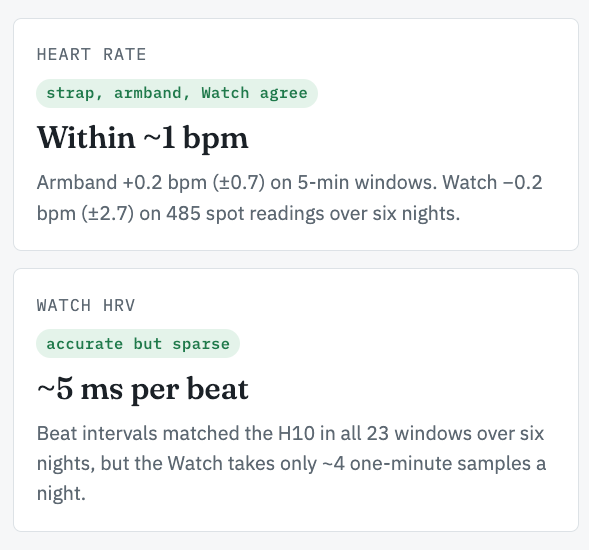
Overnight heart rate: the strap, armband and Watch are interchangeable. The ring is fine when it works, but there’s no way to tell. (It failed for me 2/6 nights)
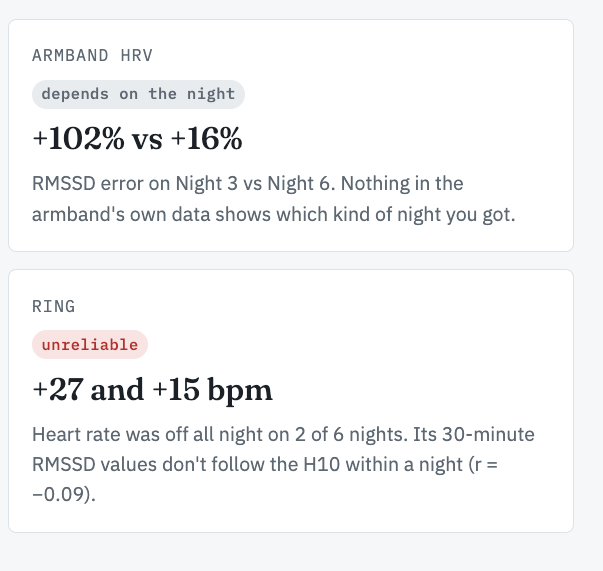
Overnight HRV: the H10 is the only device that covers every beat all night with data you can trust. The armband can match it on a good night, but on other nights you can’t tell whether it was accurate or not.
The Watch’s few HRV samples are accurate. There are too few to show how HRV moves through the night, but when it does report, it’s usually pretty accurate.
The ring’s HRV isn’t usable for detailed tracking. Its nightly average is close enough to the H10’s that it might be usable for a rough daily average.
Armbands are okay until they’re not
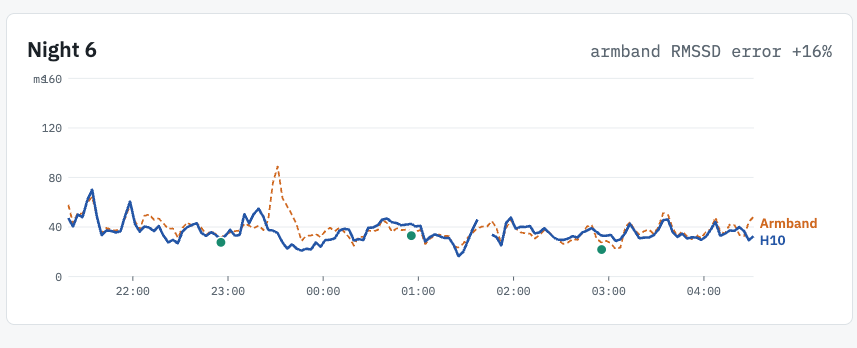
The armband can be just fine some nights. The two curves mostly overlap: dark blue of the chest strap and the light orange of the armband. And notice those tiny dots along the lines: that’s the Apple Watch, which I found tracks reasonably closely, though at sparse intervals.
But when the armband is wrong, it’s really wrong. The ring (in purple squares) was off too, but never as much as the band.
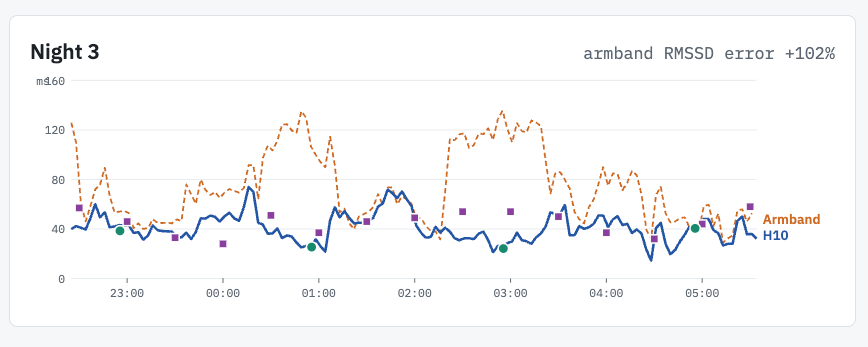
The bigger problem is that there was no way to tell when the band was wrong. If I had relied on it exclusively, I’d end up with nights that were completely off and no way to tell when that happens.
Personal Science Weekly Readings
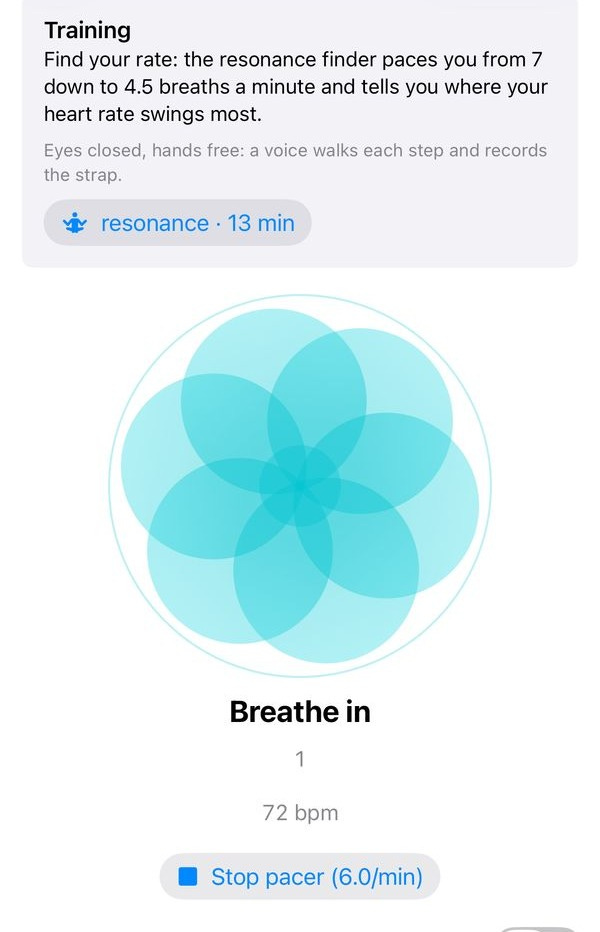
Speaking of Polar H10, I’ve been continuing to upgrade the StrapLog app (see PSWeek261029). It now supports an interactive ‘pacer’ feature that watches your breath and heart rate to hone in exactly on your breathing “resonance” frequency (that maximizes RSA). I’m testing the theory that you’ll sleep better and experience overall better alertness when the heart rate is timed to your breathing rate. Try it yourself and please give me feedback. Updating the app with new features is minutes of work now thanks to my Claude Code harness.
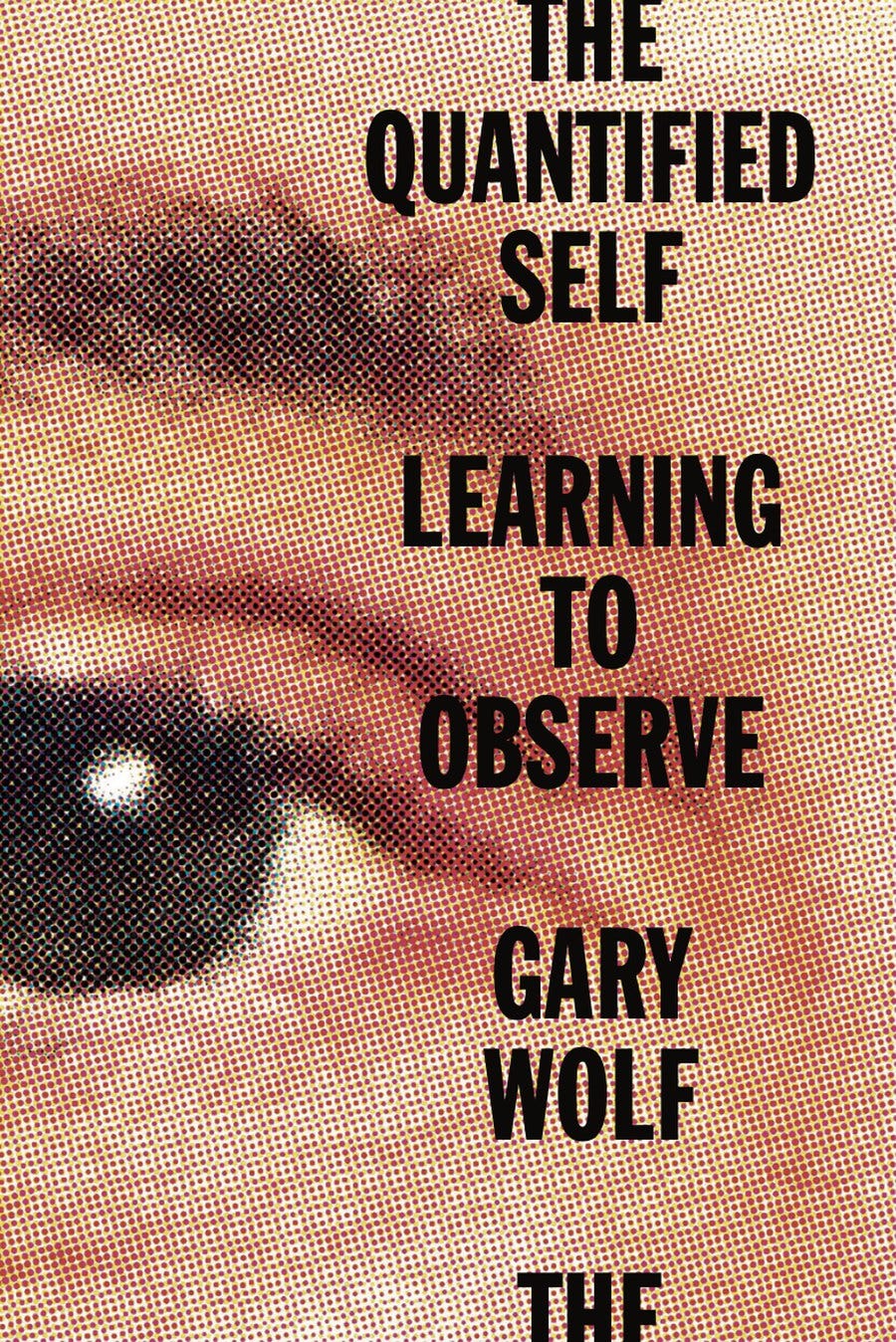
Quantified Self co-founder and Personal Science OG Gary Wolf discussed his new book at an NYC book launch and mentioned Miranda Fricker, an NYU philosophy professor.
Fricker’s book Epistemic Injustice: Power and the Ethics of Knowing points out two kinds of injustice:
Testimonial: a speaker’s credibility is discounted due to prejudice. (e.g. when a woman is interrupted more than a man)
Hermeneutical: a whole group lacks the vocabulary to make sense of its own experience, even if there is no “prejudice”. (e.g. the term “sexual harassment” didn’t exist until c.1975)
It’s easy to apply this to personal science, where the opinions of normies like us are often not taken seriously by professionals. You walk in with two years of HRV data and the doctor waves it off because you’re not a doctor. Your n-of-1 is “anecdote”; his n-of-2,000 is “evidence,” even when it was measured on people nothing like you.
But Fricker’s argument is too good. It applies to her as much as to the groups she defends. If credibility should track the argument rather than the speaker, then a Substacker gets to criticize an NYU professor as well. My guess is that she doesn’t always like where that goes and it runs into a problem she underweights: stereotypes are often decent heuristics. A professional’s priors (“patients overinterpret noise”) are often right. The personal scientist’s job is to bring enough data (and careful LLM-based consideration) to beat that.
Fricker is most useful not as a theory of oppression but as a checklist: when you dismiss someone’s observation, is it because of the observation, or because of the observer?
(We reviewed Gary’s book, “the best book ever written on how to get started with personal science”, in PSWeek261015. )
About Personal Science
Too many of our beliefs are based on something we read or heard. Personal science is the idea that you can investigate for yourself, using data you collected.
We publish every Thursday. If you have something else you’d like to cover please let us know.