
LLMs make it so cheap and easy to build apps that I wonder about the future. Will we need general-purpose apps at all?
I was frustrated with a self-tracking app, so this week I built my own that’s much better and does exactly what I need. I even shipped it to the App Store. What did I learn?
We’ve discussed how much I enjoy my Polar H10 chest strap, which is hundreds of times more precise than Oura and costs just $100. The only downside is that it’s a chest strap, which is less convenient and comfortable than a ring or a watch. But for in-depth heart-rate testing, it’s the best I know. (see PSWeek260409-Polar H10)
To make use of that torrent of data, you’ll need a specialized app, and until recently my go-to software was HRV-Logger. (see PSWeek260430-HRV) But unfortunately the developer hasn’t been maintaining it, so when I upgraded to a new iOS version, the app stopped working and my Polar H10 became essentially useless.
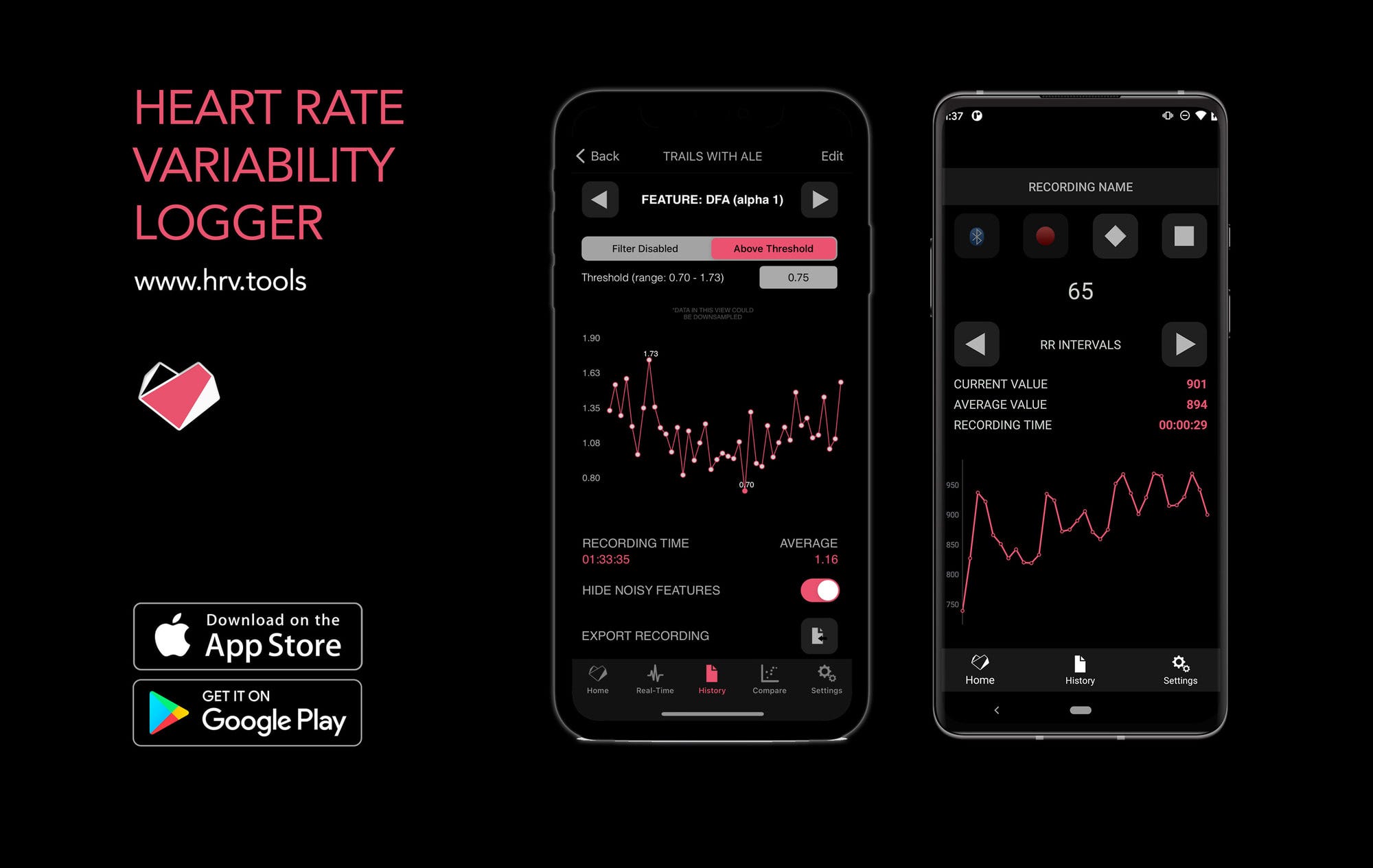
So I wrote my own app! I jotted down a basic list of the features I want, and pointed Claude to it with the instructions “build this for iPhone”. The only hard part is the prompting, which requires some thought about exactly what I want. Although it can take a while for Claude to write the code, most of that time is walkaway for me. I set up the prompt and go do something else. In an hour or so it will have completed the next turn of the app, I try it, and then write some followup prompts until I like the result.
Not only was I able to completely replicate all the HRV Logger features I care about, I threw in several more:
A much prettier, easier-to-use interface
A separate Watch app, so I can operate the key features without touching my phone.
A “night stand mode” so I can view all my data live while I’m in bed. (Bonus: now I get an indicator in my Mac status bar that shows my current heart rate)
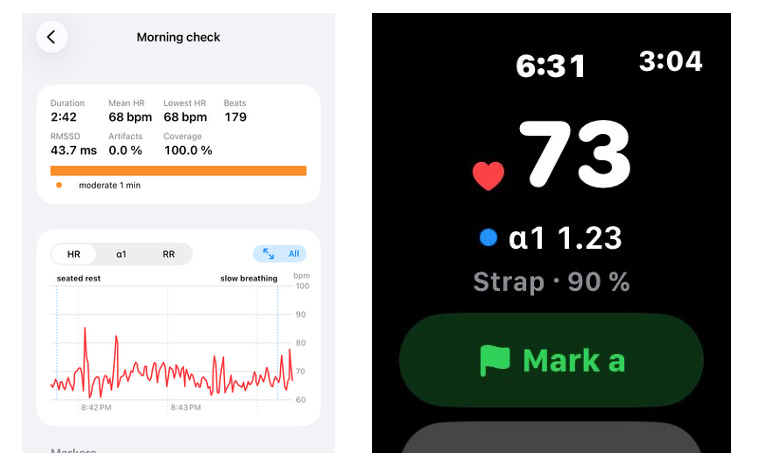
More importantly, all my data is automatically saved to iCloud, making it easy to study in detail when I’m back at my Mac. I wrote a whole set of skills to perform analysis on those files.
I literally can’t think of a reason to go back to HRV Logger.
I had the idea on Thursday night, and a working prototype a couple hours later. By Sunday afternoon I had submitted it to the App Store and the following Wednesday it’s available to everyone.
Make your own app
In the old days, a good Personal Science post (or Quantified Self Show-and-Tell talk) was supposed to include a section on “how did you do it”, because sharing knowledge is an important ethic of us personal scientists. So my first instinct was to write up a step-by-step overview for how to think through the design, construct the prompt, prepare an App Store submission, etc. But why bother? Your own LLM will give you more complete, personalized instructions that I ever could. And even if I took the time to write it up, you’d still feed your followup instructions into Claude anyway.
So here you go. Just copy this into your favorite chatbot and ask away:
Look over this Github Repo and explain step-by-step how I can build something similar: https://github.com/personalscience/StrapLogThe big takeaway is that software coding is now free. HRV Logger is $9.99. I slapped a 99 cent price tag on my new app, not because I hope to get any money from it, but to signal that it really works.
There’s no reason to buy it from me. You can build it for free using your favorite LLM.
Is that the future of apps?
I’m not the only one
Several times a week, I get an email from a PSWeek reader who wants me to try out a new app they vibe-coded. Here are a few recent ones:
Faisal emailed me about his app Tracelet with this (AI-generated) description
It lets you record symptoms, caffeine, food and supplements, then explore patterns alongside sleep and recovery. Your comment about previously deciding the headaches weren’t worth tracking felt particularly relevant. I wanted to make keeping that kind of record easier.
Hesham Meneisi wanted me to know about Biostacks, his iPhone supplement tracker.
You log doses and quick mood, energy, sleep and focus check-ins, and it compares days on and off a supplement. Everything exports to CSV, so you can hand it to your own tools. There’s no account, it works offline, and it collects no data.
Jay-J saw I was studying my Watch data and suggested I check out his Apple Health export app
Mattias Geniar asked me to try SnapKin as an easy way to track meals:
The part your readers might actually care about is the method: we tested it against 500 meals weighed on a scale (83% median accuracy per meal, median error 16.8%), and the write-up, including the studies that argue against tracking at all, is here: https://getsnapkin.app/en/research/own-accuracy
and many more
I love seeing these (and please keep sending them!) and I feel bad I don’t have time to try them all. But it does make me think hard about what AI is doing, not just to personal science, but to everything.

So what’s left for us?
Of course finding a trustworthy app is another story, especially now that AI Slop is everywhere. But you can ask LLMs to filter for you and that problem will be solved too.
There are some things that only humans can do. It’s what I call the “what vs how” distinction.
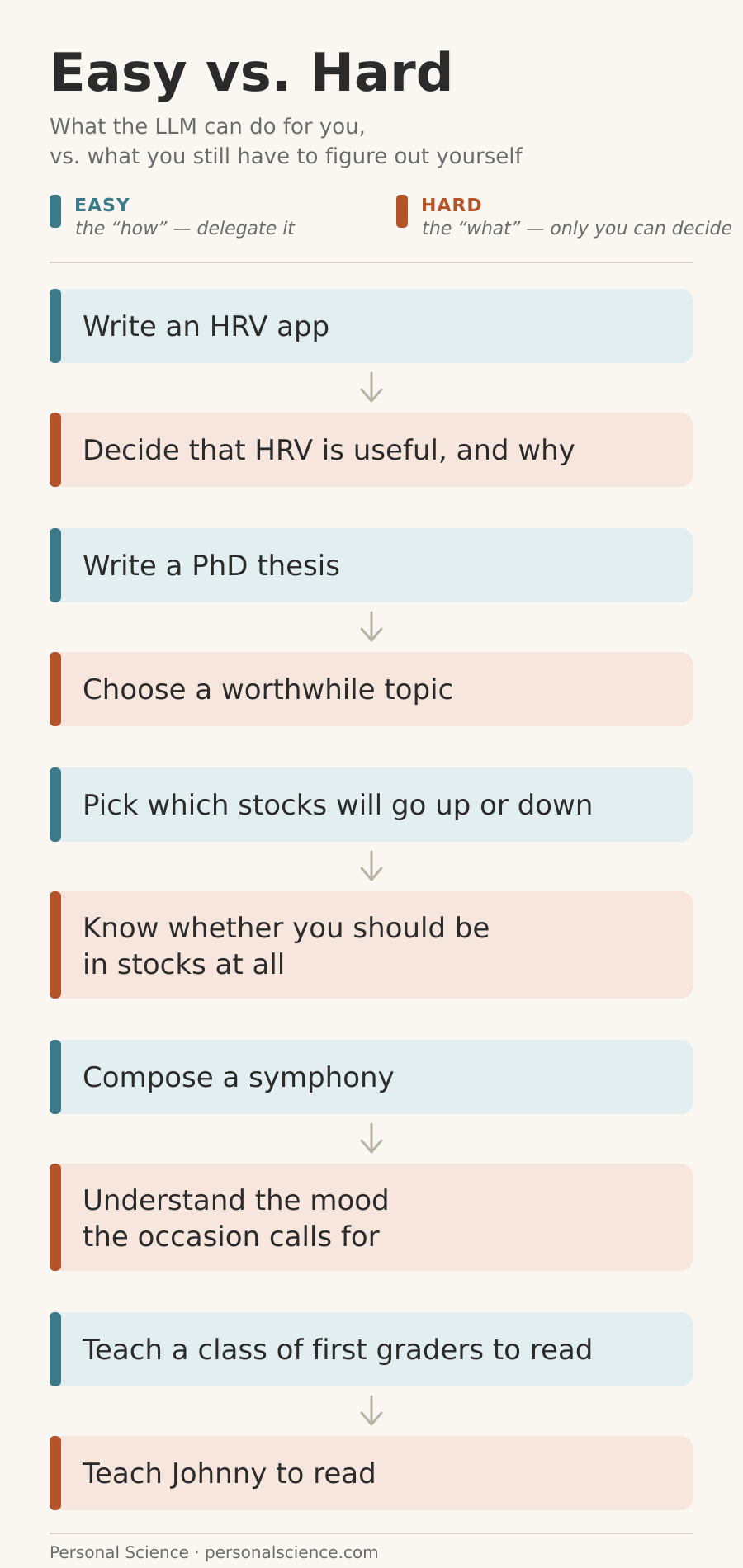
We’re in for an exciting several years ahead of us, now that the “how” bottleneck has been broken. What used to be the big advantage smart people had over the rest of us is now going away, as anyone can do work that used to be reserved for highly-trained professionals. What’s left is knowing what’s worth doing in the first place.
About Personal Science
LLMs change everything about how we go about solving problems, but they don’t choose which problems we tackle in the first place. That’s always been the hard part, and it’s why the scientific method — open-minded skepticism—is still an important skill.
We publish every Thursday. If you have comments and suggestions, please let us know.
I've been reading your articles for a couple months and had actually been holding off on spamming you about the app I've been working on for over a year as I assumed you probably get that a lot and it's just annoying at this point. When I first started working on Health Check-In around August of 2025, I had no idea just how many people were already developing custom apps until I started exploring some of the Reddit groups like "r/Quantified Self", etc. You're right, though... anyone can write an app now... the difference can really be knowing which direction to take with features/functionality.
And, welp, you can find links to Health Check-In for iPhone and Android on the website: https://healthcheckin.app
Idea on Thursday, live on the App Store the following Wednesday is a great data point for how far this has come. Did review push back on anything, like the Bluetooth permission prompt for the H10 or the iCloud storage, or did it go through on the first try? That's usually where first-time submitters get stuck. Also agree on skipping the how-to: describing the problem clearly to the LLM seems to matter more than any recipe.