
Although I regularly experiment with a variety of self-tracking products, my trusty Apple Watch is the one all-purpose device I’ve worn for years.
This week I’ve been comparing it to my latest toy, the Polar H10 heart rate monitoring chest strap.
How Much Does Your Wrist Lie?
As we discussed recently in PSWeek260326, I’ve worn an Apple Watch continuously for years. It tracks my resting heart rate, flags illness before I feel it, and logs my sleep. For everyday health monitoring, it’s the best single device you can buy. Quantified Scientist YouTuber Rob ter Horst agrees.
But I’ve been wanting to go deeper on heart rate variability (HRV), the beat-to-beat variation that many researchers consider one of the best single markers of autonomic health. I’ve been following personal scientists experimenting with vagus nerve stimulation to improve HRV and I’ve been curious whether my Z2 cycling sessions actually shift my parasympathetic tone the way the academic scientists suggest.
The problem: my Apple Watch can’t give me the HRV data I need. Not because it’s bad — it’s fine for overnight trends — but because wrist-based photoplethysmography (PPG) has fundamental limitations that become obvious once you strap on a proper ECG sensor.
So this week I got a Polar H10 chest strap (~$100) and took it on a two-hour cycling ride alongside my Apple Watch Ultra 2. The results taught me more than I expected.
Two Devices, Two Very Different Stories
Here’s what both sensors reported for the same 119-minute, 32 km ride:
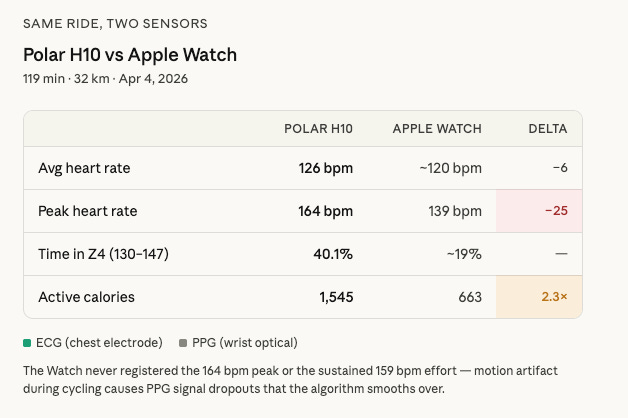
The Apple Watch never saw my actual peak heart rate. It missed a 164 bpm surge entirely, and it never registered the sustained 159 bpm effort that followed a few minutes later. Instead of the spiky, dynamic trace the Polar captured at 1 Hz across 7,149 samples, the Watch produced a smoothed, flattened version that made a hard threshold ride look like a gentle tempo session.
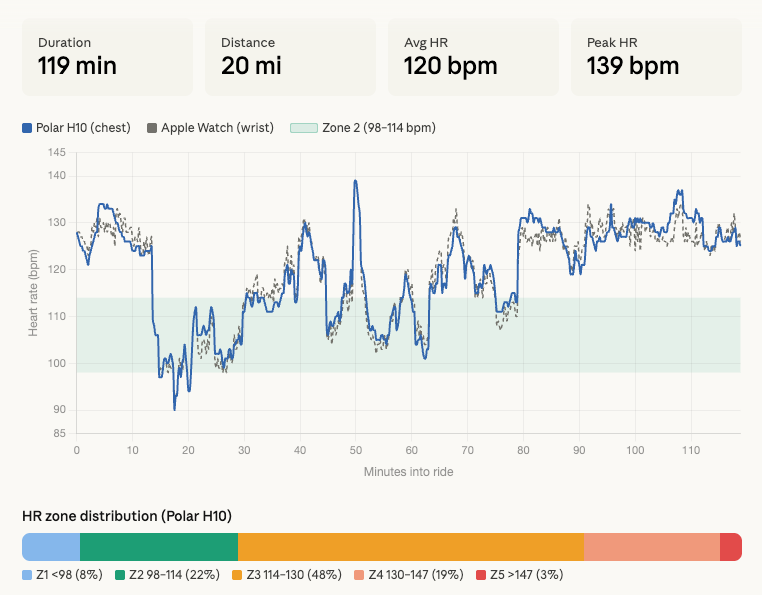
This is the textbook PPG failure mode during cycling: motion artifact from handlebar vibration and grip changes causes signal dropouts, and the Watch’s algorithm interpolates through them, clipping peaks and compressing the range. It’s impressive engineering — the Watch does a remarkable job reconstructing something from a noisy optical signal — but it’s still interpolation, not measurement.
For resting HR and walking? The Watch is excellent. For cycling, and especially for capturing the rapid HR transitions that matter for interval training and HRV analysis, it’s not enough.
Why This Matters Beyond Heart Rate
Heart rate is actually the easy part. The bigger issue is HRV.
The Polar H10 is functionally a single-lead ambulatory ECG. It measures the electrical depolarization of the heart muscle directly, sampling internally at 1000 Hz and deriving R-R intervals (the time between heartbeats) at roughly 1 millisecond precision. That’s the raw material you need for proper HRV metrics: SDNN, RMSSD, frequency-domain analysis, Poincaré plots.
The Apple Watch measures something different: pulse rate via green LED reflectance at the radial artery. Pulse arrival time is delayed 100–200 ms from the actual R-wave, and that delay varies with blood pressure, vasomotor tone, and arterial compliance. The resulting jitter — maybe 10–20 ms on an 800 ms beat interval — washes out when you’re averaging for heart rate, but it corrupts the fine-grained beat-to-beat variability that is HRV.
For overnight HRV trends (which Apple reports as a single nightly SDNN value), this is probably fine. But for exercise HRV, post-exercise recovery kinetics, and real-time biofeedback during Z2 training, you need true interbeat interval data. That’s what the chest strap gives you.
The Calorie Puzzle (And What It Taught Me About Fitness)
The calorie discrepancy — 663 kcal (Watch) vs. 1,545 kcal (Polar) — is striking, and both numbers are probably wrong. Neither device is measuring real exercise—they’re just using algorithms based on heart rate to estimate how hard my body worked.
The Watch’s 663 kcal is built on an under-measured HR trace, so it’s too low. The Polar estimate uses the Keytel 2005 equation, which at my HR average of 126 spits out a number that’s too high: ~1,545 kcal. And neither measure takes into account how the heart responds to a longer ride, especially in people who are less fit.
A power-based estimate (the most defensible method) suggests 800–1,100 kcal for a 20-mile ride at ~10 mph average.
But here’s the non-obvious part: the mismatch between my low average speed (10 mph) and high heart rate (40% in Z4) is itself diagnostic. It means my heart is working hard to produce modest power output — the classic signature of a detrained cardiovascular system.
I thought I was in decent shape. The Polar H10 data, honestly analyzed, says otherwise. That’s exactly the kind of uncomfortable truth a personal scientist should want to find.
The $90 Upgrade That Beats Oura
Back in PSWeek220616 we mentioned Oura as the winner of a head-to-head competition for heart rate accuracy — largely because the ring’s PPG sensor sits on the finger, where blood flow is better and motion artifact is lower than the wrist.
But the Oura Ring 4 starts at $349 plus a $5.99/month subscription ($70/year), and it's still PPG. It's still measuring pulse waves, not electrical signals. It still can't give you true R-R intervals with the millisecond precision you need for serious HRV work.
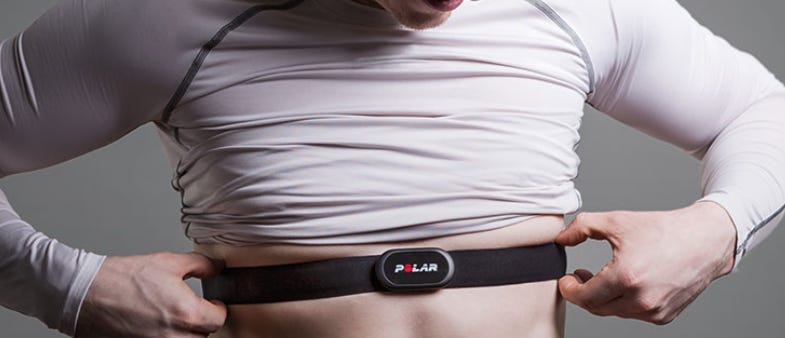
The Polar H10 costs about $100, has no subscription, uses a CR2025 battery that lasts over a year, and gives you actual ECG-grade data. It stores a workout internally if you leave your phone behind, connects via Bluetooth and ANT+ simultaneously, and works with essentially every fitness app and device on the market.
The tradeoff is convenience: you won’t wear a chest strap 24/7. But that’s actually fine. Think of it like a Keto-Mojo blood ketone meter versus a CGM — one is a spot-check instrument for when precision matters, the other is continuous but lower-fidelity.
My recommendation: Keep the Apple Watch for 24/7 passive tracking (RHR, overnight HRV trends, sleep staging, step counts, illness detection). Add the Polar H10 for dedicated cycling sessions, structured interval work, and any experiment where you need clean HRV data.
What I’m Testing Next
That difference between the two devices was actually proof that I’m out of shape. My ride data shows I spent only ~15 minutes in true Zone 2 (98–114 bpm) — far below the 90–150 min/week target that the endurance pros recommend for building aerobic base. What I thought was a Z2 ride was actually a Z3/Z4 threshold session, because I was relying on Apple Watch data that understated my HR by enough to shift the zone classification.
With the Polar H10 providing cleaner real-time feedback, I can now actually hold the narrow Z2 band — which, for someone in my current fitness state, means riding at what feels uncomfortably easy: maybe 12–14 mph on flat terrain. The hypothesis: sustained Z2 work → improved parasympathetic tone → lower resting HR → better sleep consolidation. I’ll be tracking all of it.
Personal Science Weekly Readings
A Harvard physics professor successfully got Claude Code to write a significant paper, the kind that would normally take a second-year grad student a year or so. Claude made lots of mistakes, so the final result required substantial hand-holding from a knowledgeable human. Importantly, this was theoretical physics, where innovation comes from new ideas rather than new data — the tools are already powerful enough that a determined personal scientist could probably make a real contribution in domains that previously required an academic lab.
Evolutionary biologist Bret Weinstein The Dark Horse podcast has a fascinating segment disputing that Jackson Lab study that seemed to show mice live longer when exposed to long-term cellphone radiation. The catch: laboratory mice are specifically bred for tumor susceptibility, which Weinstein argues makes them paradoxically more likely to live longer by affecting the cancer/longevity tradeoff. Be very skeptical of experimental results on lab mice.
About Personal Science
The lesson from this week’s experiment is one that applies across all of personal science: your measurement tool shapes what you see. The Apple Watch showed me a comfortable tempo ride. The Polar H10 showed me a threshold session with a detrained cardiovascular system struggling to produce modest power. Same ride, same body, different story — and the uncomfortable version was the more useful one.
Personal scientists don’t just collect data. We question whether the data collection itself might be the source of our blind spots.
If you have topics you’d like us to explore, please let us know.
The PPG on my Garmin Fenix can handle high heart rates while in motion, but only if it wants to: It works if start a "cardio" activity, but a mere "hike" won't do... I'm guessing they are trying to conserve power?
I also have a Scosche Rhythm 24 armband, which is able to capture RR intervals (as long as you hold still). This works better for me for taking no-sweat morning readings than a Polar chest strap, don't need to resort to electrode gel 😬
The free bicycling app I use (Map my Walk) doesn't use heart rate or weight as parameters, just distance and elevation gain. It also can't compensate for wind speed. I question the idea of focusing on heart rate because a heavier person riding up a hill at a particular heart rate will use dramatically more energy than a lighter person. The weight of the bike also matters. Maybe what you use does allow a weight input.
My longest ride last year was on June 1 with 129.4 miles in 13:08 for an average speed of 9.8 mph. The app recorded 2168 feet of elevation gain and assigned a calorie expenditure of 3600 kcal. Despite the lack of weight and HR parameters, my sense is that the calories are pretty close to the true value, but if I weighed 250 pounds, I think it would be way off.
That day, I talked to a Boeing engineer at lunch who had passed me slightly earlier. He was in his late 60's, quite tall, and over 300 pounds. He had a better bike than mine and could ride faster - he was clearly in better athletic condition, but he was in no way as healthy as I am or able to ride as far. He was dumbfounded when I told him I had already ridden 65 miles, but I also told him that I weighed so little, it took hardly any effort. The weight of me plus my bike was, at a minimum, more than 150 pounds less than his was, and it was probably more like 175.
I see a lot of elite bicyclists on the trail in far superior athletic condition who can ride much faster than I can, but many have unhealthy physiques, and in talking to them, I gather that many are also exhausted after only 20 - 30 miles. I tend to think they are kidding themselves, but it is vigorous exercise, at least. I know many people in terrible physical condition who do not exercise at all.