
On Thanksgiving Day, personal scientists should reflect on all that we have to be thankful for.
But it’s also a big food day so it won’t hurt to do a little number crunching while we’re at it.
Am I getting sick?
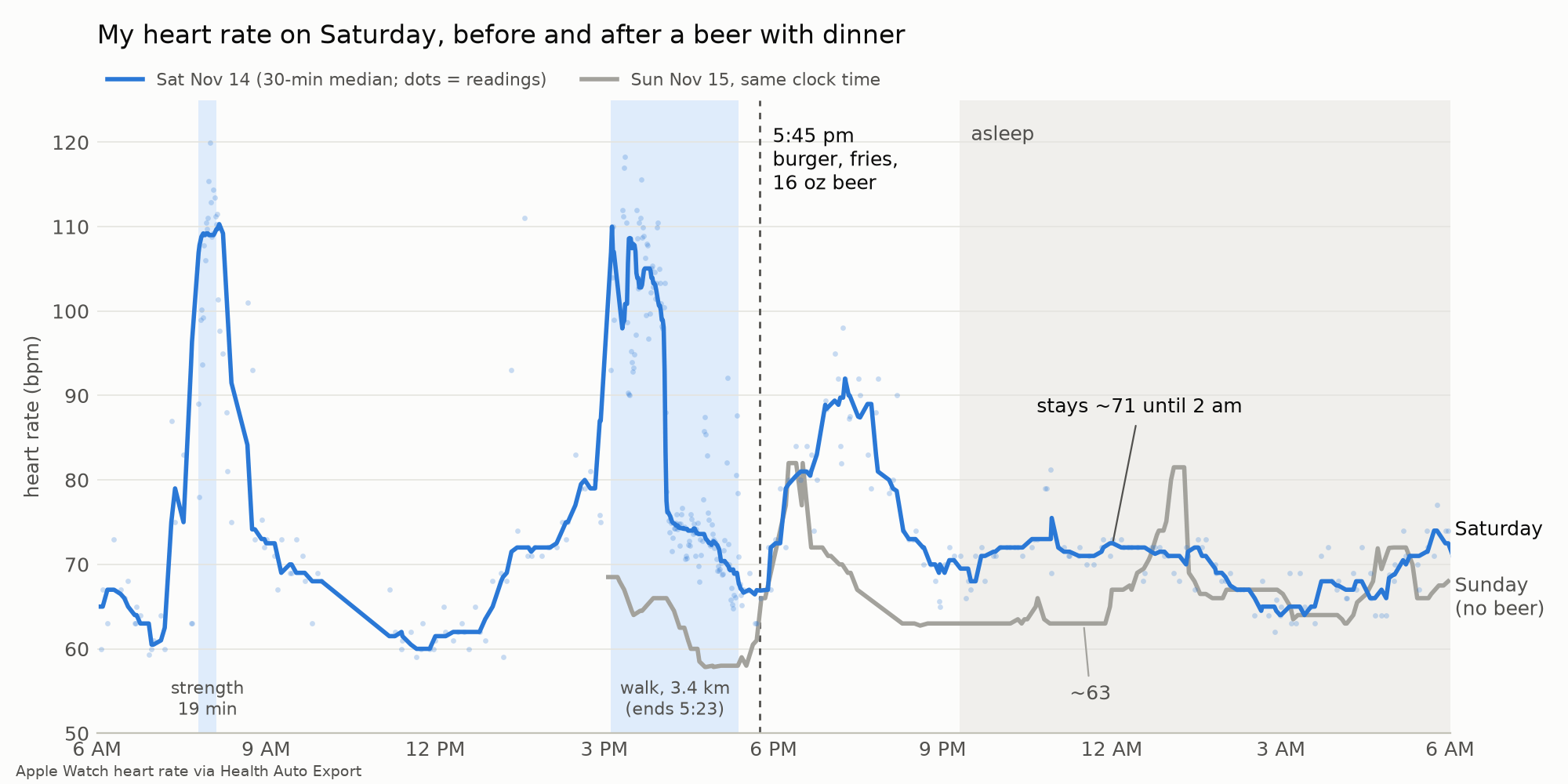
That was my first thought. My heart rate was unusually high when I went to bed Saturday night, and it stayed high all night long. My sleep was okay, but my HR was high the following day as well.
I have years worth of Apple Watch and other heart rate data, and this isn’t the first time I’ve noticed a change in heart rate (see PSWeek260430)
But my daytime numbers for that day were normal: resting heart rate was right in the middle of my week’s 58-60 range. Something happened later that evening.
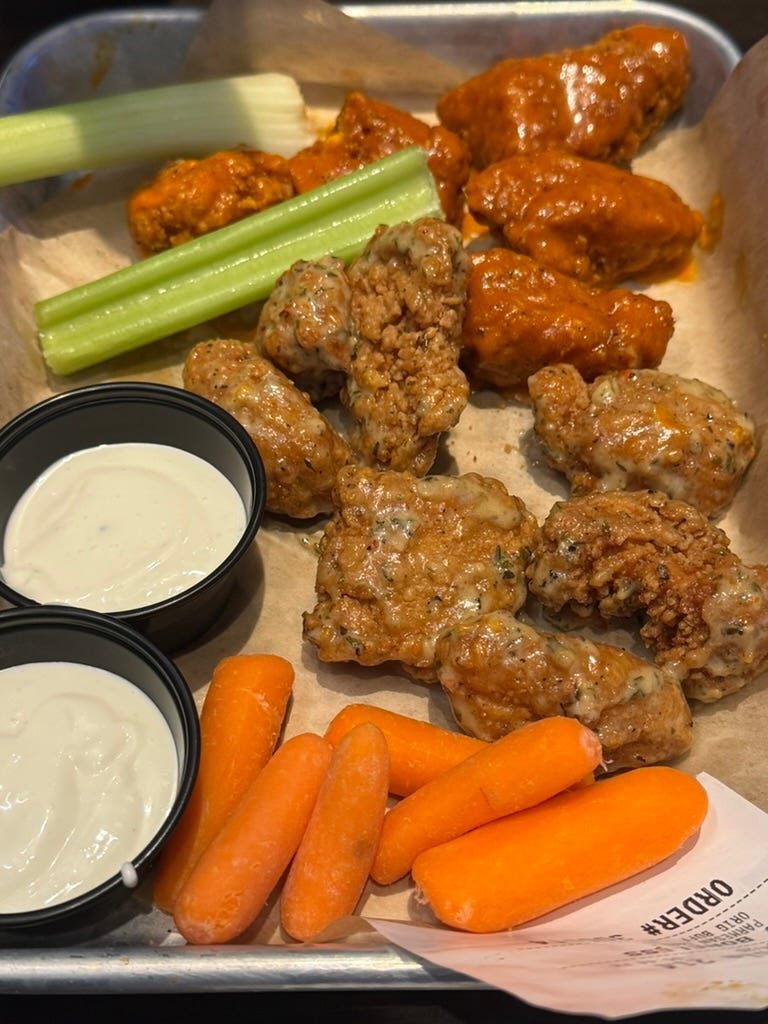
Dinner at Buffalo Wild Wings: cheeseburger, fries, and a 16 oz, 4% beer. (Hey, it was Saturday night.)
Aha! when I looked into it further, I discovered that alcohol—even that small amount of beer—was enough to raise my heart rate. You can see it in the chart for that night.
Studies say
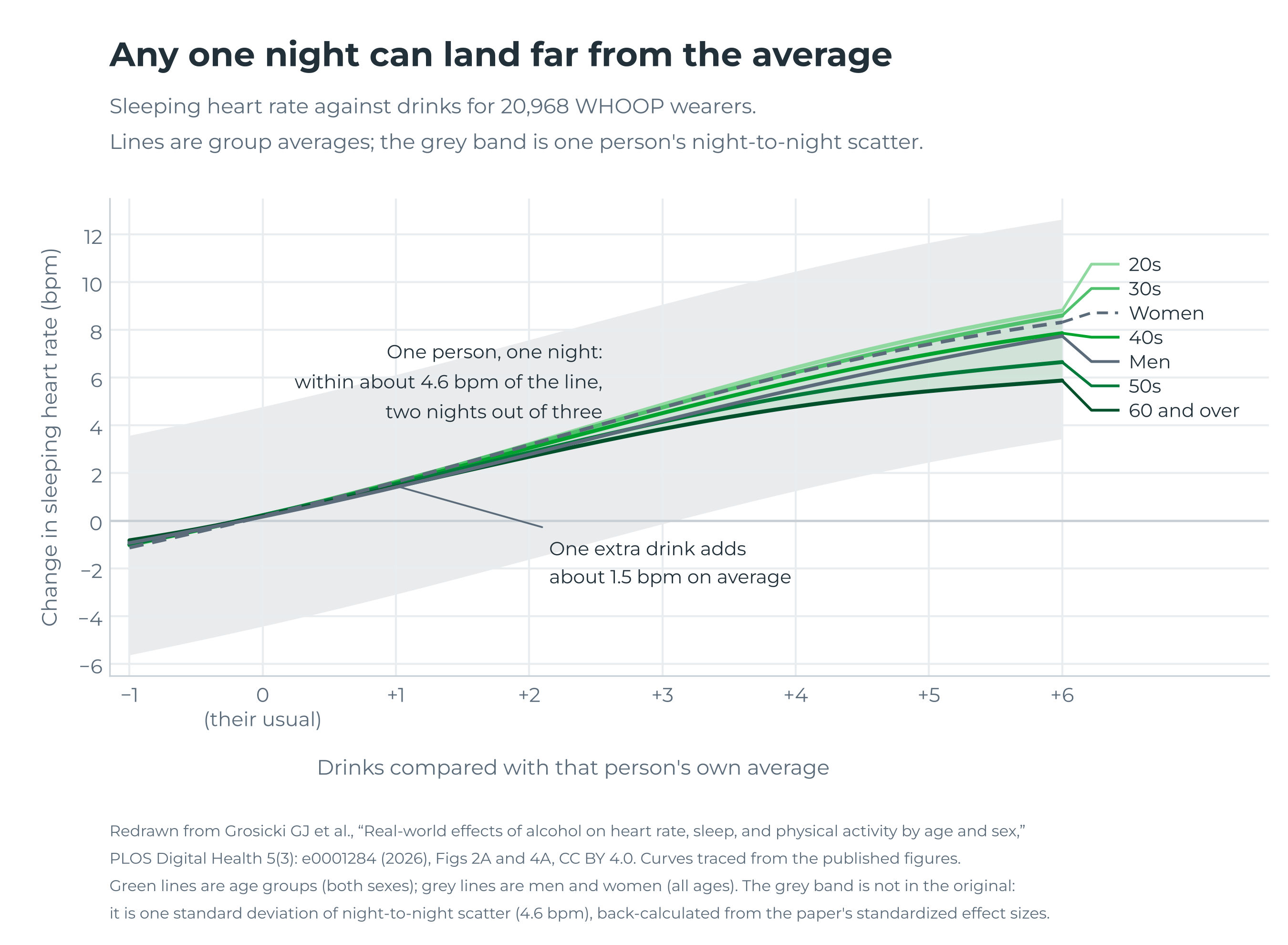
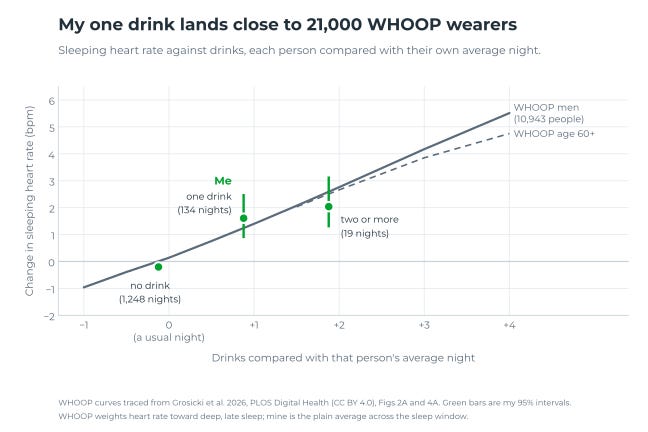
Turns out this is the kind of thing that has been studied quite a bit. Professional scientists from WHOOP got a dataset of 20,000 users over a total of 5 million days, of which roughly 30% of days included self-reported drinking. They published a study (March 2026) that concluded on average that one drink was “associated with an increase in RHR (Resting Heart Rate) by 2.8 bpm (99.9% CI: 2.7, 2.9) in females and 2.4 bpm (99.9% CI: 2.3, 2.4) in males”.
But as we keep saying around here, you’re not an average—you’re you. I want to know what alcohol does to my heart rate.
In fact, here’s what that same WHOOP paper shows when you look across all the people, all ages, all drink amounts. That gray area shows the ups-and-downs variation that any single individual can have. That’s a huge spread!
What about me?
I have several years of data, most of it very brief daily notes that indicate what I ate or did that day, including whether I had alcohol. Before LLMs it would have been a weekend or more work to turn that into something that could a simple question: was my increased heart rate normal for me?
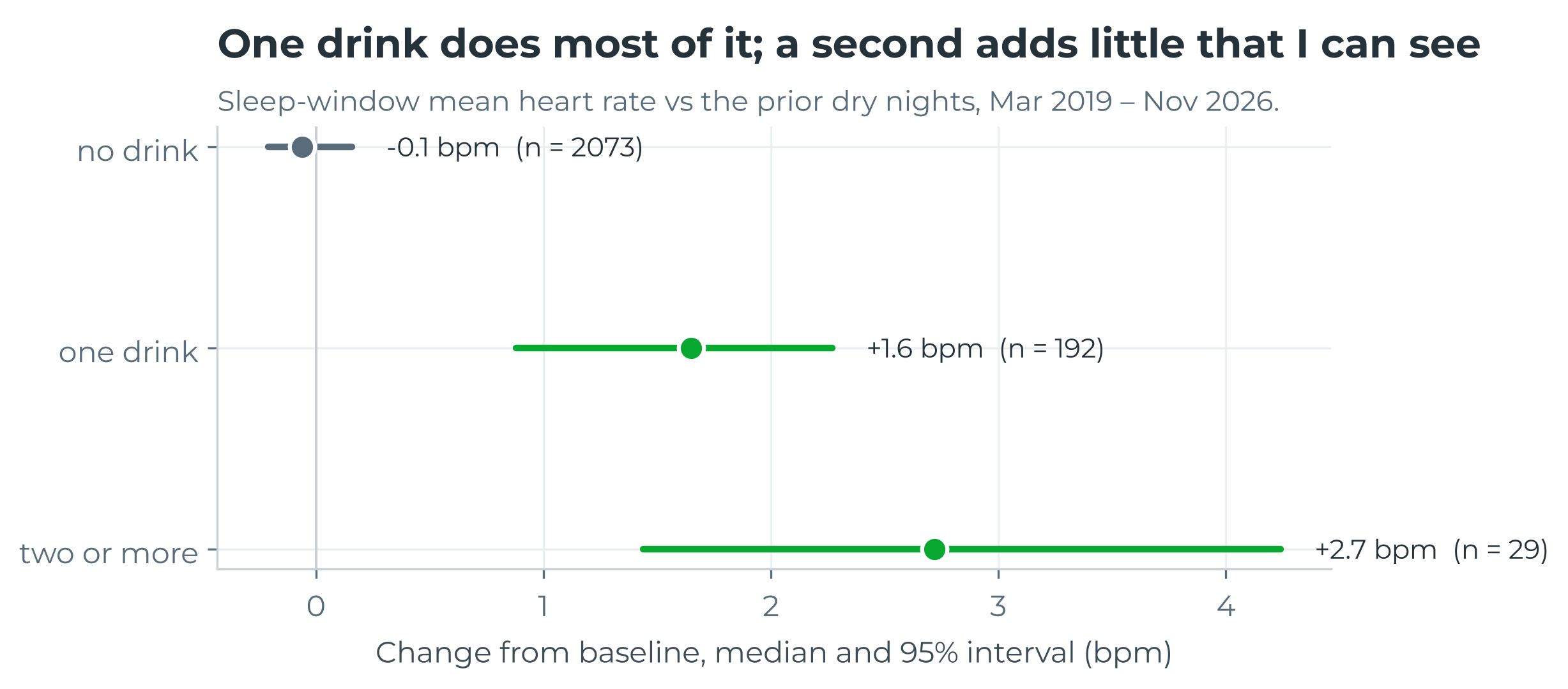
But with Claude it’s a breeze. In less than the time it took me to write this post, Claude code gave me this:
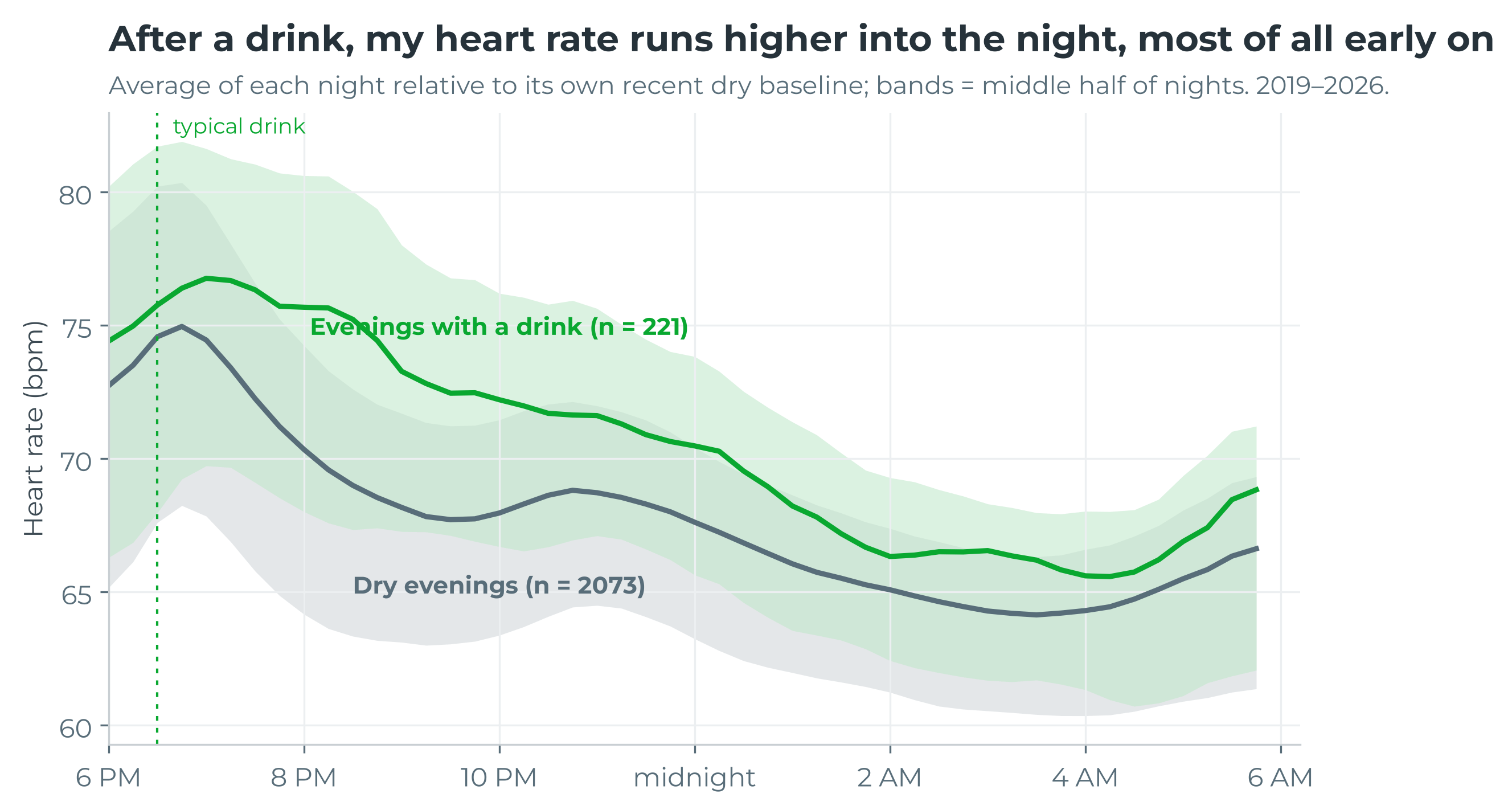
Bottom line: it’s normal for my heart rate to go up for a few hours after a single drink.
And for what it’s worth, most of the damage happens on that first drink. On the (rare) occasions when I have more than one, my HR usually doesn’t go up a whole lot more.
And back to that WHOOP study, my calculations match their overall averages pretty well. I’m not all that unusual after all.
Tips for your own calculations
Of course, as fun as it was for me to do this for myself, nothing about this exercise matters to you. We’re all different, and you’ll want to get your own data. Here are a few tips
Don’t obsess about tracking. A simple note (even on paper) that vaguely describes something is plenty for modern LLMs.
Break the calculation into pieces. I didn’t say “Claude, look through all my data and make interesting charts”. I first told it to do one pass where it consolidated my heart rate and drinking data into one easy-to-process CSV file.
Turn the problem into code. You don’t need to know programming yourself, but it helps to know that sometimes a quick coding job beats an LLM’s normal “thinking” process. After it had my CSV file, then I asked it to do the analysis and I encouraged it to write reusable scripts and save them.
Emphasize good data visualization. I’ve pre-specified the types of plots I prefer (colors, fonts, etc.) which makes it easier to turn my conclusions into easy-to-understand charts. Ask your LLM how to set that up.
In general, the rule I’m discovering is that my biggest limitation is my own imagination. Thinking of interesting questions is the hardest part.
Personal Science Weekly Readings
Speaking of peer review, efforts at scaling the fact-checking of previously-published academic papers is gaining momentum. Dan Elton describes Scaling forensic metascience: the Metascience Observatory is auditing images from millions of published PMC papers and supplementary files.
You may have heard about the recent breakthroughs in math, but another effort to look systematically at previously-proven and peer-reviewed math papers turned up 96 errors in 47 published papers, some in the Annals of Mathematics. And when another group of researchers compared 15 LLMs with humans on their ability to find errors in clinical trial data, the comparative accuracy of LLMs led co-author Ruslan Rust to conclude:
TLDR: From now on I won't do any peer review without AI. For clinical trials, I'd even call human-only review dangerous
About Personal Science
Powerful new LLMs are narrowing the gap between professional scientists and the rest of us. Armed with a low-cost subscription to ChatGPT or Claude, anyone can do fact-checking and deeper analysis in subjects that until recently required years of training.
We hope that this weekly summary can stimulate your own imagination on how you can apply the techniques of science to issues that matter to you. It’s called personal science and we publish every Thursday.
If you have questions or comments, please let us know.
So interesting. I would love it if you would try a Sugar Shift before you have that beer and see if it makes a difference. I think it would.