
Regular PSWeek readers are not especially impressed just because something is “peer reviewed”. LLMs are already flooding the world with examples of highly-regarded academic research that, upon closer inspection, is riddled with errors.
This week: a brief tour of peer review and how it spells opportunity for personal science
AI is going to shake academia more than we imagine, and we are just beginning to feel the first tremors.
When in 2013, graduate student Thomas Herndon wanted to understand a highly-cited 2010 paper, he asked the prestigious Harvard authors for their Excel files, which is how he discovered that the paper averaged cells in lines 30 to 44 instead of lines 30 to 49, throwing out a key takeaway. Oops. To their credit, the authors acknowledged their mistake (”full stop”) but noted their overall conclusions were directionally solid, if less headline-worthy.
But Herndon was a grad student specializing in the field. What happens when the rest of us can do the same thing—at scale?
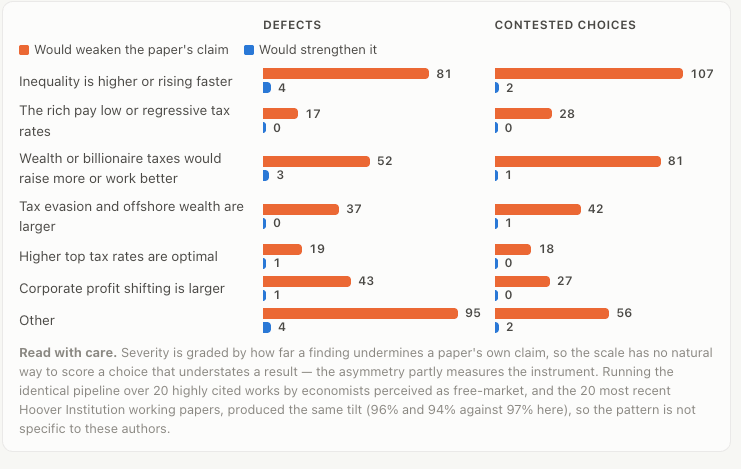
For example, much of the support for the (apparently failed) California “billionaires tax” is based on the life work of two famous UC-Berkeley economists who are regularly cited by Elizabeth Warren, Bernie Sanders, and others as evidence for increasing wealth inequality. But now a recent AI-driven deep-dive of 138 of their papers since 2011 finds 53 major defects (indisputable arithmetic or citation-related that no author would defend) and another 94 that are “contested” (defensible but debated). Only 3/4ths of the reproduction checks matched the published number. (Incidentally, one of the authors responded: he ignored the specific claims ... and blamed billionaires.)
Similarly, when economic historian Joseph Francis used LLMs to dig more deeply into a famous 2013 paper, he found indisputable errors in regression that call into question the whole idea that US manufacturing employment declines were caused by a “China shock” of new, cheaper imported goods. These are not debatable errors—they wipe out the entire statistical basis of the argument.
These examples, from economics, won’t necessarily change any minds on policy—there are plenty of non-statistical reasons to tax billionaires or raise tariffs—but the arguments are no longer polished with the veneer of math and science.
What good is peer review anyway?
Highly-cited research is supposed to be protected by peer review, the process where fellow experts scrutinize a result before stamping it with their approval.
Academics spend a lot of time on it. One estimate says that in 2020 over 100 million hours were spent globally on peer review; for the US alone, that’s about $1.5B if you calculate the value of the researcher’s time.
When the well-regarded Cochrane review studied it, they found “little empirical evidence is available to support the use of editorial peer review as a mechanism to ensure quality of biomedical research”
And everyone’s favorite example: where scientific rigor proponents had to retract their paper on benefits of scientific rigor.

Some of the problem can be traced to Goodhart’s Law, the idea that once a metric becomes a standard (e.g. number of peer-reviewed citations), it will be gamed and eventually loses its value.
And as we’ve noted when paraphrasing Adam Mastroianni:
peer review and much of the rest of professional science is built around solving the “weak link” problem—ensure there are good filters for removing the weakest ideas. But a dysfunctional peer review system is actually worse than the alternative—no review at all—because it promises greater trust than is warranted.
The online people at the popular Biohack Yourself magazine proudly note that all their articles are “peer reviewed sponsored content” . Come to think of it, by their definition, Personal Science Week clearly qualifies. Maybe we’ll get more subscribers if we add “peer reviewed” to our header?
Brace yourself for change
Psychology researcher Spencer Greenberg has the right idea
ask the most powerful AI you have access to to find as many factual errors in your work as it can. Have it say what you claimed, what’s actually true, and have it provide links to back up claims.
and he lists multiple errors he found in his published essays.
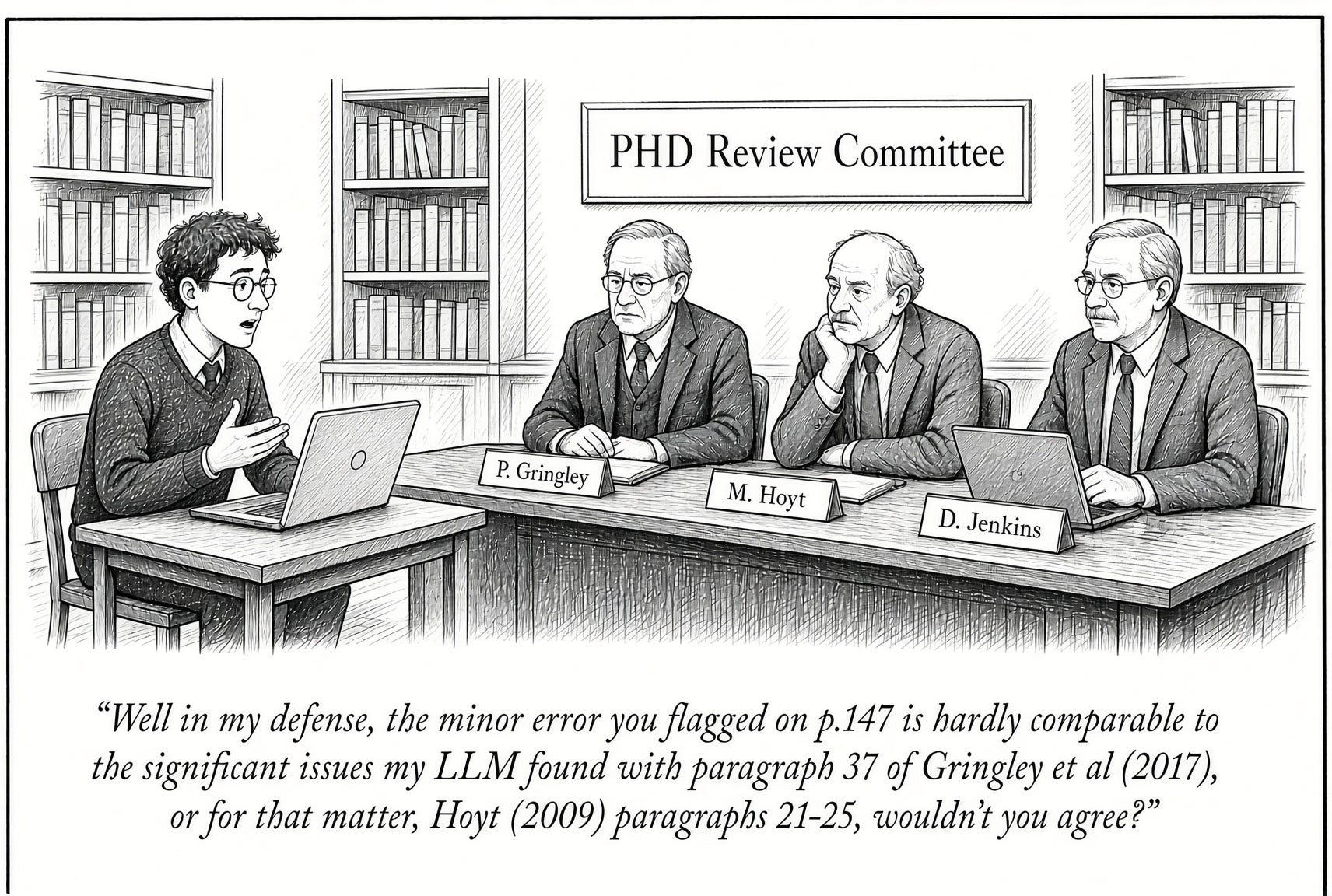
If you’re standing for your PhD defense, note that your review committee is likely to be using laptops and ChatGPT during the session. Arm yourself with an AI-driven review of all the papers the committee elders themselves had published, just in case.
Personal Science Weekly Readings
If you have a scientific claim you’d like tested, ResearchHub will make an AI-generated experimental design and offer it for anyone to test—and fund. Here’s one that just got $97K of funding that way: Can a Nasal Dilator Improve Fragmented Sleep? A Randomized Crossover Trial
Back in PSWeek260820, we mentioned Refine.Ink a website intended to pick apart your paper before you submit it. But now people are using it to go after papers that have already been submitted. When Matthew Kahn did that to a 2026 paper about the economic cost of climate change, he got back a 28-page report showing, for example, that the results are only relevant if you assume zero technological progress over the next 65 years.
Paul Litvak writes a Substack with excellent thoughts on how AI will transform academic publishing. He thinks we’ll start to see AI-maintained “living layers” of audited claims running alongside journals, then take over certification, until scientists submit directly to the evidence layer and journals as we know them disappear.
About Personal Science
Professional scientists use the techniques of science for their jobs. But anyone can use the same techniques for personal use: to answer questions and solve problems.
If you have questions or comments, please let us know.