
I’m not addicted to coffee. I tell myself I can quit anytime I want, but lately I’ve been waking up with a faint headache that goes away as soon as I’ve had my first cup. Does that mean I’m addicted?
This week I’ll look more closely at my caffeine consumption, and correct a few things I got wrong the last couple of times I’ve written about it.
A headache that disappears after you take a drug is pretty much textbook proof of a relationship between the two. For the past few weeks I’ve noticed one early in the morning, before I get up: barely perceptible, and gone soon after my first cup of coffee. I’ve been complaining about this since PSWeek240502, when I mentioned waking with “a very mild headache that seems to disappear within an hour or two” and decided it wasn’t worth tracking.
I’ve written about caffeine before (see PSWeek230622, PSWeek241010, PSWeek260820). With more powerful LLMs available to check my work I found that some of what I wrote then didn’t hold up. So this is partly an update, partly a correction.
How much caffeine do I consume, really?
In 2023 I calculated that the six “cups” I brewed every day came to about 500 mg of caffeine. In 2024 I told you I’d cut back to four. Two years later and my OXO coffee maker is set at just over five. (Oops! personal scientists don’t always keep our commitments…)
Note that a coffee-maker “cup” is not the 8oz/ 230 mL cup you use for cooking. My OXO’s reservoir holds 45 ounces and calls that nine cups, so each one is 5 ounces. Five of them is 25 ounces (740 mL): about three real 8-ounce cups, or a mug and a half of the 16-ounce mug I actually drink from.
How much caffeine is that?
Most people measure by volume. Starbucks says that a 16oz Grande of Pike Place brewed in their stores comes in at 310mg. So if I’m having the equivalent of 1 1/2 Grandes, that gives me roughly 485mg of caffeine (310/16*25). That’s within range of the FDA‘s estimate of about 400 mg for two to three 12-ounce cups of coffee.
A better way to measure is by weight. caffeine comes from the beans, not the water. Arabica beans run 0.8–1.4% caffeine by weight (call it 12 mg per gram) and a normal drip brew pulls most of it out. The brewing instructions on a bag of Pike Place say 2 tablespoons is 10 grams, so my five cups take somewhere between 25 and 50 grams of coffee. That’s 270 to 540 mg of caffeine.
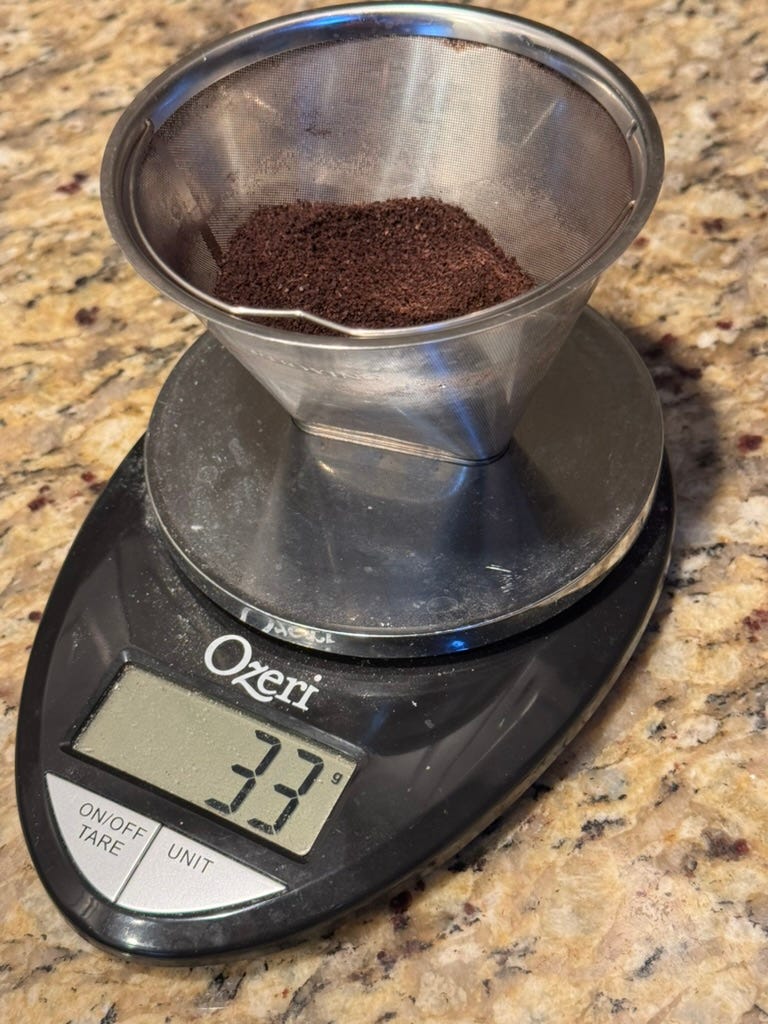
But either way, don’t expect precision. When University of Florida toxicologists bought the same 16-ounce Starbucks coffee from the same store on six consecutive days, the caffeine ranged from 259 to 564 mg.
Incidentally, another correction: in 2023 I wrote that more than 400 mg a day “is considered dangerous.” Not true. In fact, 400 mg is “an amount not generally associated with negative effects,” and puts real toxicity (seizures) at around 1,200 mg taken quickly. You’d need to drink the equivalent of about 4 Starbucks Grandes within an hour or two. I’m nowhere near that.
Coffee addiction
Caffeine works by blocking adenosine, the molecule that builds up throughout the day and gradually makes you sleepy. Drink it every day and your brain adapts. Take it away and, the theory goes, you get a rebound: blood vessels in your head dilate, and it hurts.
This withdrawal is well documented. One highly-cited review (Juliano & Griffiths 2004) says 50% of people who stop get a headache. It starts 12–24 hours after the last dose, peaks at 20–51 hours, and lasts 2–9 days. It shows up in people drinking as little as 100 mg a day, which is one small cup.
There’s even an ICDH code (8.3.1 “caffeine-withdrawal headache) for neurologists who want to bill for this. The definition assumes somebody who’s been drinking 200mg/day for more than two weeks and whose headache resolves within an hour of taking 100mg.
Yup, that’s me!
But addiction is different from dependency. Psychiatry’s manual, the DSM-5, lists caffeine withdrawal as a diagnosis but leaves “caffeine use disorder” (the real addiction label) in its needs-more-research section.
Like I said, I can quit anytime I want—I just don’t want to.
Oh, and Claude tells me I should correct my two earlier posts where I cited two 23andMe variants (one with a typo: it’s rs4410790). In 2024 I called myself an “intermediate metabolizer” because I carry two copies at one site and none at the other. Those variants come from studies of how much coffee people drink, and each “drink-more” copy is worth about 0.2 cups a day. But a later study shows that slow clearers have more caffeine in their blood, and drink less, so it looks like I can’t claim that metabolizer label after all.

Personal Science Weekly Readings
A lot of my regular reading these days comes via an interaction with an LLM, which is what happens when I saw a new review in Science “X and Y chromosomes as determinants of aging and disease”.
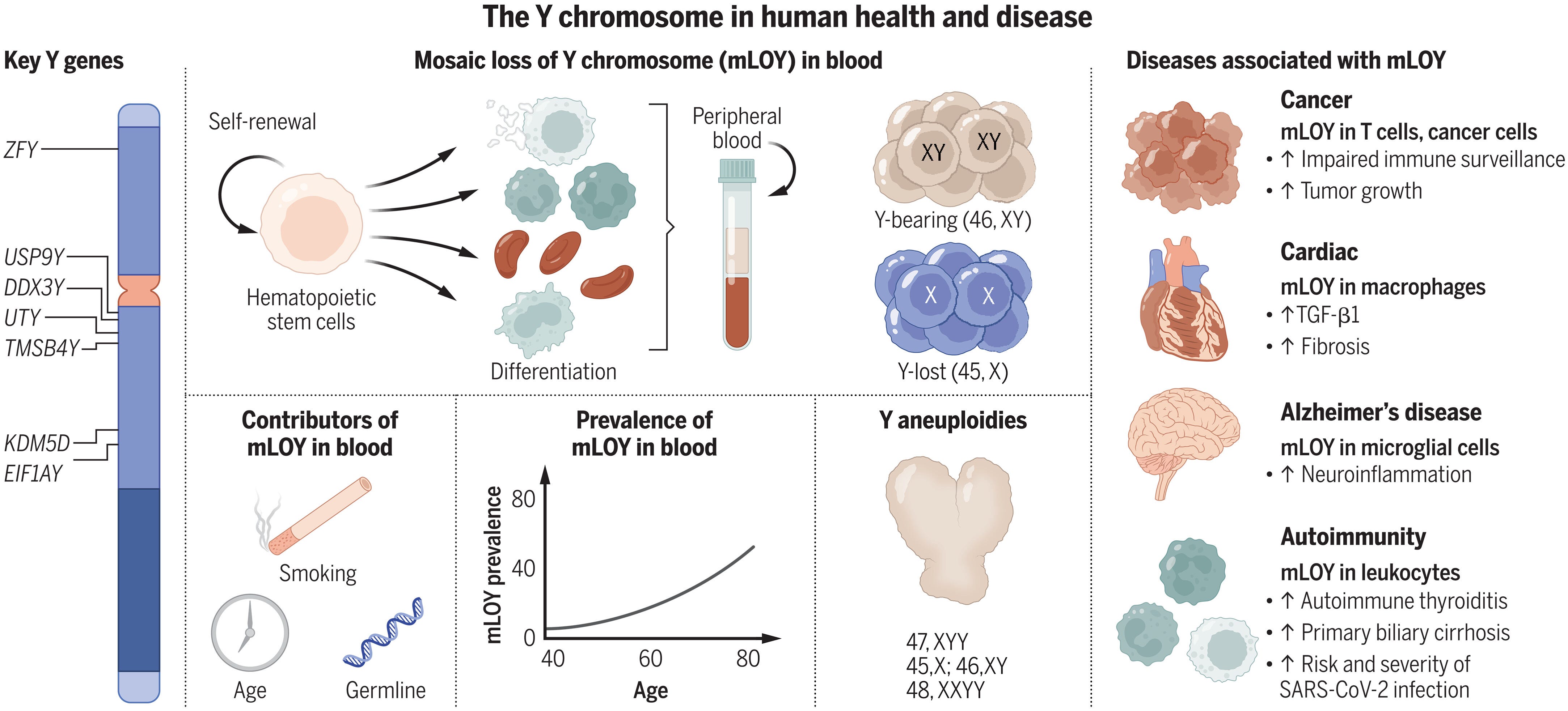
It mentions mosaic loss of Y (mLOY): by around age 70, roughly 40% of men have lost the Y chromosome in some of their blood cells, and about 20% in at least a tenth of them. mLOY tracks with higher risk of heart disease, cancer, and Alzheimer’s.
So when @jdudley suggested it as a potential longevity marker, I naturally wanted to know if there are consumer mLOY tests and what my number might be. Claude says yes—in fact, a whole genome test works—but it has to be blood, not saliva. So put that on my Christmas list I guess, as one more reason to do a WGS blood test.
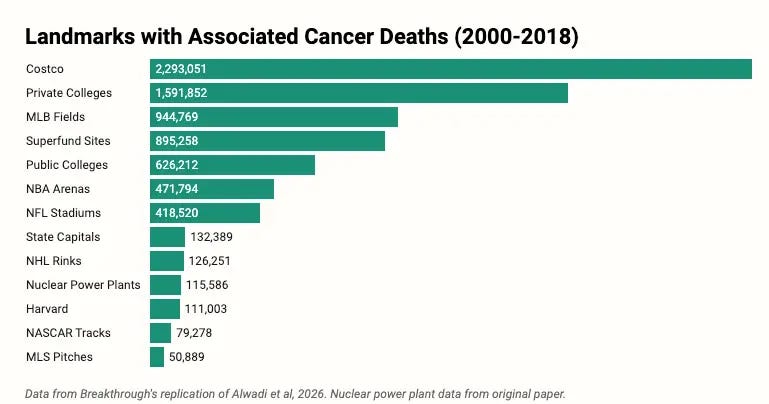
In their Substack post Things that Apparently Cause Cancer, Deric Tilson and Adam Stein do a devastating takedown of several papers published by a team at Harvard School of Public Health. The peer-reviewed studies claimed to find a link between cancer and living near a nuclear power plant. Sounds reasonable, right? if maybe a little scary.
But Tilson and Stein reran the same methodology against other landmarks and — surprise—found other locations with even bigger associations with cancer. The biggest offender is living near a Costco!
Gary Wolf in The Quantified Self Substack Outcomes Episode points to the disappointing lack of proof that self-tracking helps with medical outcomes. Thomas Blomseth Christiansen suspects the problem runs deeper than ambiguous studies. Some things are individually measurable and others are group measurable, and you can’t refine group research down until it reaches the individual.
I’d add that outliers matter a lot, even in clinical research where results are often abstracted into a single takeaway (”the drug works”). But to an individual, all that matters is whether it works for you. And how would you figure that out unless you run the experiment on yourself?
About Personal Science
LLMs have transformed how each of us can study the world around us, and if you’re not already using them in your daily life, you’re missing an important tool.
Personal scientists apply the techniques of science, including skeptical open-mindedness to understand items of everyday interest and solve problems.
If you have ideas you’d like to discuss, please let us know.
Outliers do matter, yes, case reports, too. Each of us is really a study where n = 1. Perhaps because the concept of average is so easy to grasp, we are often stuck with what I would tend to call "The Tyranny of the Average." Outliers can often be harmed in that situation, particularly in regard to medical care.