
There ought to be a word for it, and it turns out there almost is. Orthosomnia and its cousin orthorexia describe conditions where people end up worse off by focusing too much on optimizing sleep or healthy eating.
This week we’ll look at whether personal science can become too much of an obsession, and what are better alternatives.
We all know “that guy” who is seemingly over-obsessed with tracking all things related to fitness and health. These people are over-represented in the high tech industry, where wealth and success are highly correlated with the invention of new gizmos that promise ever-higher productivity thanks to automated shortcuts. And yes, I’m proud to include myself in those ranks, for better or worse. Like many in the original “Quantified Self” or “Biohacker” groups, the subject resonated with me, not because I had stumbled upon something new and exciting, but because I learned that I’m not the only one who likes to treat my everyday life like a science experiment. In the tech world, you settle arguments by building stuff, not through fancy presentations or appeals to credentials. Shouldn’t we all strive to live that way?
But there’s also “Cyberchondria — escalating health anxiety from searching symptoms online”, Valetudinarian - “A person morbidly preoccupied with their health, usually with the connotation of elaborate regimens and instruments.” (like Jane Austen’s Mr. Woodhouse), and Healthism, Robert Crawford’s term for those who view health as an individual moral duty achieved through personal vigilance.
These words have different manifestations, but they all get at something real: the measurement itself was the harm. By trying too hard to be ‘personal scientists’, we can make ourselves worse off.
Back in the old days, a self-tracking obsession was limited by the amount of data you could collect. I remember years full of pen-and-paper notebooks where I carefully logged personal data about sleep, exercise, food, and much more. Wearables eventually made that much easier, and the limiting factor became analysis. “Dashboard” apps like Zenobase or dataviz platforms like Observable helped, but they still required some effort; you’d need a free evening or weekend to figure out how to connect your data, filter and manipulate it, and then prepare it in a form that made it easier to analyze. (see PSWeek240815 for many examples).
Ironically, this exposes a weakness at the heart of the personal science obsession with tracking and analysis. What if all those weekends spent collecting and analyzing data weren’t a troublesome but necessary friction standing in the way of an important insight? What if that time spent was really a filter that prevented me from asking the questions I should have been asking all along?
Now that a question costs thirty seconds, I ask worse ones, and I ask many more of them. The tooling that finally let me analyze everything also removed the only mechanism that made me decide what was worth analyzing.
Personal science walks the fine line between being open-minded (to even the most whacky-seeming ideas) and skeptical (about even the most respected people and ideas). A professional’s reputation and livelihood are at risk if they push too hard on an idea that the “consensus” rejects. (See PSWeek240104 for how often that happened under COVID). But personal scientists have no such restrictions. Our main constraints are time and imagination.
Professionals have access to expensive libraries of information, knowledgeable colleagues and skilled research assistants. But now, thanks to LLMs, we have all of that too. Hardly a week goes by without news of another unsolved problem being cracked by AI. Many of those solutions are being found by people who have no more access to Claude or ChatGPT than you do.
So once our analytical resources have caught up to the professionals, I wonder if our failure mode isn’t measuring or analysis; it’s letting what’s measurable crowd out the important — the streetlight effect turned inward. Spending so much time obsessing about the data collection and analysis may have come at the expense of trying to understand the decision that the answer would change. If I can’t name the decision, then it’s not science—it’s just a plain ole ordinary obsession.
So what’s next? I’m going to spend more time thinking of questions and less time obsessing about tracking or analysis. Sometimes you really can miss the forest for the trees.

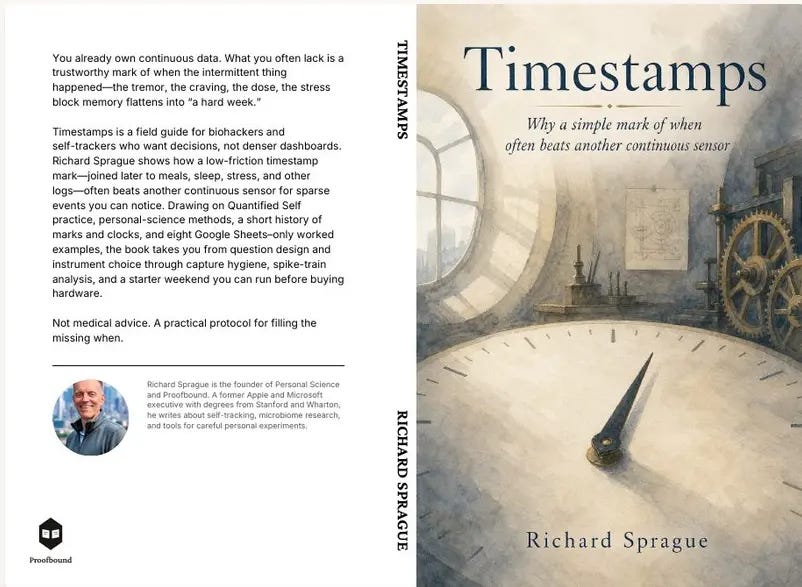
Speaking of how easy LLMs have made the conduct of personal science, I took up last week’s question about Timestamps and used my new MCP to generate a full-size book Timestamps.
Or if you don’t like that one, here’s my Self-Experimenters Peptide Handbook.
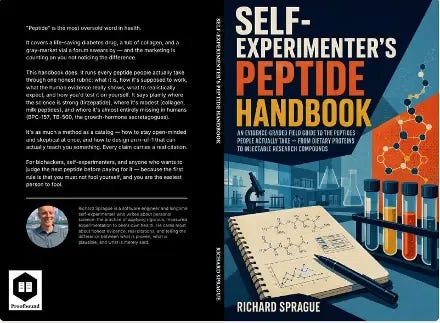
Although (or maybe I should say because?) I used AI heavily in the making of these books, I think you’ll find them accurate, comprehensive, and readable—everything you’d want from a book-size treatment of a non-fiction subject.
Where is this headed?! I’m sure that real writers will authors will find plenty to criticize, but c’mon, the same is true of most human-authored books. I’ve been a voracious reader my whole life (see PSWeek260625) and I have to honestly admit that I’m finding these AI-authored books helpful as a quick way to survey a complicated new topic. What will we do in—pick a short number of years, like 5 or 10—when the AI models are many times better than today?
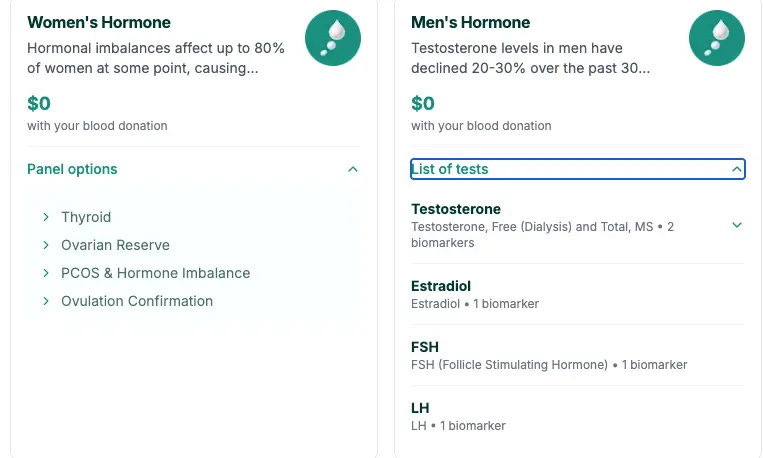
In PSWeek260716, we mentioned the great pricing on blood diagnostics at Goodlabs, and now I had a chance to try out their free service with Bloodworks Northwest, the blood donation center in Seattle. It works just like a regular blood donation (which you should do anyway), but they’ll take part of your sample and send to a lab that can return results for dozens of different blood parameters. I tried it with Cystatin-C (normally $48+) and IGF-1 ($139+), tests that are unusual and expensive enough that I ordinarily wouldn’t have bothered, but you can get these and many more:
Oh, and one thing I learned: you don’t need to be fasted for most blood tests. The old guidelines, that you shouldn’t eat 12 hours before a lipids (cholesterol) or other common tests—the latest studies say it’s not necessary. Check with your doctor (or LLM!) but except for a few insulin-dependent tests (e.g. glucose, insulin), it’s probably not important to skip breakfast before doing a blood test.
About Personal Science
Personal Scientists use science for personal reasons, not as part of a job. We treat science as a verb — something you do — not as a noun, and certainly not as a synonym for “truth” or “cool facts about nature.” Following the 1660 motto of the Royal Society, nullius in verba, we take nobody’s word for it.
But taking nobody’s word for it isn’t the same as measuring everything. The Royal Society’s founders weren’t drowning in data; they had to decide what was worth observing before they could observe it, a constraint that involved real work. Now that for us that constraint is disappearing, the discipline has to come from somewhere else — from us, deciding what actually.
We publish this short newsletter each Thursday, free to anyone who likes to use science in their daily lives. If there are topics you’d like us to cover, let us know.
I’ve spent the better part of a year building my own health tracking app over frustrations around friction of other platforms, after also struggling with over analyzing the ocean of data available and going down one rabbit hole or another. At some point, I suppose you do have to take a step back/get out of your own head and try returning to simpler questions.
Checking out Proofbound and Goodlabs! I’ve been honestly slacking on my blood donations, need to get back into a routine with that, and this would be a fantastic motivator.
I've long forced myself to take my weight only once a month for this reason. I check BP and body temp somewhat more frequently, but they are so consistent I think I'm probably wasting my time to a degree.