
I used to be a voracious reader. Back in PSWeek240208 when I last described my process for tracking my reading, my long-term average had been 2-3 books/month, and often a book a week. I read across the spectrum, from dense science and philosophy books to science fiction and popular novels.
But for the past two years I’ve barely cracked any books at all, and so far this year my tracker shows I’ve read exactly zero books.
What happened?
Tracking your books
Personal scientists like to keep score. In the old days, some of us would keep a notebook or a spreadsheet whenever we finished a book. Now it’s easier to just use Goodreads. Once you’ve entered your books, the site allows some rudimentary graphic views to help you visualize how much you’ve been reading across time. And—critically—you can export all your info to a CSV file for deeper analysis.
I’ve tried other book-tracking sites, notably LibraryThing, but ultimately came back to Goodreads because too many of my friends are there. (Friend me on Goodreads or LibraryThing).
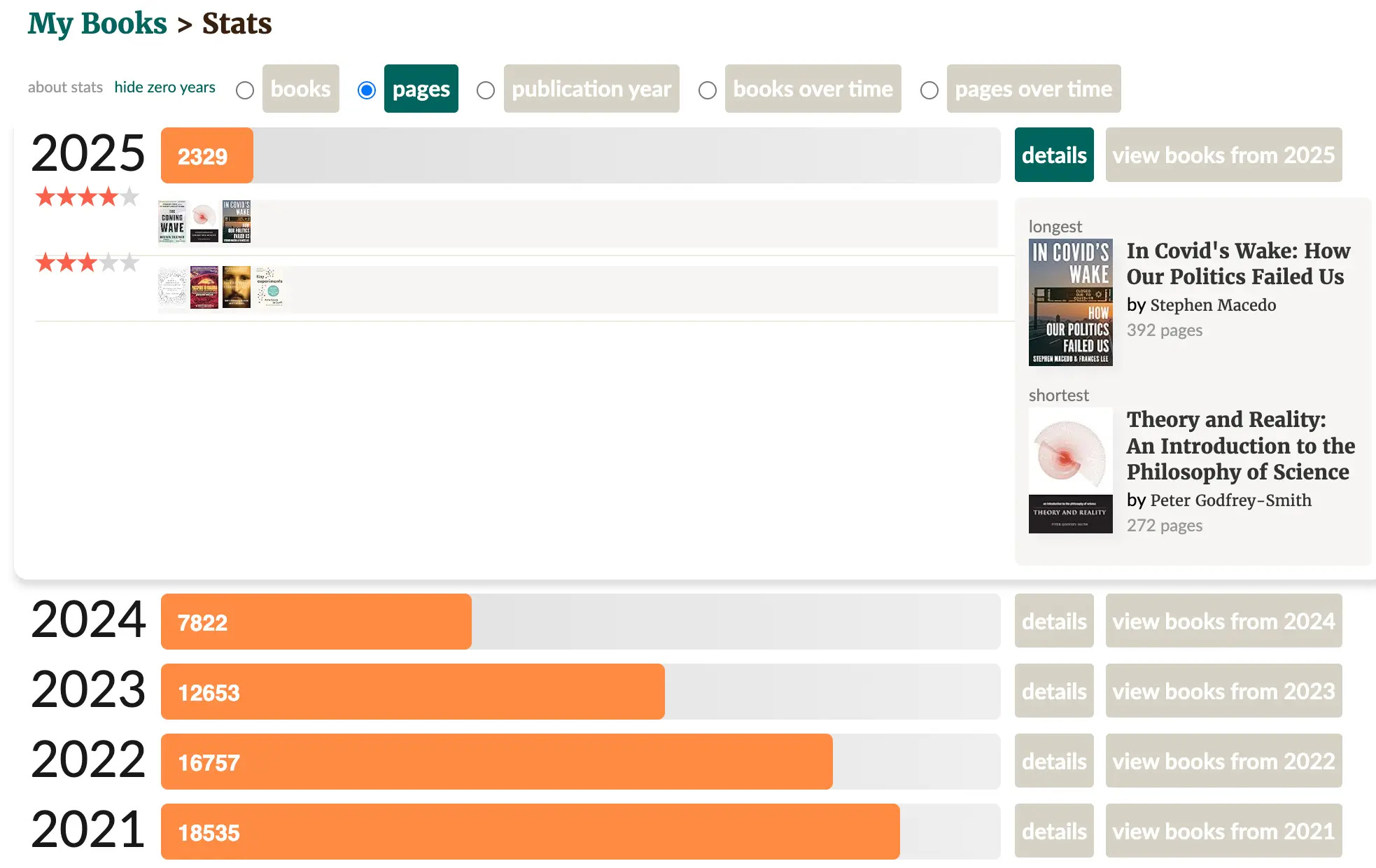
Here’s my Goodreads scorecard for the past few years. Note there’s nothing in 2026, not because I forgot to enter anything. Because so far I haven’t completed any books. Last year was a poor reading year as well, and even the books that I did read were mostly concentrated in the first few months.
It’s Not Just Me
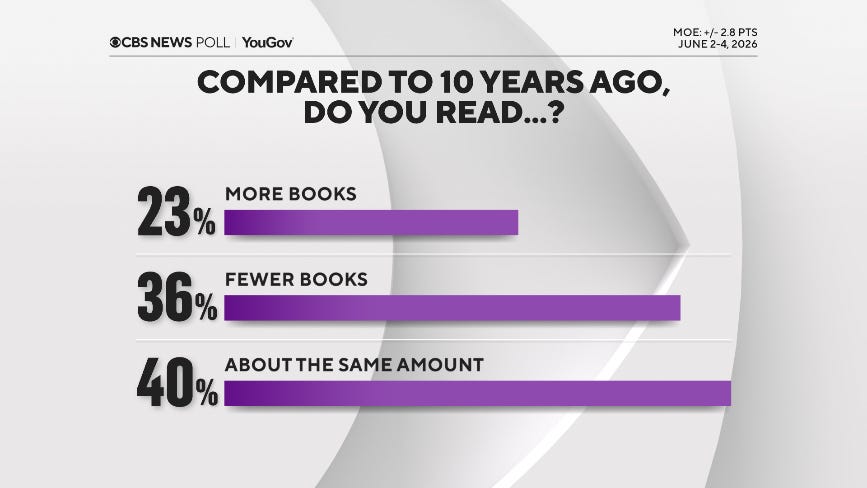
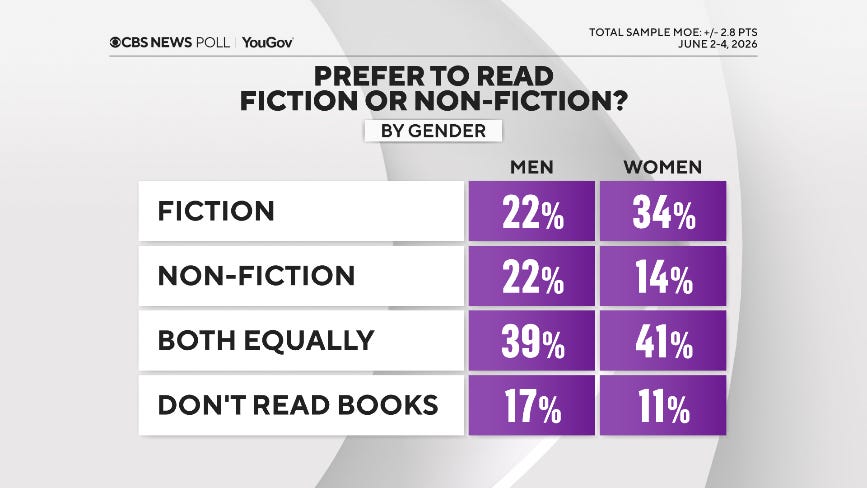
A CBS News/YouGov poll from earlier this month finds a third of Americans say they read fewer books for pleasure than a decade ago, across every age and education group. A quarter don’t generally read books at all; only 12% clear twenty a year.
The poll also asked where the hours went: of those reading less, about half blame lack of time, about half blame too many distractions, and more than a third say their attention spans have gotten worse. In place of books: TV and movies, social media (named by nearly two-thirds of under-30s), and gaming (more than half of men under 50). My own biggest new distraction isn’t any of those.
The Real Reason I Don’t Read
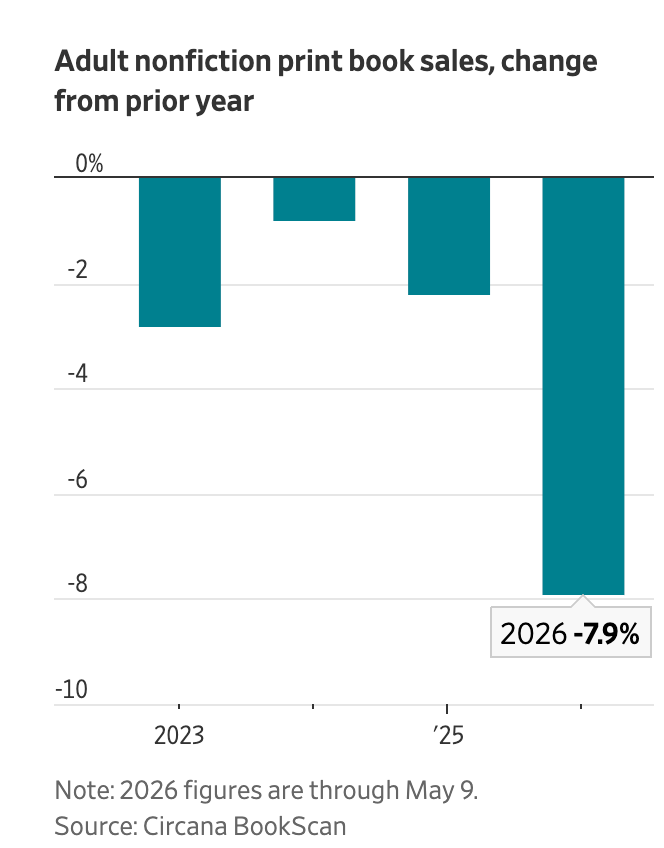
The Wall Street Journal says sales of serious non-fiction (aka “Dad books”) have been in steep decline. They blame podcasts, and I agree that’s a factor for me, but it’s only part of the story.
The bigger story for me is LLMs, and fellow personal scientist Tim Ferriss nails it when he asks Has AI Already Killed How-To Nonfiction? with a detailed stats from the supply side—the big drop in sales of his own books.
His five #1 bestsellers had been a dependable annuity. Then the BookScan print numbers year-over-year fell off a ledge of their own: −5% in 2023, −13% in 2024, −46% in 2025, and a −57% run-rate so far in 2026 — roughly 80% fewer print copies than 2022, almost all of it after LLMs went mainstream. This is consistent across the industry: Publishers Weekly had adult nonfiction down 9% in Q1, with self-help the worst subcategory at −26%.
Fundamentally, the Tim Ferris books I like to read are a lookup table: “how do I lose fat / fix my sleep / automate my income.” In 2019 the best interface to those answers was 600 pages. In 2026 it’s a free chatbot that has read his books and ten thousand others and will hand you a personalized protocol in fifteen seconds. Prescriptive nonfiction, he argues, is just the canary in the coal mine; how-to YouTube, advice podcasts, and online courses are next, because the LLM is becoming the interface to everything.
It’s already true for me. I have a Claude Project that contains the manually-entered summaries and takeaways from decades of book reading. But now, when I hear about an interesting new title, I ask Claude to summarize and help me contextualize it relative to what I’ve already read. My Claude rules also pull reviews and counter-arguments to the author’s thesis, presenting me with a pretty good description of the book before I even think to crack it open. The best part is that the summaries are not only highly-personalized, but also interactive. Before long, I’m interacting with the ideas behind the book—which I often find more fulfilling than reading the book itself.
My personal experience shows that the carnage will not be limited to how-to books. All non-fiction (and probably all but the best fiction) is becoming a poor, inefficient substitute to a meaningful LLM interaction.
Is this good?
Arnold Kling thinks reading fewer books is just fine because overall we’re reading as much as ever, only of shorter and more personally relevant online pieces (like this Substack!) Many/most books didn’t deserve more than that anyway. (like PSWeek! 😬)
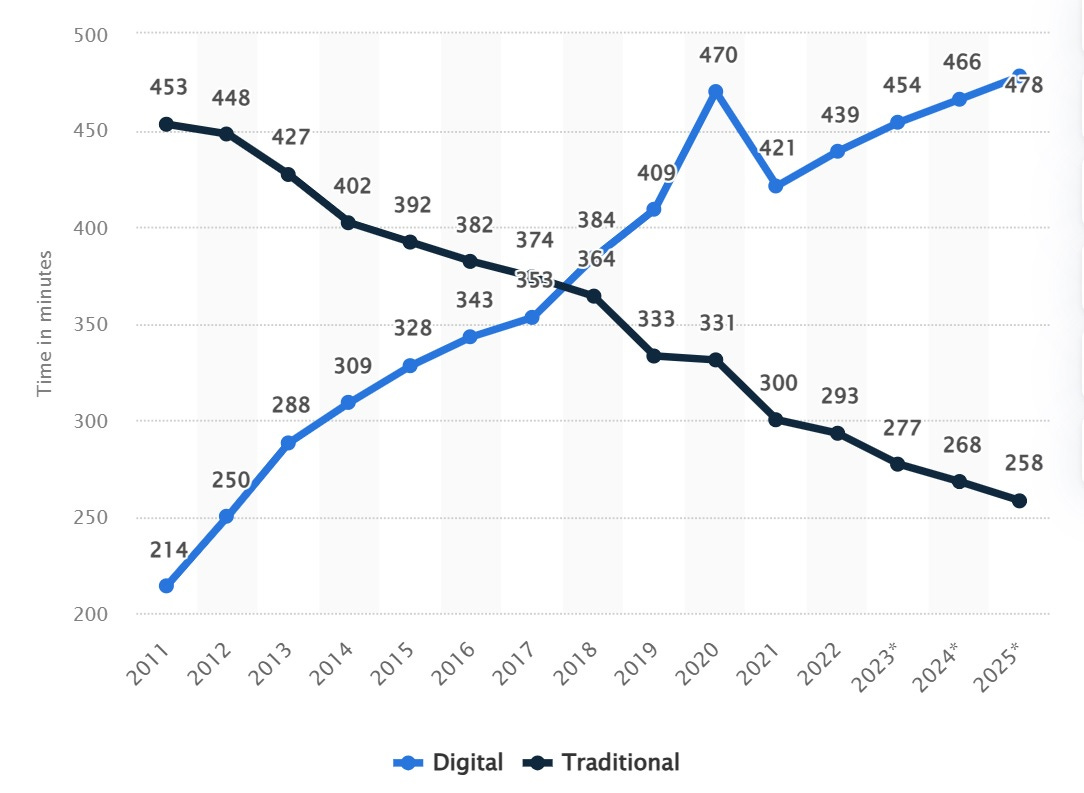
Ultimately I think this will all reverse itself, though in directions we may not be able to predict. Remember the “digital divide”, that long-ago fear that the socioeconomically-disadvantaged would miss out on the power of technology? Media theorist and Marshall McLuhan scholar Andrey Mir points out the digital divide has already reversed itself: now it’s the affluent and well-educated people who read physical books.
The downside of less book-reading is that I don’t know what I don’t know. Sometimes it’s better to spend 20 hours with a smart author who leads you down paths you didn’t think were important. As we noted in PSWeek251002, sometimes the best ideas are the ones you weren’t looking for.
Personal Science Weekly Readings
Speaking of reading, I liked Naomi Kanakia‘s tongue-in-cheek thought experiment of how probably there’s some MIT psychologist studying ways to “prove” that book-reading is bad for you:
That the stream of words in a book trained the human brain into a habit of self-consciousness, that reading books forced human beings to think of themselves as a stream of text, processed through time, making a coherent argument of some sort. And that this overall flattening effect forced readers to ignore aspects of their personality or their situation that were not otherwise in line with the overarching story they’d created about themselves
Meanwhile, If you are going to read, so much of the best content is free: Project Gutenberg has 70,000+ public-domain titles; Planet eBook formats many of the classics nicely. Anna’s Archive is the largest catalog anywhere (caveat emptor). Calibre manages it all locally and converts between every format. To read with others, hypothes.is and Fermat’s Library let several people annotate the same passage.
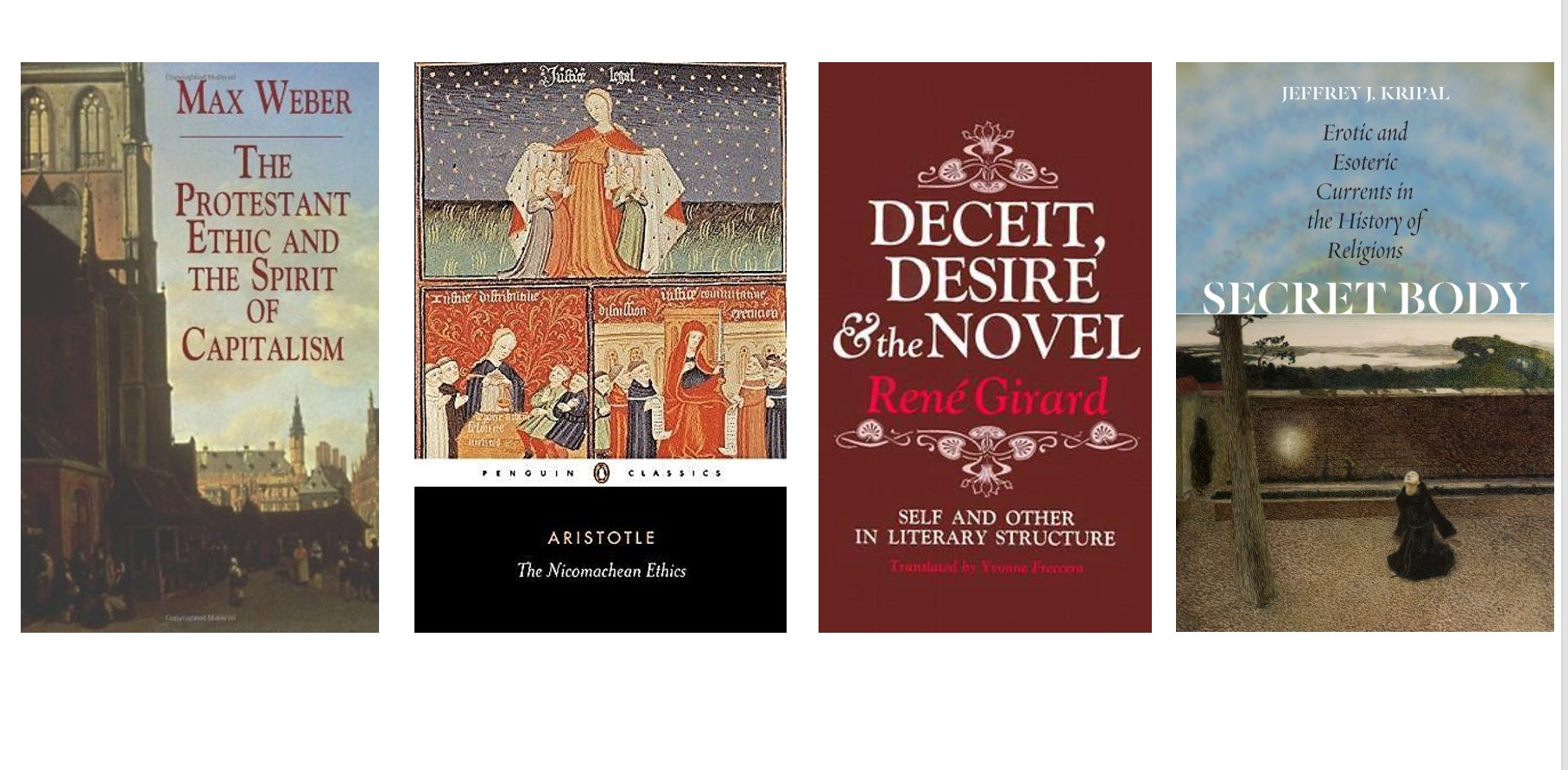
Jonathan Bi recommends these as the best four philosophy books for understanding how AI will change everything: 1. Max Weber’s Protestant Ethic, 2. Aristotle’s Nicomachean Ethics, 3. Rene Girard’s Deceit, Desire and the Novel, 4. Jeff Kripal’s Secret Body. I’ve read the first three, but Claude gave me a good enough summary of the fourth that maybe now I don’t need to bother. 🤣
ARPA-H launched a program to redefine sleep as a measurable, controllable driver of health. If you have ideas for projects to fund, check out their application page. (due August 12, 2026)

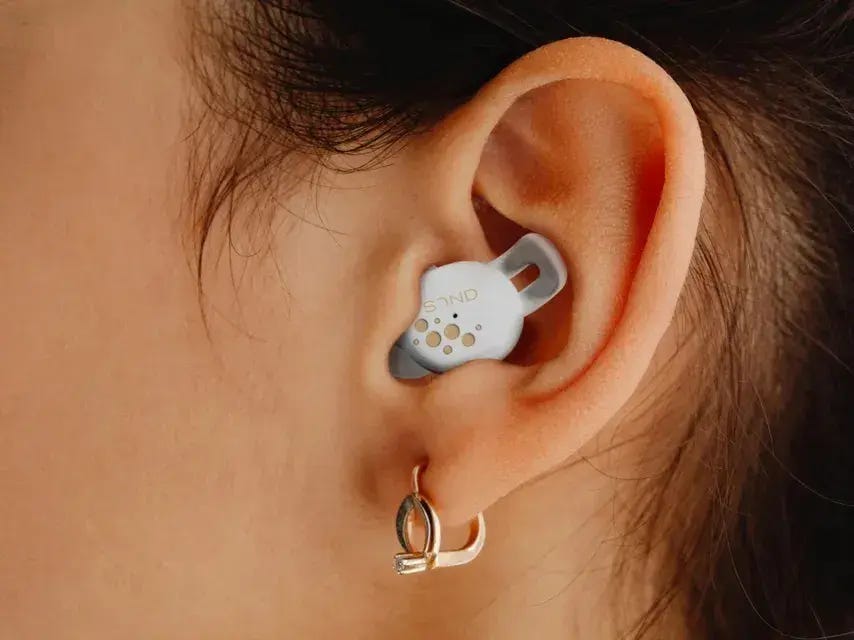
SOND just got $7M in funding for new Airpods-like sensor that tracks respiration, HRV, snoring and a bunch more metrics that it feeds to a real-time sleep coach.
Meanwhile, Kimba is a new $600/year bedside gadget that releases carefully-timed scents that supposedly will help you sleep better. The company notes that smell is the only sense that reliably influences sleep without waking you.

Speaking of wearables, Rock Health released their latest survey of 8000 people, which among other results shows that Apple continues to dominate with almost 2/3rds of the market.
About Personal Science
Personal Science is about using the methods of science for personal rather than professional reasons — delivered each Thursday as precisely the kind of short, online substitute for a book that this whole issue is about. The irony isn't lost on me. So read fewer books if you want; just don't take my word for what that's doing to you — not mine, not Ferriss's, not the chatbot's. Pull your own numbers. Nullius in verba.
Do you read fewer books now? Have LLMs reduced your interest in tackling new titles? Let us know:
I'm reading more than ever, generally several books at a time, which I often buy used off eBay because I read much too slowly for the library method to work. It is extremely inexpensive and educational, and the only real issue is having the space to store physical books. But places like Half Price Books are a convenient way to cast off culled books.