
Both the Claude and ChatGPT iPhone apps now read Apple Health directly, which gives personal scientists an easy way to fold health and fitness data into the rest of our medical history. But only on the phone.
This week I’ve been testing Health Auto Export — and its recently added MCP connector — which lets you query Apple Health data from your Mac.
We've written before about combining Apple Health with Claude (see PSWeek250410, and PSWeek221027)
But Apple Health is only available on your phone. That may be the right call for Apple, whose obsession with user privacy makes it hard to justify data transfer off the phone, but for personal scientists it’s an annoying inconvenience. I want to use my data on a much more powerful computer—and importantly—with Claude Code.
Yes, you could always use Auto Health Export, which gets your permission to read your Apple Health data on the iPhone, and copies it to your Mac. But that’s been clunky: it requires a time-consuming step involving iCloud drive, and often for inexplicable reasons it just fails. To be honest, I stopped using it after Claude (and ChatGPT) added their own integration. When I wake up, for example, I’ll ask my iPhone Claude to tell me how I slept; later at my computer I’ll ask the Claude Desktop app to read that thread and run additional numbers on my local machine. A bit hacky and cumbersome but at least it’s reliable.
Well now Auto Health Export has an MCP —a “Model Context Protocol” — a type of connector —and pulling the info from your iPhone has become fast and trivially-easy. The iPhone app runs a small server on your local Wi-Fi which can be accessed on your Mac. It’s easy to set up and now I get essentially instant Apple Health syncing, and because it’s controlled from my Mac I get all the rest of Claude Code power, especially its thorough integration with all the massive amounts of health and other data in my local file system.
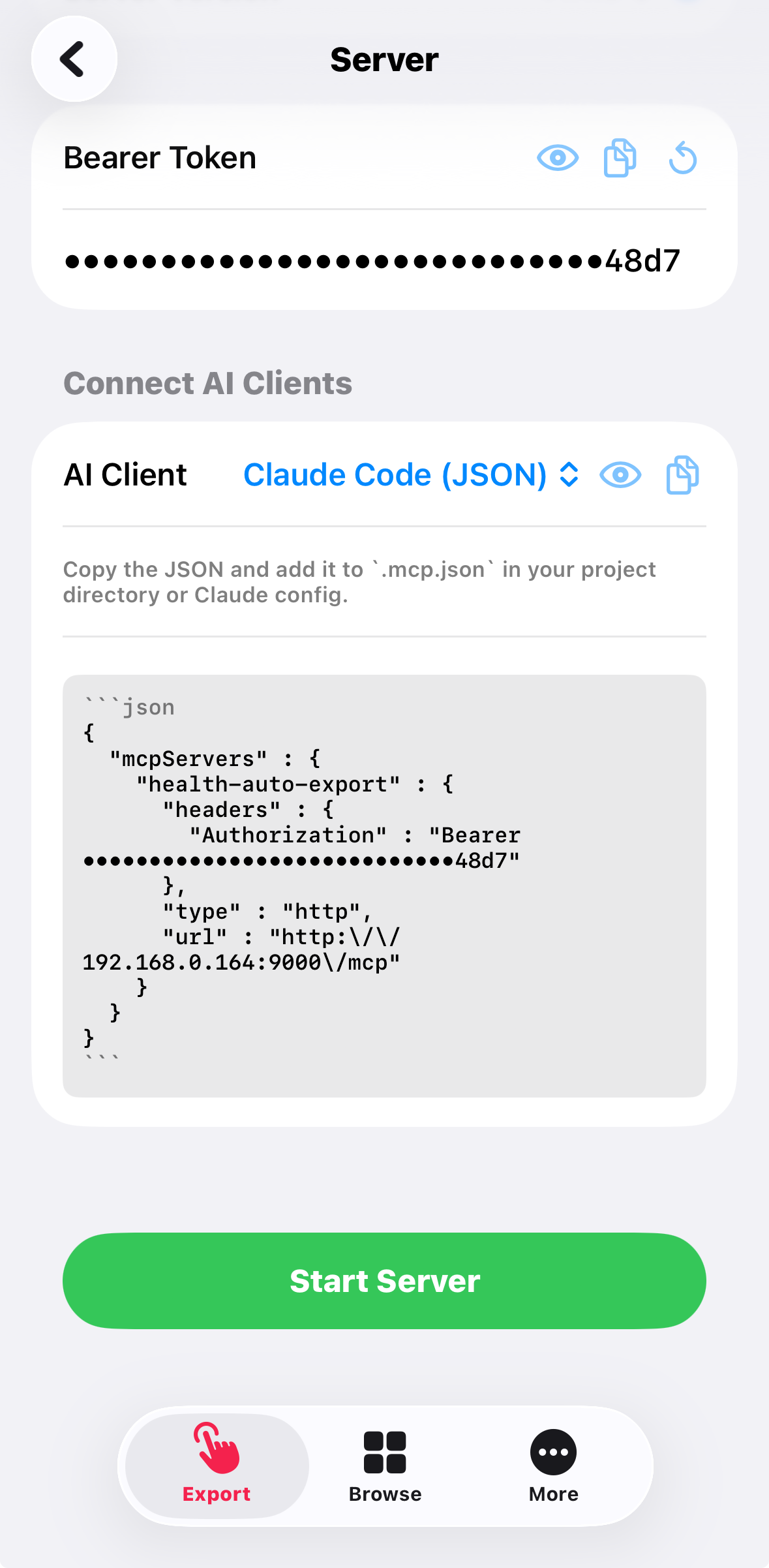
Taking it for a spin
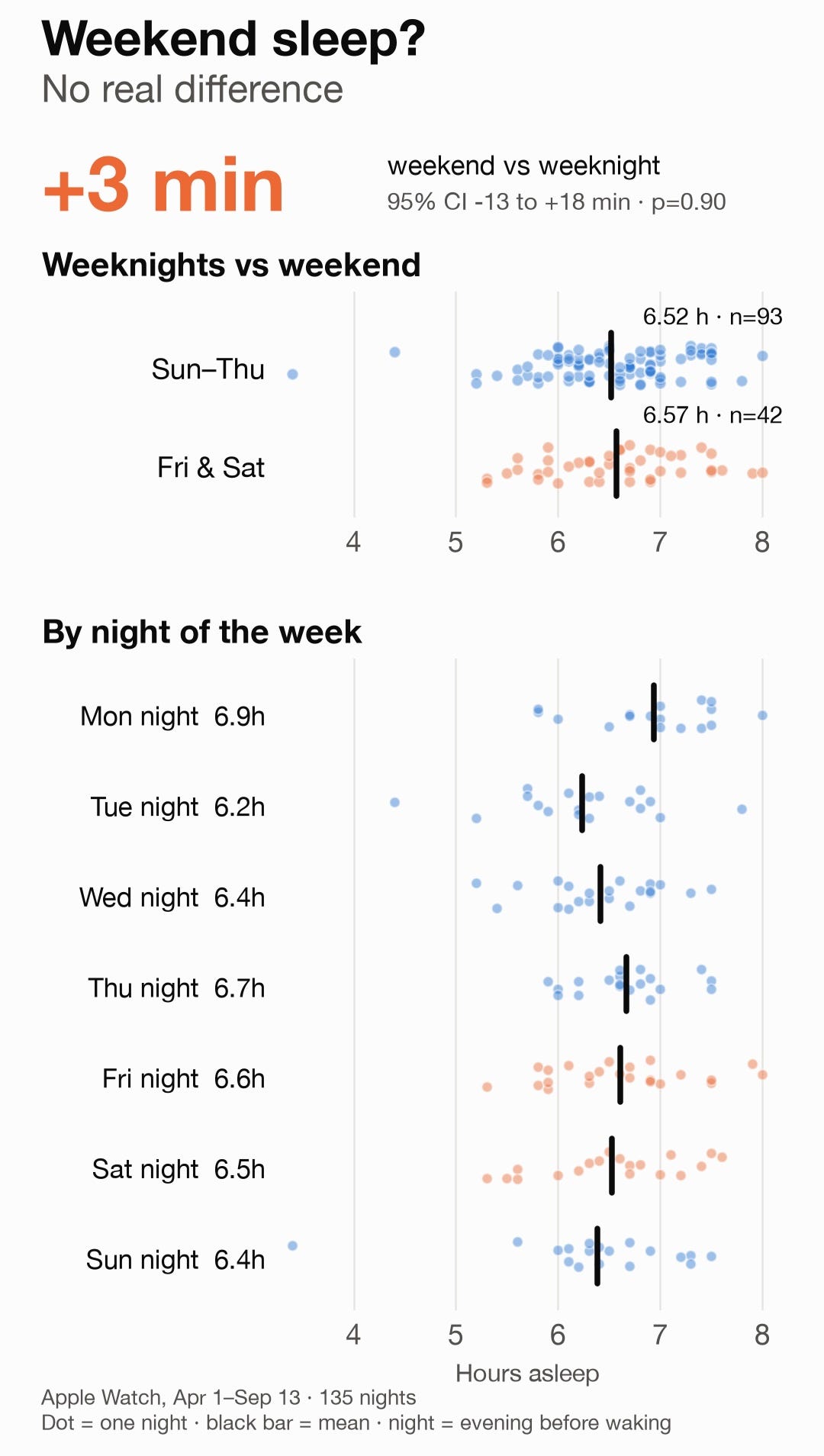
Here’s an easy example. Here’s what I type on my Mac:
For the past 6 months, do I tend to sleep longer on weekdays or on weekends. Show me a nice comparison plot
That’s it!
How about older data?
Back in PSWeek250410 I described how I used Claude to repurpose a medical journal paper using my own data:
A new study published in the Journal of the American Heart Association proposes a new metric, Daily Heart Rate Per Step (DHRPS), which they claim is highly associated with heart health. (Read a layman’s summary here). The researchers, from Northwestern University, used wearable data from 7000 participants in the NIH All-of-Us research program, to calculate the ratio between daily heart rate and daily step counts. Yes, it’s a crude metric, but they have enough data that they were able to find an interesting relationship with overall health.
At the time, it seemed outrageously easy to replicate that study’s findings with my own data. Hours, maybe days of programming were reduced to a single Claude prompt. But it still required that cumbersome data transfer step to get the raw data into my Mac.
Now that’s all changed and the same prompt and analysis requires nothing more than the MCP setup. Here’s the new chart Claude created when I asked it to redo my 2025 analysis using more recent data:
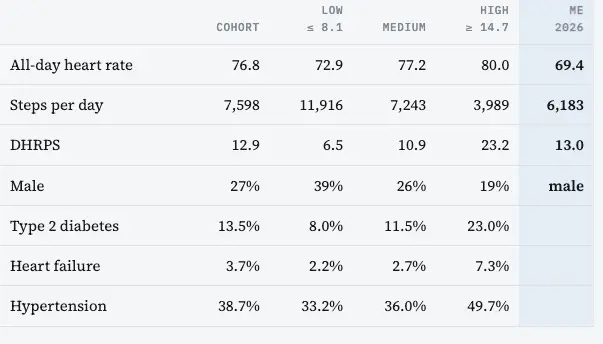
Those last three rows are the percentage of people in my age group from the study who developed those health conditions. Read it as "people like me who scored low were about half as likely to already have Type 2 diabetes" — not a forecast. It found no association at all with stroke or heart attack. Since I'm well within the "low" group, my odds on those conditions look correspondingly low. Low-ish, anyway, given my all-day heart rate.
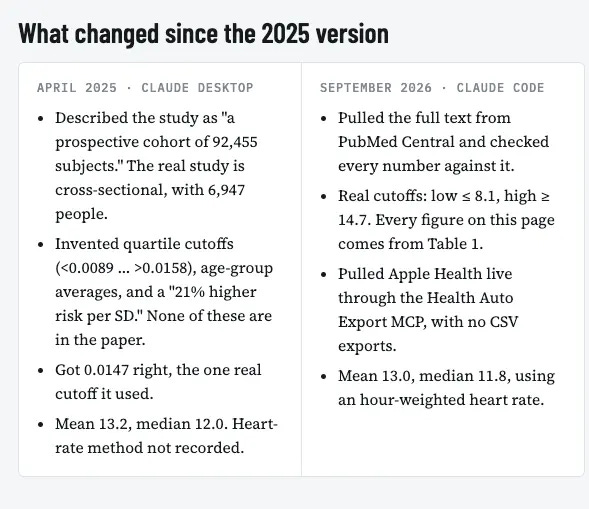
Incidentally, the 2025 Claude made a number of hallucinations in its analysis of the paper. Although those hallucinations didn’t directly affect the accuracy of my post — I always try to double-check facts that I write— there were some serious errors that Claude 2026 was able to find and correct in its older analysis.
If you don’t have Health Auto Export, check it out: HealthyApps.dev. Don’t bother with the free or basic versions; just jump to the $25 Lifetime version—it’s totally worth it.
Personal Science Weekly Readings
Speaking of wearable health data, Gary Wolf’s Quantified Self post Oura Builds a Moat describes the history and present success of the popular Oura ring and its maker, which has filed to go public for billions of dollars. Gary reminds us of some inconvenient missing pieces in promises made by the self-tracking industry:
There is no general answer to a question like: “Why did I start breaking out?” Or, “Can I start eating bread again without getting sick?” Or, “Will these exercises improve my tremor?” Or, “Can I avoid scaling back my training, even though I hurt a bit?” Nor is there any definable-in-advance set of things worth tracking. I’ve learned from my own and others’ experience that even a seemingly simple question like “how has my pain level changed over the past weeks” requires tinkering in the context of daily life to get right. Systems of personalized health advice struggle, still, to get anywhere nearly personalized enough.
What did George Washington eat? According to Mount Vernon's curator: three small hoecakes with butter and honey and three cups of tea at 7 a.m., nothing until a dozen-dish dinner at 3 p.m. washed down with beer and Madeira, then a single cup of tea at sunset and bed by nine. Late suppers gave him headaches. He lived to 67, which in 1799 was doing fine. Intermittent fasting FTW?
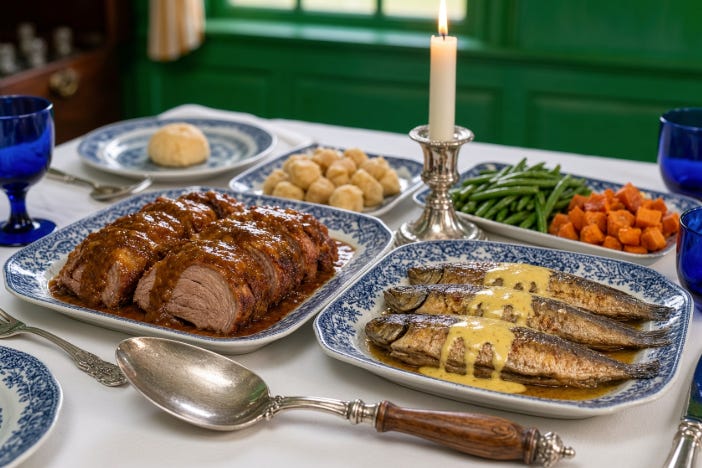
Speaking of nutrition advice, see school lunches over time — a nice short history of how the government decided what a child should eat, and how often it changed its mind.
College textbooks The Scandal of Outdated Science
Major studies compare high-cost commercial textbooks to free Open Educational Resources (OER), without noticing that both have a “strikingly similar design,” and contain identical content.
An undergraduate education should be organized around three questions: What do we know? How do we know it? And what remains unknown? This pedagogy cannot be done at scale.
Meanwhile, Hollis Robbins points out that college science textbooks — both the $200 kind and the free kind — carry identical, years-stale content, because the studies comparing them looked at cost and never checked the science. Her proposed fix is three questions per topic: What do we know? How do we know it? What remains unknown? In other words, think Personal Science.
About Personal Science
Personal scientists prefer to figure things out for ourselves. We listen to experts not because they’re necessarily right, but because they’ve had more experience than the rest of us. Still, experts are often wrong and frequently disagree with one another, so whether you listen to experts or not, you’ll need to make up your own mind.
We publish every Thursday for anyone who uses science for personal rather than professional reasons. If you have other topics you’d like us to explore, let us know.