
I’m a sucker for any opportunity to do blood testing. Few metrics give as much valuable, actionable information as a venous blood draw. Meanwhile, new technologies (and competition) are causing the testing prices to drop to less than what you’d pay for a decent lunch.
This week I’ll show what I learned from Goodlabs, a new company that promises free blood tests when you donate blood.

For the past couple of years, I suspended my regular blood donations when I found out that my blood iron levels had collapsed. (See PSWeek230427). I had been persuaded by the idea that male humans, in particular, had evolved in an environment that expected regular cuts and bruises, and that an occasional blood-letting and the re-charge that it forces, would be good for me. I still believe that, but apparently I overdid it (Pro tip: the official guidelines “no more than every eight weeks” is way too aggressive—I’d shoot for every six months or so).
Well now I have a reason to donate again: free blood tests! Goodlabs is a new diagnostic company with an idea that seems obvious: if you’re already donating blood, why not run some other tests at the same time? Meanwhile blood donation centers are always strapped for donors, so why not use the promise of a diagnostic as an incentive to donate? For personal scientists, a free blood test is way better than the cookies and orange juice they usually give you.
I signed up for my next blood donation, thanks to Goodlabs, but the company also offers a la carte blood testing at unbelievable prices, so I tried that too. Long-time readers know that I have essentially two go-to places for regular blood testing: SiPhox (for at-home testing, see PSWeek221222) and OwnYourLabs for discounted professional blood draws through LabCorp (see PSWeek220622). I’ve also tried Function Health and others (see PSWeek240912) Well, now I think I’ll standardize on Goodlabs.
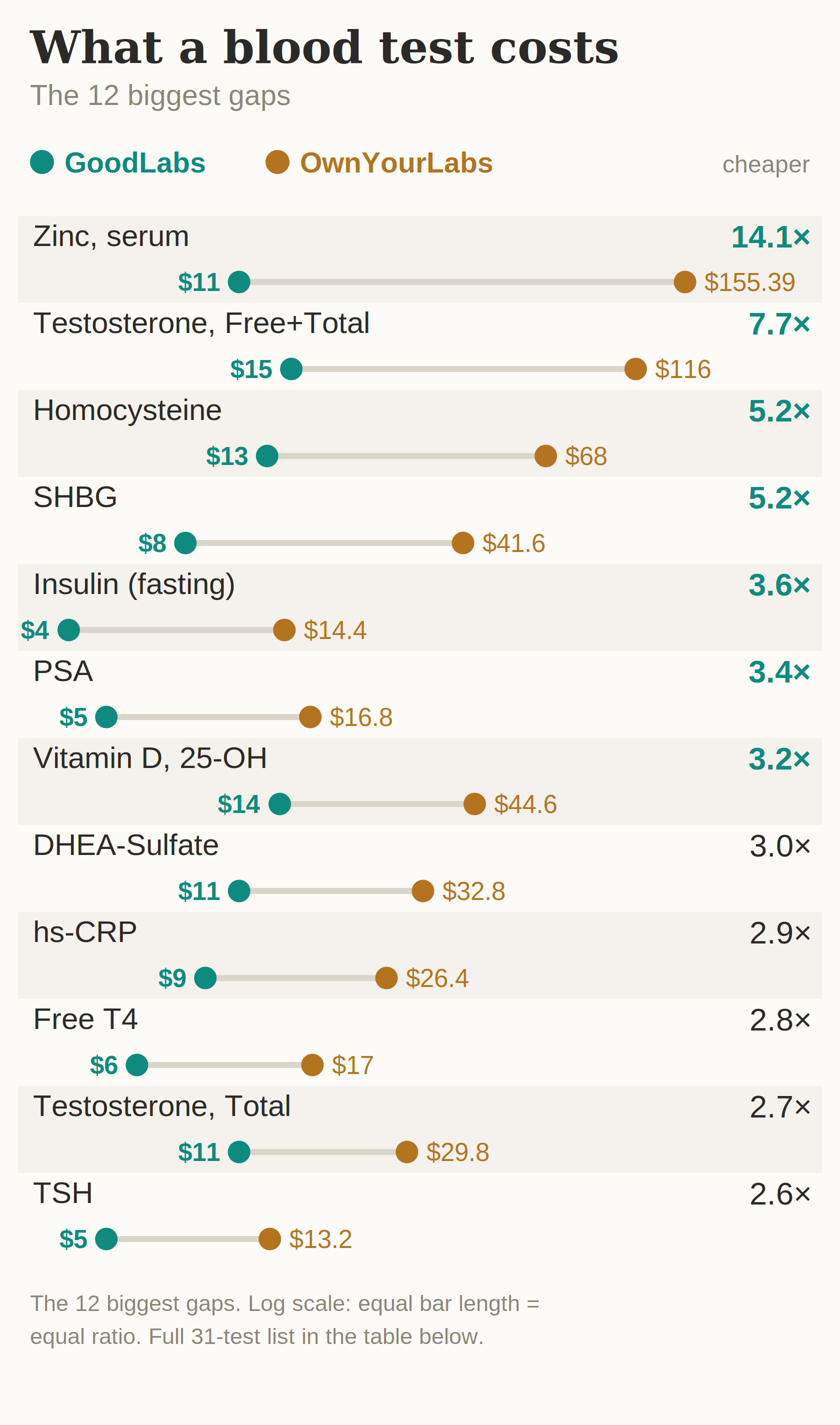
After ordering on their website, the rest of the experience is just like you get with the other providers:
Confirmation email that lets you schedule a time and place for the professional blood draw. Both Quest and LabCorp have dozens of locations near me, so I just pick the one that’s earliest in the morning (I do fasted tests). Usually a 10-minute drive.
A PDF requisition order with a barcode. I print this and show it at the reception desk at the lab.
Results arrive in my account, usually within 24 hours.
Goodlabs has an export feature that lets you export as either CSV or the raw PDFs from the laboratory (Quest, in my case). I found the raw PDF to be more complete, with specifics such as fasting status and time of collection (which matters for some parameters like iron). Also some of the Goodlabs data is “derived” (i.e. a ratio computed from the raw numbers), and so redundant if you’re going to use Claude for the analysis anyway. So my advice: just download the lab PDFs and skip the CSVs, which you can always generate yourself later in Claude.
Goodlabs, like Function Health and SiPhox and most every diagnostic company these days, has a pretty UX to display your results along with an AI “chatbot” that can answer basic questions. The Goodlabs chatbot is pretty good, but honestly I think personal scientists will just want to export everything and study it ourselves. My Claude project contains way more information about myself and my history, including a connection to Apple Health. It’s just easier to get more comprehensive answers with my own LLM.
For example, here’s something actionable I learned thanks to Claude and the Goodlabs result:
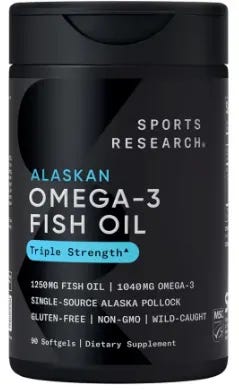
I’ve been taking 1 softgel of a Sports Research Triple Strength Omega 3-Fish Oil (Costco $26 for a bottle of 150), and it seems to have actually improved my Omega-3 levels noticeably compared to the Nature’s Bounty brand I’d taken previously. I was able to show that Sports Research brought me into the normal range. (6.0, up from 4.8 in Jan 2025).
Claude also added that there’s a genetic variant (FADS1/FADS2 cluster, e.g. rs174537) that can affect EPA/DHA intake, and when I gave it my 23andMe SNP data it found specific variants that affect how my body handles fish oil. It’s always nice when genetics and blood results agree—a concordance that before LLMs would have required hours or days of additional research.
More on Goodlabs
I have no affiliation with Goodlabs other than as a (so far) happy customer. They gave me this code 9VWGYY (or this link) which I think might give you a discount. But with or without the discount, these prices are unbelievably cheap, and I can attest that everything about the experience is legit. Highly recommended.
Incidentally, the Goodlabs people told me they’ll be in Seattle in early August, so I’m trying to organize a biohacker/longevity event for people who are interested in meeting to discuss blood testing and more. The tentative date is Monday August 3rd, as I look for a venue (If you want to attend, or can help us find a place, let me know).
Personal Science Weekly Readings
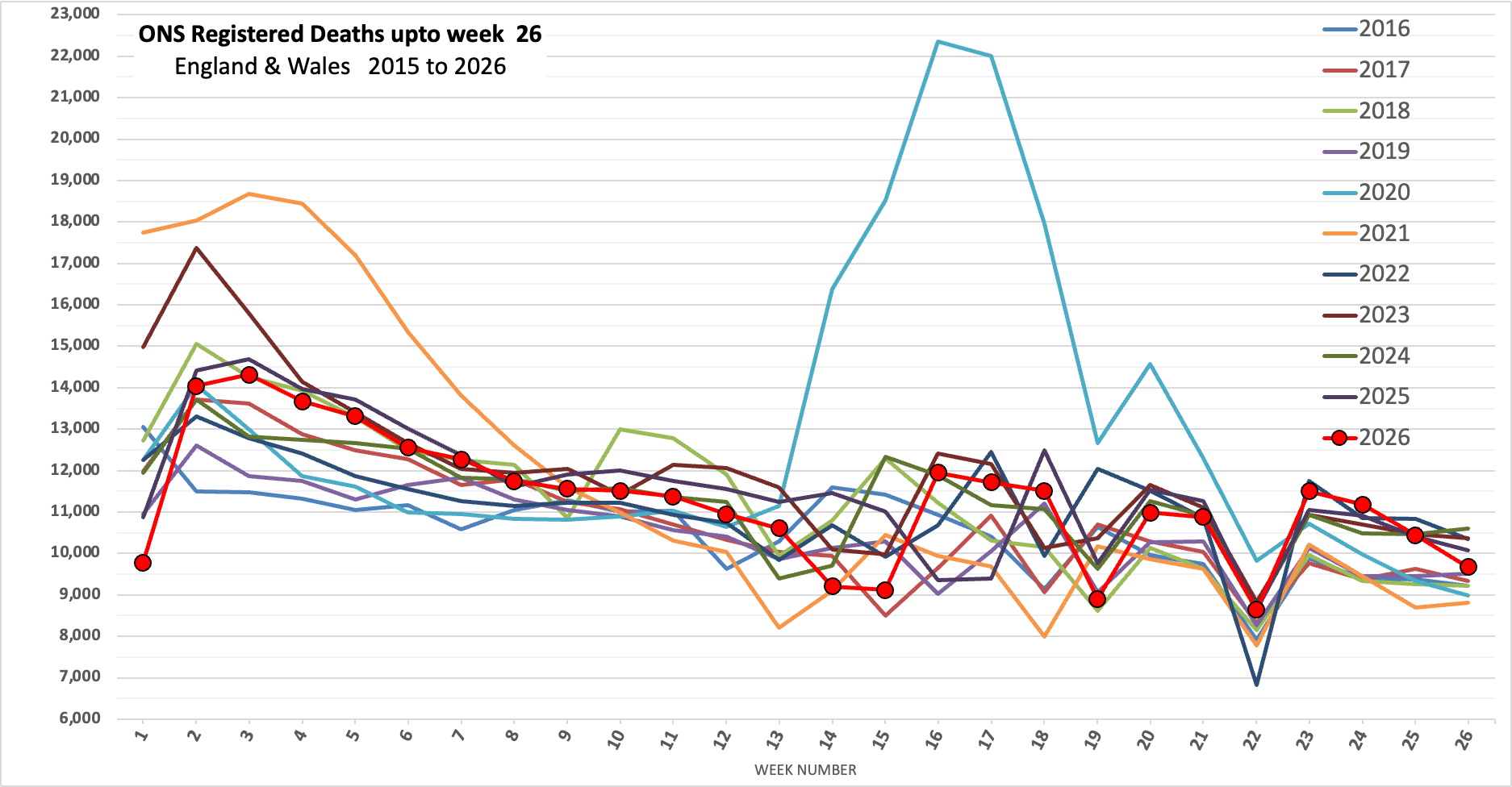
We all know about the record-setting heat wave in Europe over the past month. Since air-conditioning is relatively uncommon there, news headlines emphasized the heavy death toll among the elderly and other vulnerable people. So then, asks the ornery team at Trust the Evidence , why can’t you see a rise in the average death rates in the UK compared to previous years? Their answer: because the warnings are based on modeled projections, which are always dependent on the assumptions that go into the model. In fact, people die for all kinds of reasons in good weather and bad. A reminder to (1) be wary of in-the-moment calculations made before all the data is in, and (2) never assume the “first draft of history” is correct. The world is a complicated place, and we should be humble when making statements like “this caused that”.
Speaking of academic research that makes me wonder, this new paper from team of microbiome and nutrition researchers reviews Applying Artificial Intelligence and machine learning to precision nutrition. It defines all the latest AI buzzwords (CNN, RL, RAG) and describes how each applies to precision nutrition. It’s fine and I’m sure given all the co-authors it’s been carefully edited and accurate for when it was made. But how actionable is it? Will it affect any future research program or clinical decision? what people really want to know is “Is such-and-such food good for me?”, or better yet “What diet will let me fix such-and-such problem”. I’m not sure that papers like this help lead to those sorts of answers, especially in a world where LLMs are soon able to do more comprehensive literature reviews than any human team can hope for.
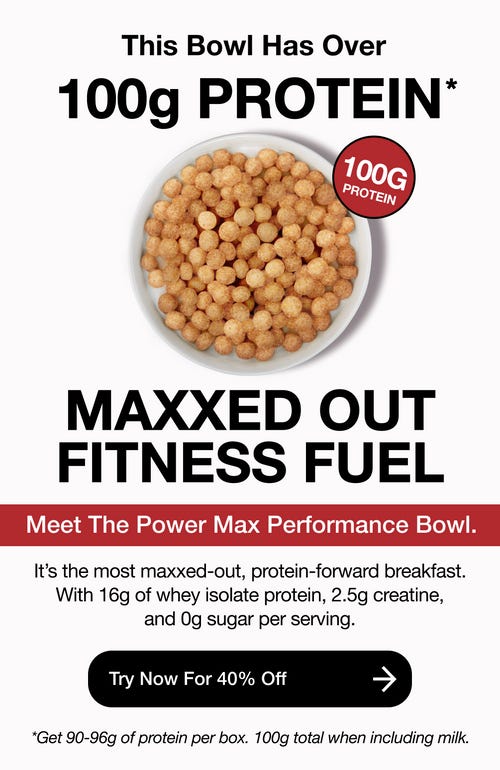
Have we reached Peak Protein? Here’s a new, apparently serious product, “Man Cereal“ for people who really really want more protein.
Remember Colon Blow?
About Personal Science
“Following the science” used to mean obeying highly-credentialed people from prestigious universities and research labs, but these days there are so many different, often contradictory voices telling you what’s true, that it’s hard to know what to believe.
Personal scientists know that real science is never settled, and that what works in a laboratory study may not work for what matters to you or your loved ones. But science itself—careful observations, willingness to remain open-minded and skeptical—is the best way to uncover the truth, and it’s something we can practice every day in our own personal lives.
We publish this newsletter each Thursday. If there are other topics you’d like to explore, or if you have other questions, please let us know.
That is much cheaper! Thank you for the recommendation!
Even though my hemoglobin has always been fine, my ferritin levels won't recover if I donate more than 1-2x per year (with no supplementation). YMMV.
For an even larger (and head-scratching) price discrepancy, check how much Quest charges for the same blood tests through their direct-to-consumer business...