Some leftovers are worth worrying about more than others
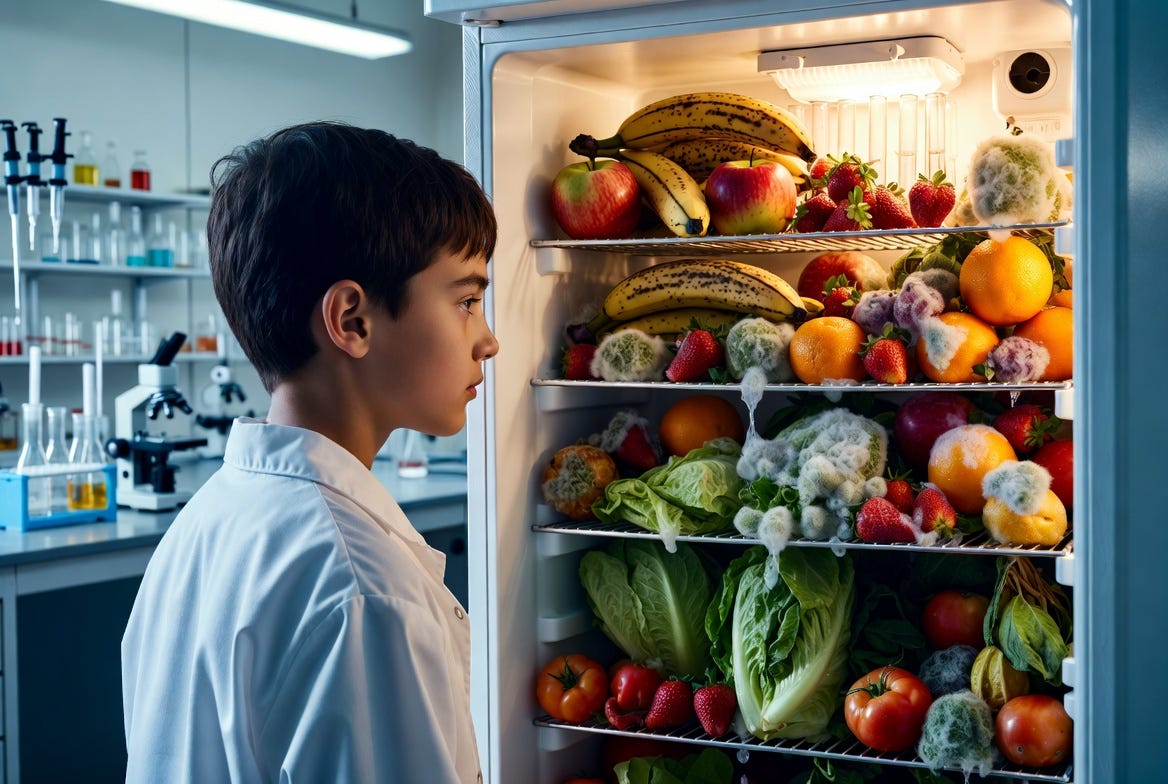
When I returned to my house after a month of being away, several of the food items in my refrigerator had passed their expiration dates. Nobody wants to get sick from spoiled food, but on the other hand it’s a shame to waste it.
This week I’m looking at germs: what should I know about how to keep food safe?
Personal Science is delivered each Thursday to anyone interested in science for personal, rather than professional reasons
Personal scientists get skeptical when a nameless bureaucrat tells us what we can or cannot do, so I look suspiciously at any “expired by” label.
That’s how I felt when I opened my refrigerator and inspected the various uneaten containers inside. Some were easy to chuck: the cottage cheese was covered in green “fur”, the sour cream smelled obviously wrong. But I kept most of the remaining items: the heavy cream had “expired” weeks ago but it smelled and looked fine. Some of the cheese had a little mold on it, but nothing that I couldn’t cut around. The carrots and the onion in the bottom drawer looked (and tasted) okay. It’s not like I’m a hippie who refuses to throw anything away, but I don’t see a need to be extra careful either.
Back in PSWeek250109 we discussed food safety in the context of cooking, where I wondered why we are so paranoid about raw meat. After all, that’s what animals eat.
Most of us wash fruits and vegetables before eating (why else would you need a salad spinner?), but I wonder how necessary that really is. These days nearly all store-bought produce has already been treated with peroxyacetic acid (PAA), a vinegar-like liquid chosen because it degrades safely into harmless byproducts like water and oxygen. You can buy PAA for home use (SaniDate™) but why bother when your produce has already been washed with it?
Washing raw meat — especially chicken — can actually increase risk rather than reduce it. When you rinse a chicken in the sink, water droplets can aerosolize and spread bacteria (particularly Campylobacter and Salmonella, which are very common on raw poultry) onto the surrounding counter, sink, and nearby foods. This is a classic example of cross-contamination. Because you’re going to cook the chicken thoroughly anyway, the rinsing step usually removes very little of the risk while potentially spreading pathogens to things you won’t cook, like salad ingredients or utensils.
For the same reason, I generally don’t wash meat or vegetables I intend to cook thoroughly, unless there’s visible dirt or residue. The heat of cooking takes care of surface bacteria far more reliably than rinsing does.
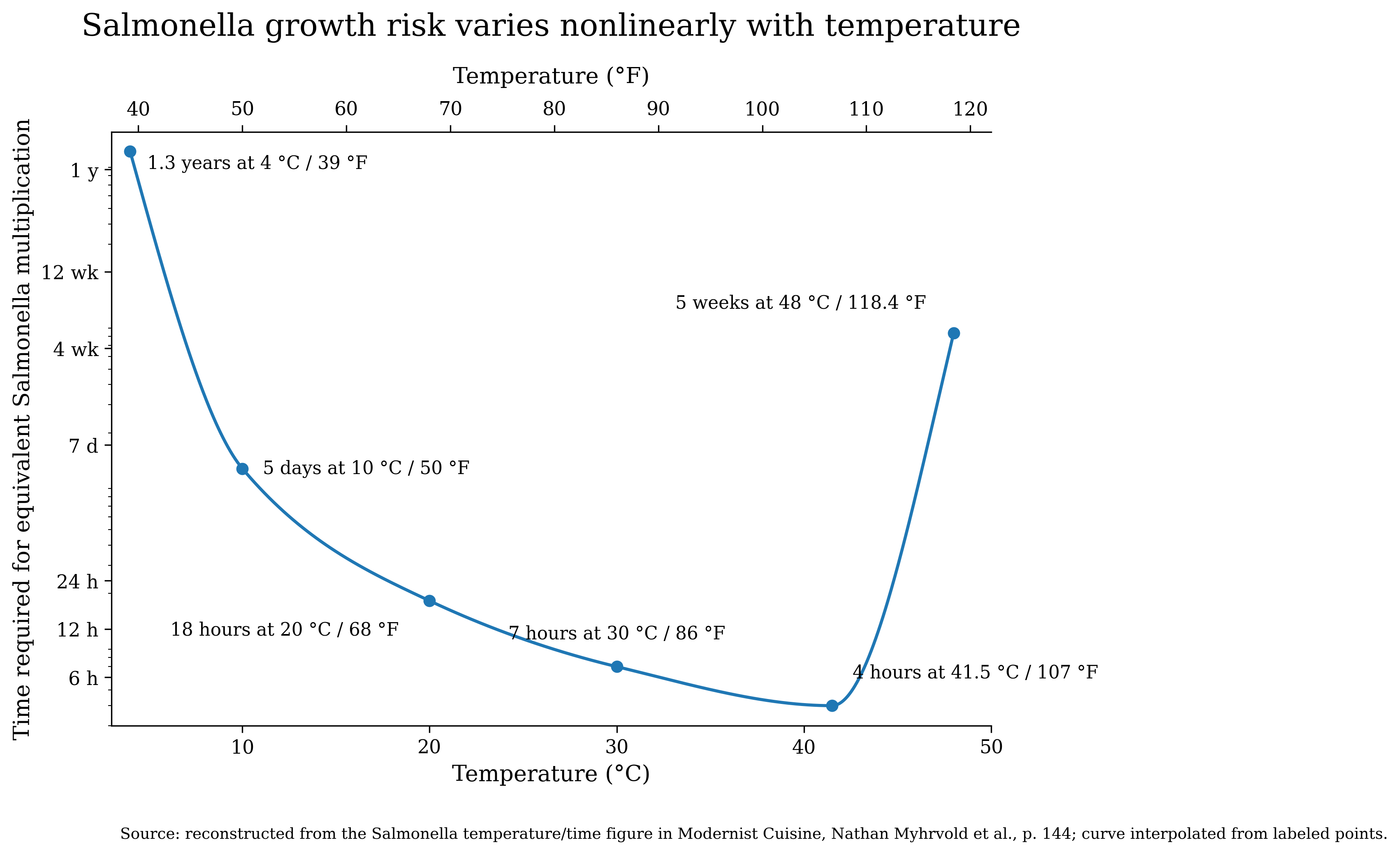
Cooking, while effective, is also over-rated. Pretty much all pathogenic microbes die at temperatures above 75ºC (165ºF), which is the origin of the better-safe-than-sorry advice you’ll find in cookbooks. But that’s only if you want to be really, really safe. In fact, pathogens stop multiplying above ~120°F and are progressively killed over time at temperatures well below 165°F — it's the combination of temperature and time that matters, not a single magic number. When the scientists at Nathan Myhrvold’s Modernist Cuisine Lab tested USDA’s claims about microbe survival, they produced this chart:
Many common food pathogens can’t handle heat very well.
In general, these microbes reproduce best at just above body temperature, but get even a little warmer (120º or so) and they basically stop growing. You don’t need to get anywhere near the 165º it takes to kill them.
That said, my personal science experiments have not been without risks. My lackadaisical attitude caught up with me recently—not from my past-the-due-date food from the refrigerator, but when I ate some reheated leftover Costco Southwest linguini with sausage. It looked and smelled fine. And I nuked it well beyond 165º. So why did I get sick?
At first I blamed “fried rice syndrome,” the classic Bacillus cereus illness. Its spores shrug off both cooking and freezing, hibernating until the food sits out long enough for them to wake up and multiply. As they grow they pump out cereulide, an emetic toxin so heat-stable that reheating destroys the bacteria and leaves the poison untouched — which is why leftover rice and pasta can sicken you even when they look and smell perfect. Staphylococcus aureus runs the same play with its own pre-formed toxin. No amount of microwaving saves you.
But my dish was sausage, and meats and gravies are the calling card of a different bug: Clostridium perfringens, which you and I already carry in our guts at low levels. It doesn’t poison the food; it poisons you. Its spores survive cooking, multiply while the dish cools slowly or sits warm, and then — once you swallow a big enough live dose — sporulate in your intestine and release their enterotoxin there. Here reheating should have protected me, except a microwave heats unevenly: “well beyond 165º” is an average, not a guarantee, and the cold spots are exactly where the survivors ride through.
So the personal science lesson is: use your senses, but be careful. In general, traditional foods that were available before refrigeration (e.g. butter, yogurt) can last a while; but things that have traditionally always been cooked (e.g. pasta, rice) had better have some other means of preservation, like salt or fermentation, before they’re worth eating unrefrigerated.
Personal Science Weekly Readings
When Euan Ashley published one of the first clinical analyses of a human genome back in 2010, it was a big deal that required a team of 30 people working for 9 months. Over the July 4th weekend, he tried it again with Claude. He was able to get the same results in 30 minutes using an 800-word prompt and about $5 worth of tokens. As he says, “There is no world in which this is not utterly remarkable.”
Eric Topol, who is as optimistic about AI in medicine as anyone, cautions that “there are no studies in real world medicine; all we have now are simulations, case vignettes, patient actors, etc.” One problem is that medical publishing is extremely slow by computer industry standards, with many of today’s headlines serving up results from models that are a year or more old. Yishan Wong built a Github repo that lets anyone re-try those results with any model, including new and open-source ones.
And check out Open Science, an open source competitor to Claude Science.
You give it a goal, and it works through the research loop the way a capable collaborator would. It reads the papers that matter, forms a hypothesis, writes and runs code, runs experiments on real compute, queries the major scientific databases, and writes up the result. It runs as a workspace in your browser and works with any frontier or open-weight model from Anthropic, OpenAI, Google, and dozens of other providers, using your own API keys. No account is required.
About Personal Science
Personal scientists don’t take the label’s word for it — but we don’t take the contrarian’s word for it either. A printed date is a quality hint, not a safety command; In each case the interesting truth was one layer below the slogan, reachable by anyone willing to check. Nullius in verba — take no one’s word for it — applies as much to the “expired by” stamp as to the influencer telling you it’s fine.
We publish every Thursday. If you’ve run your own experiment on food safety, raw milk, or germophobia, let us know.
Thanks for this. I was recently reading about rice handling and learned what you mentioned. I don't think I have ever gotten sick from left over rice but am now being more careful. I am curious what details you have learned about proper handling of cooked rice.
A little anecdote from when my wife and I operated a small cafe in Annapolis, MD. I can still hear the Health Department inspector who was licensing us, in her south county drawl., when we told her the kinds menu items we planned. That's what we call the part of Anne Arundel County (where Annapolis is) that is south of the South River off the Chesapeake Bay. Some people say the south begins at the Mason-Dixon line (MD-PA border). I think it starts at the South River. Here's what she said, "They may eat it raw in Provence, but . . . not here in Anne Arundel County"




Hi Richard:
Thanks for this. I was recently reading about rice handling and learned what you mentioned. I don't think I have ever gotten sick from left over rice but am now being more careful. I am curious what details you have learned about proper handling of cooked rice.
A little anecdote from when my wife and I operated a small cafe in Annapolis, MD. I can still hear the Health Department inspector who was licensing us, in her south county drawl., when we told her the kinds menu items we planned. That's what we call the part of Anne Arundel County (where Annapolis is) that is south of the South River off the Chesapeake Bay. Some people say the south begins at the Mason-Dixon line (MD-PA border). I think it starts at the South River. Here's what she said, "They may eat it raw in Provence, but . . . not here in Anne Arundel County"
I'm curious if you've changed anything re:what you wash/cook/eat with the news of the cyclosporiasis outbreak.