
I’m back from Biohackers World New York, the first New York stop for a conference series that is also being offered in Los Angeles, Miami, and Chicago.
This week I’ll summarize some of what I saw.

Biohackers, like personal scientists, are open-minded about new techniques for optimizing health and wellness. That’s why I enjoy attending biohacker conferences like the one held last weekend in New York City. More than 1,000 people paid $300 for a two-day pass that includes talks by various health-optimizing speakers, training sessions, and access to an exhibit hall featuring dozens of biotech-related products.
There is often a fine line between genius and crazy, between under-rated medical miracle and scam-driven snake oil. If you’re somebody who relies on “experts” to decide the difference for you, then you won’t enjoy biohacking events. But we personal scientists are open-minded and skeptical about everything—whether the claim comes from credentialed mainstream researchers or from sincere amateurs. So that was the attitude I took while passing through the booths at the show.

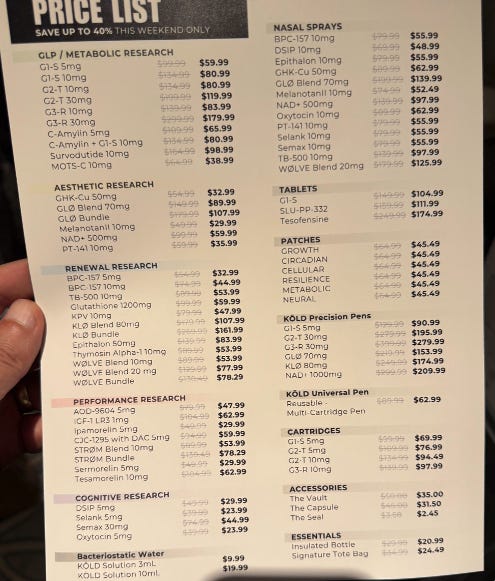
Peptides!
The biggest trend I’ve noticed at these shows is the surging interest in peptides. Several booths were selling the usual suspects—BPC-157, TB-500, CJC-1295/ipamorelin, and various thymosins—most of them labeled “research chemical, not for human consumption,” the legal fiction that lets sellers sidestep the awkward fact that none of these is an FDA-approved drug.
Knowledge of peptides is an occupational hazard for personal scientists, and I’m doing my best to come up to speed. But like I keep saying, personal scientists are open-minded and skeptical, so I don’t try anything—especially something that goes directly into the bloodstream—unless I see very clear evidence that it’s safe. For BPC-157 (“tissue repair”), that evidence still doesn’t exist: the encouraging results are almost entirely from cell and animal studies, and nobody has established a safe human dose. “Popular at the expo” is not a clinical endpoint.
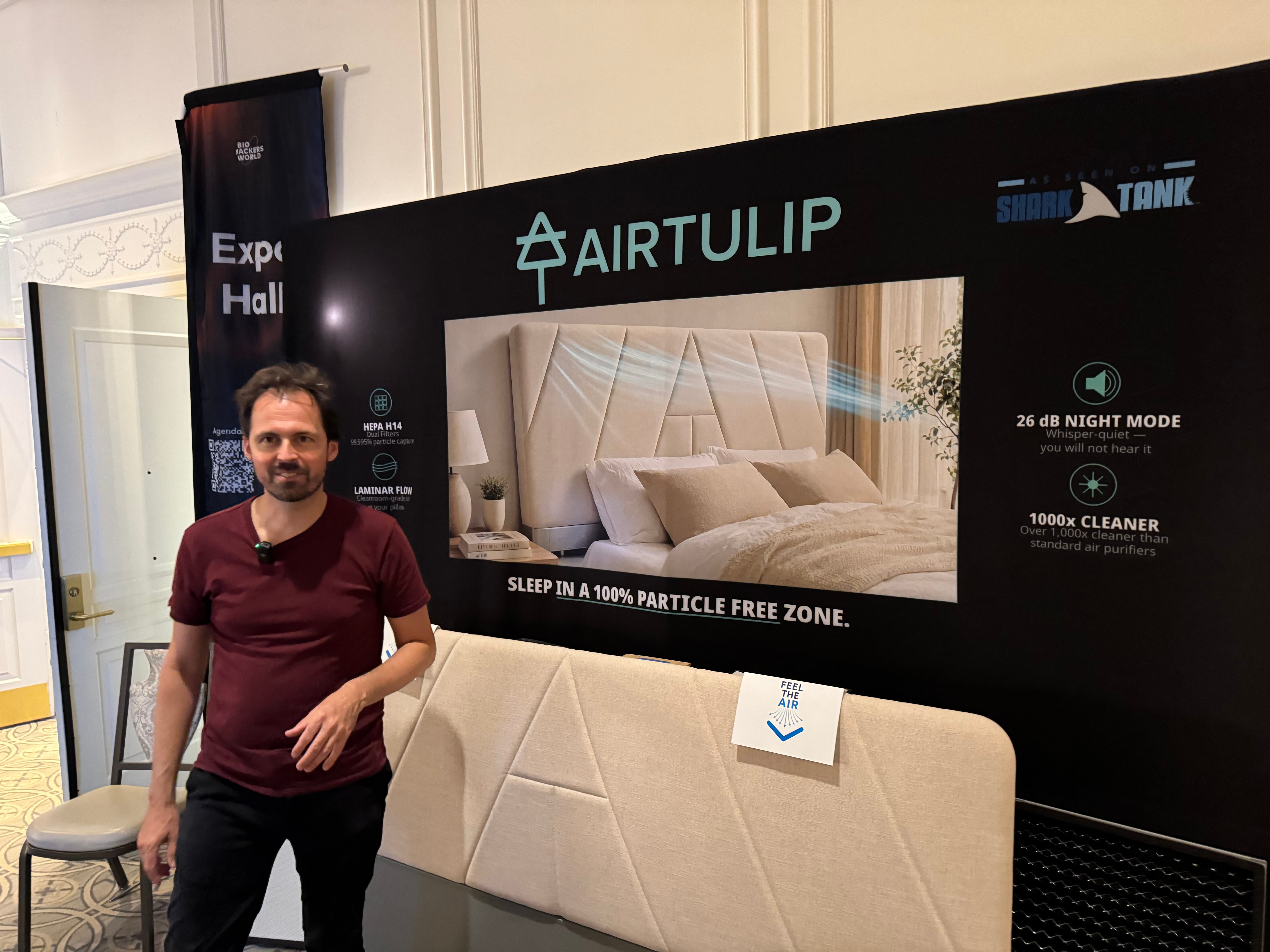
Sleep in a bubble: AirTulip
AirTulip (airtulip.co) seemed like a genuinely clever idea for people who suffer from allergies. It’s a headboard that runs roughly $2,000–$3,500 depending on size—founded, appropriately enough, by a Dutch aerospace engineer—that uses laminar airflow (the unidirectional, non-mixing flow used in industrial cleanrooms) to push HEPA/ULPA-filtered air across your pillow. Instead of filtering the whole room, it creates a “100% particle-free” zone right where your face is. The company cites testing at Eindhoven University of Technology and has appeared on Shark Tank.
Light and sound: Braintap
I’ve seen Braintap at these shows before. They make a headset that uses carefully timed sequences of colored light flashes to help your brain enter a state of better concentration. This time I was able to talk to the founder, Patrick Porter, who explained how this is more effective than binaural beats (your brain quickly adjusts to sounds).
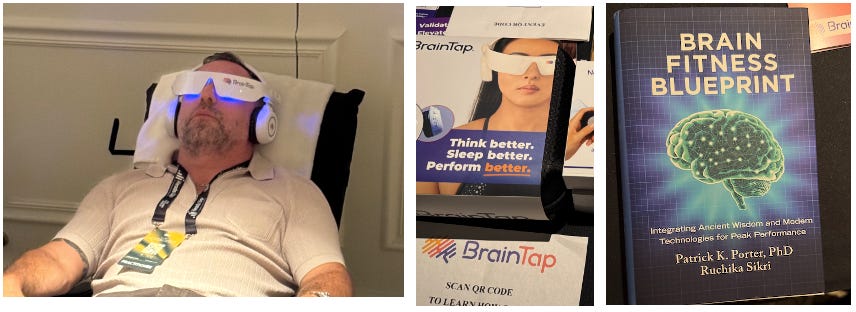
Photic entrainment is real: rhythmic light does produce measurable EEG responses (steady-state visual evoked potentials), and 40 Hz “gamma” light-and-sound has real, if early, clinical evidence—mostly in Alzheimer’s patients, though, not healthy people chasing focus. The weak link is that consumer devices like Braintap—and roXiva, which I’ve tried—are open-loop: they deliver a precise stimulus but never measure whether your brain actually synchronizes to it. When I tried a roXiva session I came away feeling more relaxed, but the effect quickly faded—exactly what you’d expect from a pleasant experience that isn’t necessarily changing anything durable. Maybe if you do it regularly you’ll have different results.
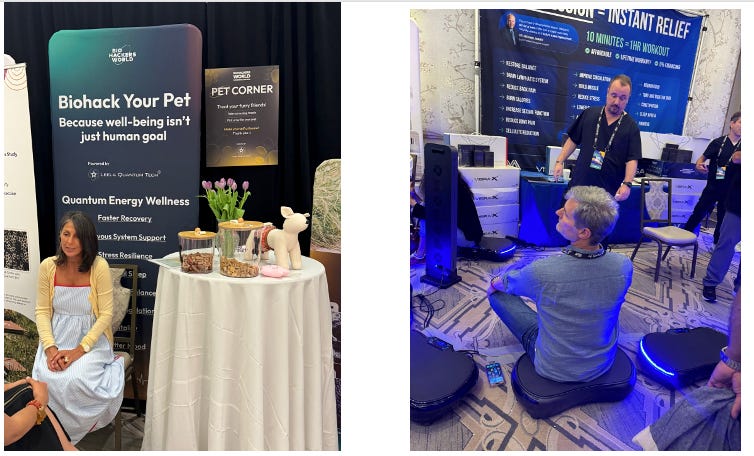
Go to personalscience.com/docs to see a complete list, with photos, of all the products I saw, including some for beauty and hair tools and the Oxefit AI strength trainer.
Personal Science Weekly Readings
I used my new Claude skill to help me look through the show booths. I took photos at each booth, and after I got home I pointed Claude to the photos. It automatically read the text from the photos, looked up the company website for more information, and generated a handy summary of the exhibits I’d visited, making it much easier to remember the products I saw. You can add this to your Claude and give it a folder of photos:
claude plugin marketplace add Proofbound/conference-booth-report
claude plugin install conference-booth-report@proofbound-plugins
If you miss the days when people were recruiting subjects for COVID studies, SeaPrep is now looking for volunteers for their study of respiratory infection outbreaks. You must live in the Seattle area and be willing to provide nasal swab samples if you or someone in your household comes down with something.

People walking in crowds tend to move counter-clockwise, a phenomenon that seems to be true in all cultures and ages studied. I wonder how hard it would be to make an iPhone/Watch app that would keep track of my movements throughout the day and see if I more often turn to the left (counter-clockwise) or right? (Spoiler alert: not hard.)
In the age of AI, analysis is easy and data collection is hard, but the hardest part of all is thinking of interesting new questions to ask about the data. One cool example: After studying data on how many people are displaced after dams are built in rural areas, water resource management experts in Finland think we may be greatly miscalculating the number of humans . Headlines promptly inflated this into "1–3 billion more people on Earth," which the lead author has explicitly disowned—the paper never estimates a revised global total. Still, once you see how census-dependent the UN's ~8.2 billion figure is, it gets easier to distrust the precision. Countries have a built-in incentive to overestimate their population numbers (e.g. Africa’s largest country, Nigeria, hasn’t had a census since 2006 and allocates government money based on reported population).
About Personal Science
Personal Science is the process of using the scientific method to solve problems and get better results on an individual, personal level. Following the motto of the Royal Society, established in 1660, nullius in verba, we take nobody’s word for it.
This newsletter is a weekly summary of a few observations we think will be interesting to anyone who wants to be a personal scientist. If you have other topics you’d like to cover, let us know.
Perhaps the UK was right about driving on the wrong side of the road after all!
Regarding people walking counterclockwise in crowds, it would feel really awkward to run a track event or car race in a clockwise direction, but I don't know why that is.