
Is red wine good for you? We asked this question back in PSWeek231221, when most mainstream advice said that moderate drinking is fine, maybe even slightly beneficial for some people. Since then, many new large studies have been published that were supposed to settle the question once and for all. Spoiler alert: they didn’t.
This week we’ll look at what’s changed — and how a personal scientist can decide for themselves when the experts won’t.
The Downside of Alcohol
The downsides of alcohol at a population level are undeniable. Nearly all sexual abuse and most crime is accompanied by drinking. A massive 2016 global study commissioned by the Gates Foundation concluded that “the safest level of drinking is none” — and in early 2025 the outgoing U.S. Surgeon General went further, calling for cancer-warning labels on every bottle. That may be why many notable leaders, from Presidents Biden and Trump to Warren Buffett, never touch the stuff.
Personal scientists prefer to make up our own minds, so we don’t delegate our decisions to experts and their fancy studies, so we’re not surprised that the “no safe level” consensus has been publicly splintered. To inform the 2025–2030 Dietary Guidelines, the government commissioned two evidence reviews that reached opposite conclusions — the National Academies found moderate drinking associated with lower all-cause mortality, while a second federal panel found risk climbing from the first drink. The tie was never broken. In January 2026 the new guidelines simply dropped the numbers: no more “two drinks for men, one for women,” just “drink less.”
The story didn’t end there. Just this week the stricter analysis — the Alcohol Intake and Health Study, federally commissioned to inform those very guidelines — was published in peer review anyway, reporting no protective effect at low intake and an alcohol-attributable death risk of about 1 in 25 at 14 drinks a week, with a recommendation to tighten the limit to a single drink a day for everyone. So within five months the government both removed its numeric limit and watched its own commissioned scientists publish the case for a stricter one. Did the government cave to Big Alcohol pressure, or did the Prohibitionists just have an ax to grind? Like we keep saying, most of us decide who to believe before we decide what to believe.
A key premise of personal science is that we’re all different and your experience could differ. But when the experts fracture this badly, “follow the guidelines” stops being an option — so how do you decide?

Alcohol Isn’t That Popular
First, a reality check on the social pressure. Most drinkers assume “everybody does it,” and are surprised how many people never touch the stuff. As of 2025, only 54% of U.S. adults say they drink at all — the lowest Gallup has measured since it began asking in 1939, down from 62% just two years earlier. Forty-four percent now call themselves total abstainers.
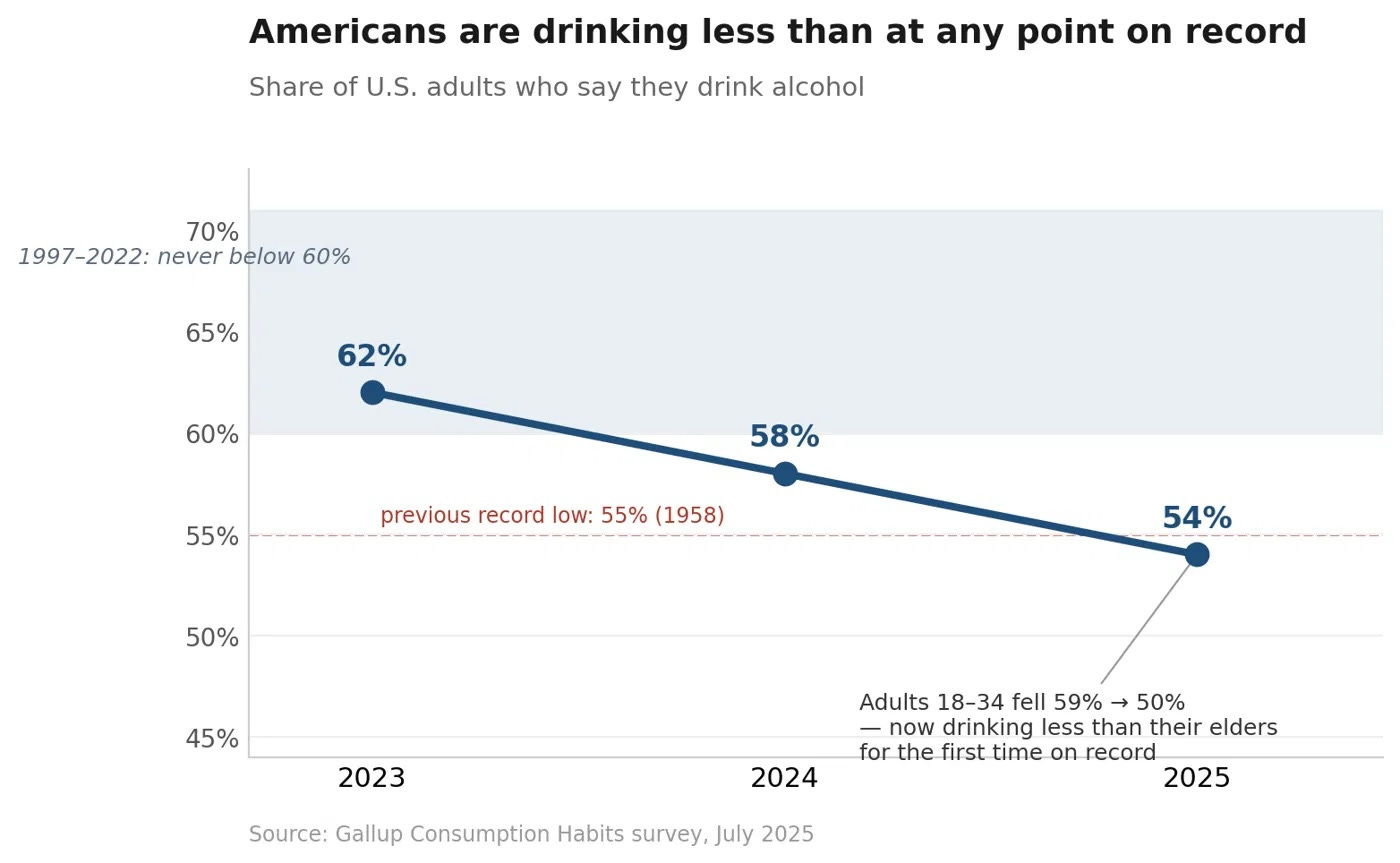
The drop is steepest exactly where you’d least expect it. Young adults (18–34), who two decades ago drank more than anyone, have fallen from 59% to 50% in two years — now drinking less than their parents and grandparents for the first time on record. And among those who still drink, it’s light: about 2.8 drinks a week.
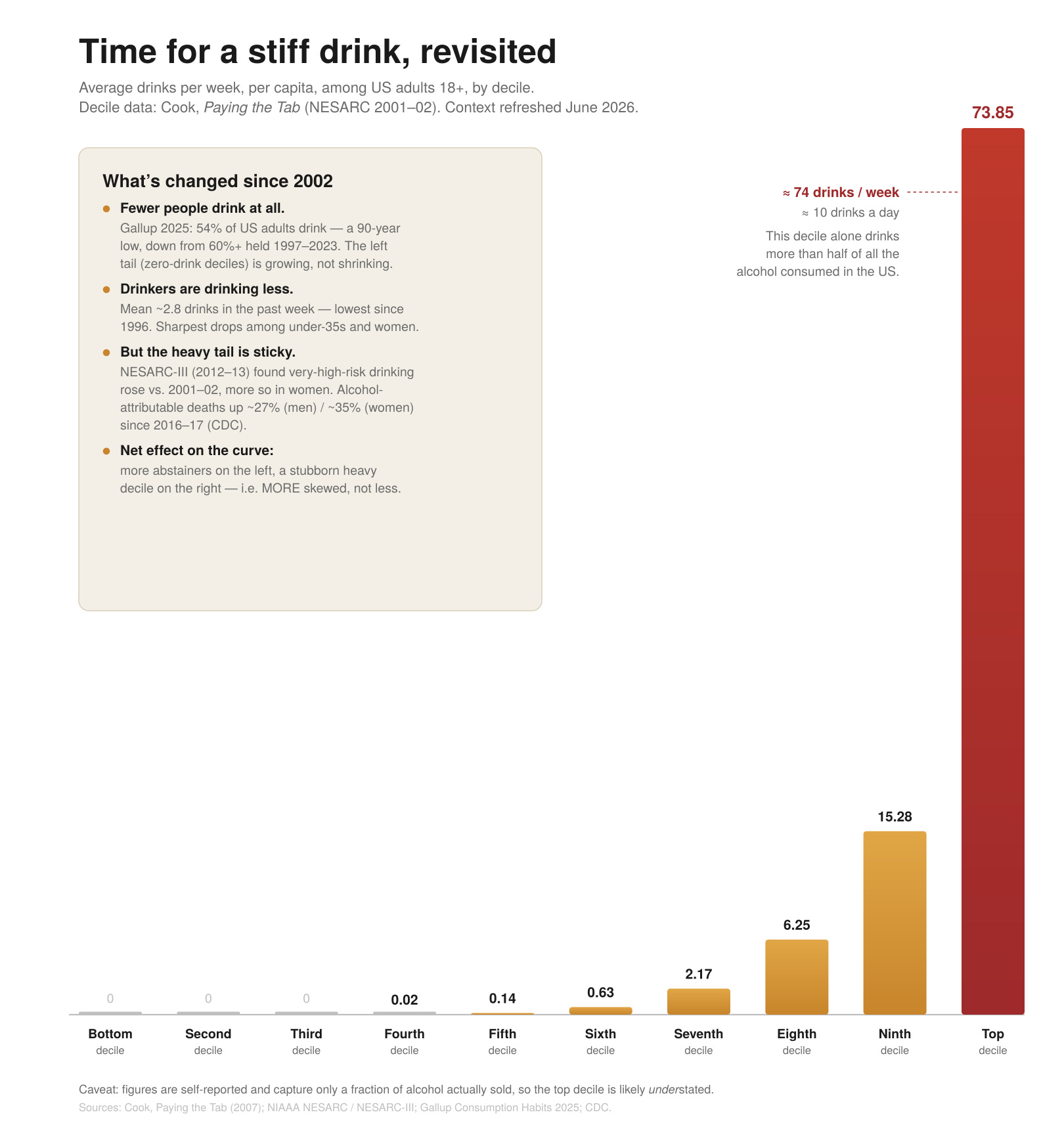
That said, most of the decline has happened among those who didn’t drink all that much in the first place. Among the heavy drinkers, not much has changed.
It isn’t only an American story, nor a new one. More than a quarter of Italians don’t drink at all — a similar share as Russia — and today’s French drink only a quarter as much as they did in 1960. You’re not weird if you abstain. Increasingly, you’re the majority.
How Alcohol Affects My Body
The known effects are real but modest: alcohol shortens the time to fall asleep while degrading sleep quality (especially REM), temporarily raises heart rate, and shifts the gut microbiome. Although I’ll still occasionally have a drink in special social situations, I concluded through my own testing that alcohol just “isn’t worth the squeeze.”.
Case in point from a wedding I attended last month: half a glass of champagne and a Stella — about 20 g of ethanol — finished roughly 3.5 hours before bed, with the Polar H10 recording all night. The first five hours were wrecked. My heart rate held at 75 bpm (a clean night runs ~64), and rMSSD — the beat-to-beat metric that tracks parasympathetic recovery — collapsed to 27 ms, about half my clean-night baseline of ~54. Then, as the ethanol cleared, the second half rebounded: rMSSD climbed back toward 45 ms and heart rate fell. Whole-night LnRMSSD came in at 3.53 against a morning baseline of 4.05 — roughly two and a half standard deviations down. (I carry the ADH1B slow-metabolizer variant, so I clear it slowly; your mileage will differ.)
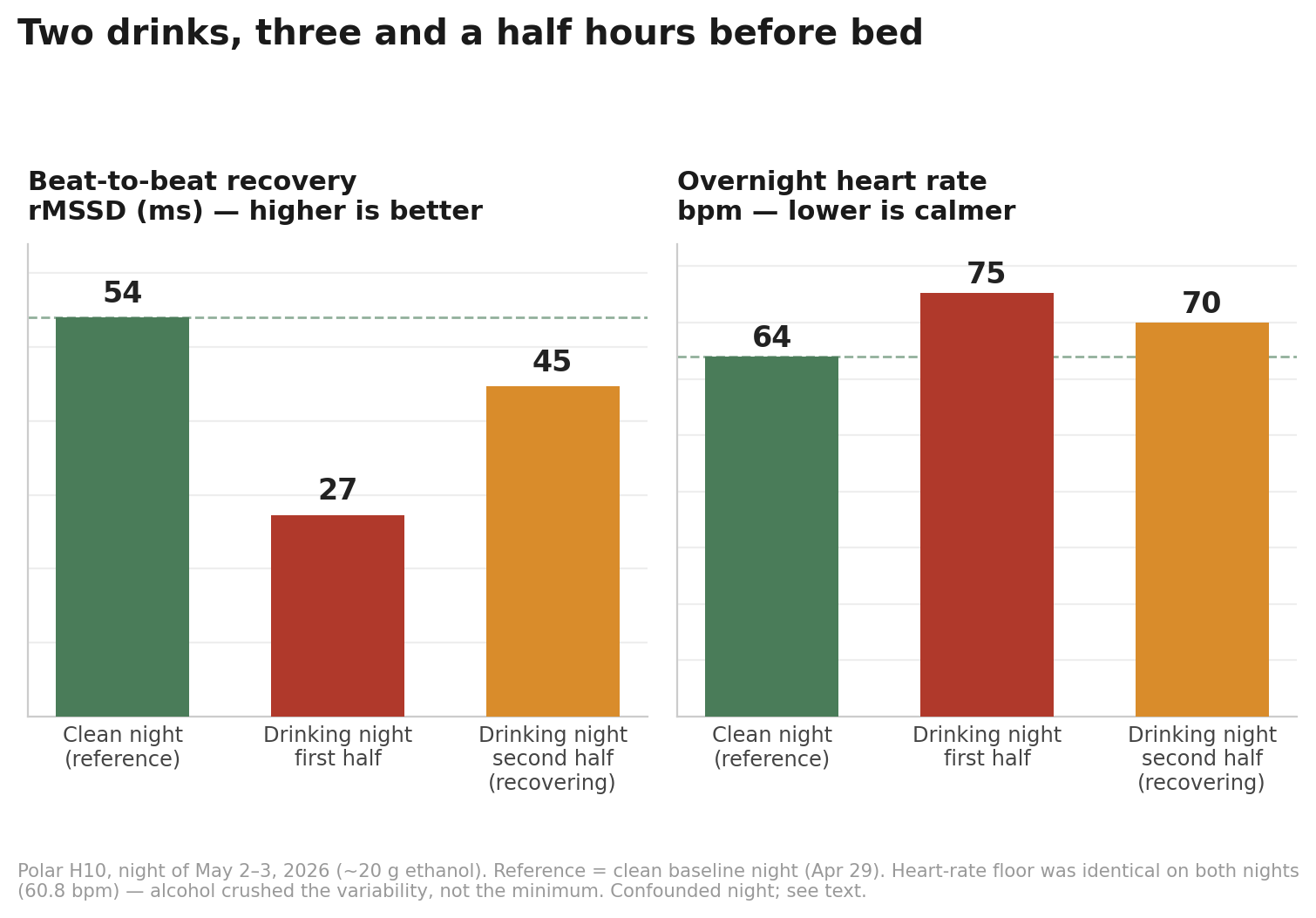
One clarifying detail: my heart rate’s floor for the night was identical to a clean night. What alcohol crushed wasn’t my minimum heart rate — it was the variability, the flexibility of the system. That “first half ruined, second half recovers” shape is exactly what Whoop and Oura have published at population scale.
Now this is just one night—an anecdote confounded by all the rest of the wedding-related travel, eating, socializing—but I don’t need more data to confirm what I already know: drinking and restful sleep are not compatible for me.
Red Wine Headaches
Do you get a headache after red wine? UCSF researchers think it might be related to how your body reacts to the flavanol quercetin, which is found in higher quantities in expensive, aged wines and is also sold as a cheap supplement. Here’s how to test it on yourself:
Drink a form of alcohol that doesn’t contain quercetin (vodka, gin, whisky).
Take a quercetin supplement (under $10 for a month).
If you get the headache, you’ve found your culprit — and ironically, because aged wine has more quercetin, you may find that cheaper wine treats you better.
Quercetin is wine-specific, but it’s one case of a broader rule: the darker and more “crafted” the drink, the more congeners — fermentation byproducts like acetaldehyde and methanol that track with hangover severity. It’s why Tim Ferriss’s standing advice is clear, low-congener alcohol with club soda, popularized lately as “just drink a White Claw” — hard seltzer being low-congener and low-ABV. The skeptic’s footnote: congeners modulate the severity; ethanol is still the toxin doing the real work. A clear drink is a smaller tax, not no tax.
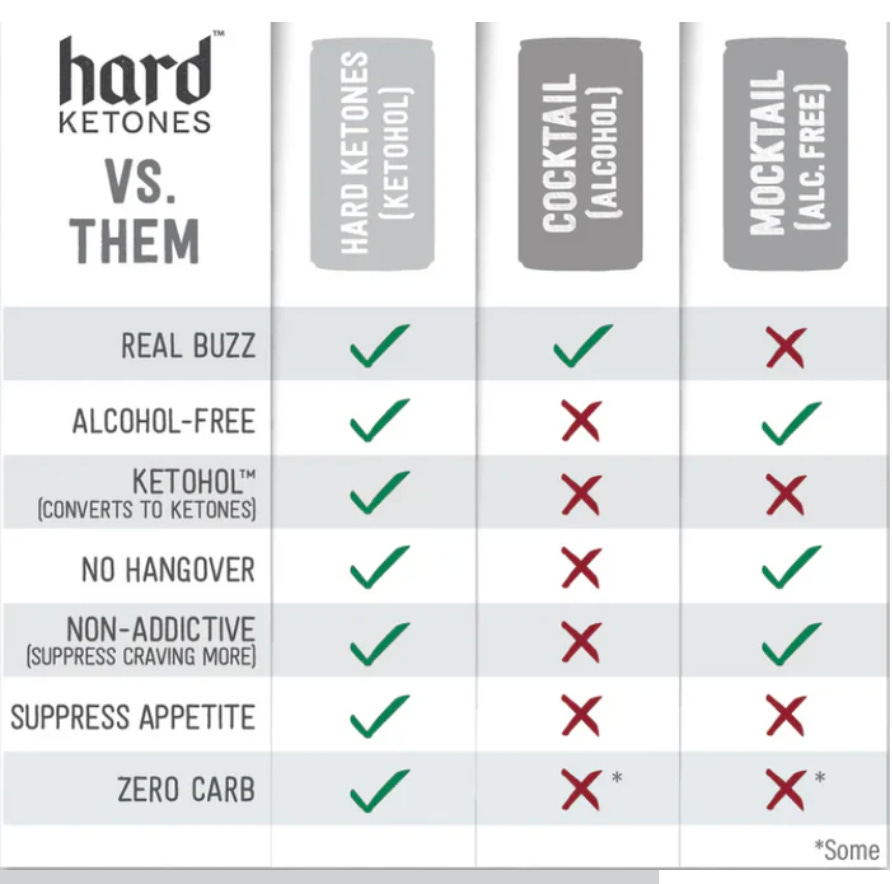
Or you could skip ethanol entirely. I tried ZBiotics (a B. subtilis strain that breaks down acetaldehyde in the gut) with no effect I could detect — but I never tested it rigorously. Now I’m testing Hard Ketones, which swaps ethanol for R-1,3-butanediol (”ketohol”) — a non-intoxicating alcohol the liver converts to ketones rather than toxic acetaldehyde. The pitch: a buzz with no hangover, appetite suppression, and raised blood ketones. I’m withholding judgment. When a food chemist tested it on herself under continuous blood monitoring, the result was “not a slam dunk” — inconsistent ketosis, no reliable buzz, dose hard to dial in — and the molecule was originally shelved because the lab mice started stumbling. Loud claims, thin independent data, trivial to measure on myself: a perfect personal-science candidate. Results in a future issue.
Personal Science Weekly Readings
Speaking of measuring sleep, we’ve previously recommended the Polar H10 for serious HRV measurement, but people who don’t like the chest strap often go for the Oura Ring. But one of my favorite weekly email newsletters Recomendo, suggests the RingConn Gen 3 as a better alternative because it doesn’t have the monthly subscription.
A brilliant new Lesswrong piece takes this 2013 observation from Scott Alexander:
Byte for byte, an average Game of Thrones reader/viewer probably has as much Game of Thrones information as a neuroscience Ph.D has molecular biology information, but getting the neuroscience info is still a thousand times harder.
and proposes a way to use LLMs to translate intricate details of cell biology into easy-to-remember stories.
And speaking of stories that try to explain complicated things, please read The World Is Bigger Than You Can Imagine by economist Scott Sumner, who offers powerful reminders of how national economies seem to plod along despite all attempts to predict or change them. Almost any grand summary of economies, history, cultural products like movies or music—it’ll barely scratch the surface of what’s really happening. We humans know far less than we think.
About Personal Science
Personal scientists prefer to figure things out for ourselves. We listen to experts — not because they’re always right, but because they’ve usually thought about it longer. This year the experts handed us a rare, clarifying gift: two federal panels looked at the same evidence and disagreed so completely that the government gave up on a number. When that happens, Nullius in verba — take no one’s word for it — stops being a slogan and becomes the only practical option.
We publish every Thursday for anyone who uses science for personal rather than professional reasons. If you have topics you’d like us to explore, let us know.