
Shortly after the 2020 election, a controversy erupted over how to appropriately refer to the incoming President’s wife, who holds an EdD from the University of Delaware. If we refer to her simply as “Jill,” rather than “Dr. Jill,” does that deny her the recognition of her hard-earned degree?
This week we’ll dig deeper into the actual privileges afforded by the “doctor” credential, and what it means for personal scientists.
Nobody asks a programmer for a diploma
I grew up in the personal computing industry, where nobody cared about your credentials. They cared whether your code ran. That really hasn’t changed. The compiler is the most ruthless examiner ever built — it doesn’t read your transcript, it just tells you, instantly and without sympathy, whether the thing works. It is nullius in verba enforced in silicon: take no one’s word for it, least of all your own.
Just one example: Matt Mullenweg was a jazz saxophonist studying political science when he co-created WordPress; he dropped out, and the thing now runs something like 42% of the web. No CS degree, no permission slip, no board exam. The work was directly inspectable. Who cares about his credentials?
But software engineering is different from “doctor” because it has two properties at once — the output is self-verifying, and there’s no legal gate in front of doing it. Other professionals must rely on credentials and we tell ourselves the credential certifies competence, when mostly it certifies the right to do gated things.
The anatomy of a “doctor”
I worked with Claude to build the following table of doctoral credentials, ordered not by prestige or years of training but by the breadth of legal monopoly each one grants. Watch what happens to the other columns as you read down.
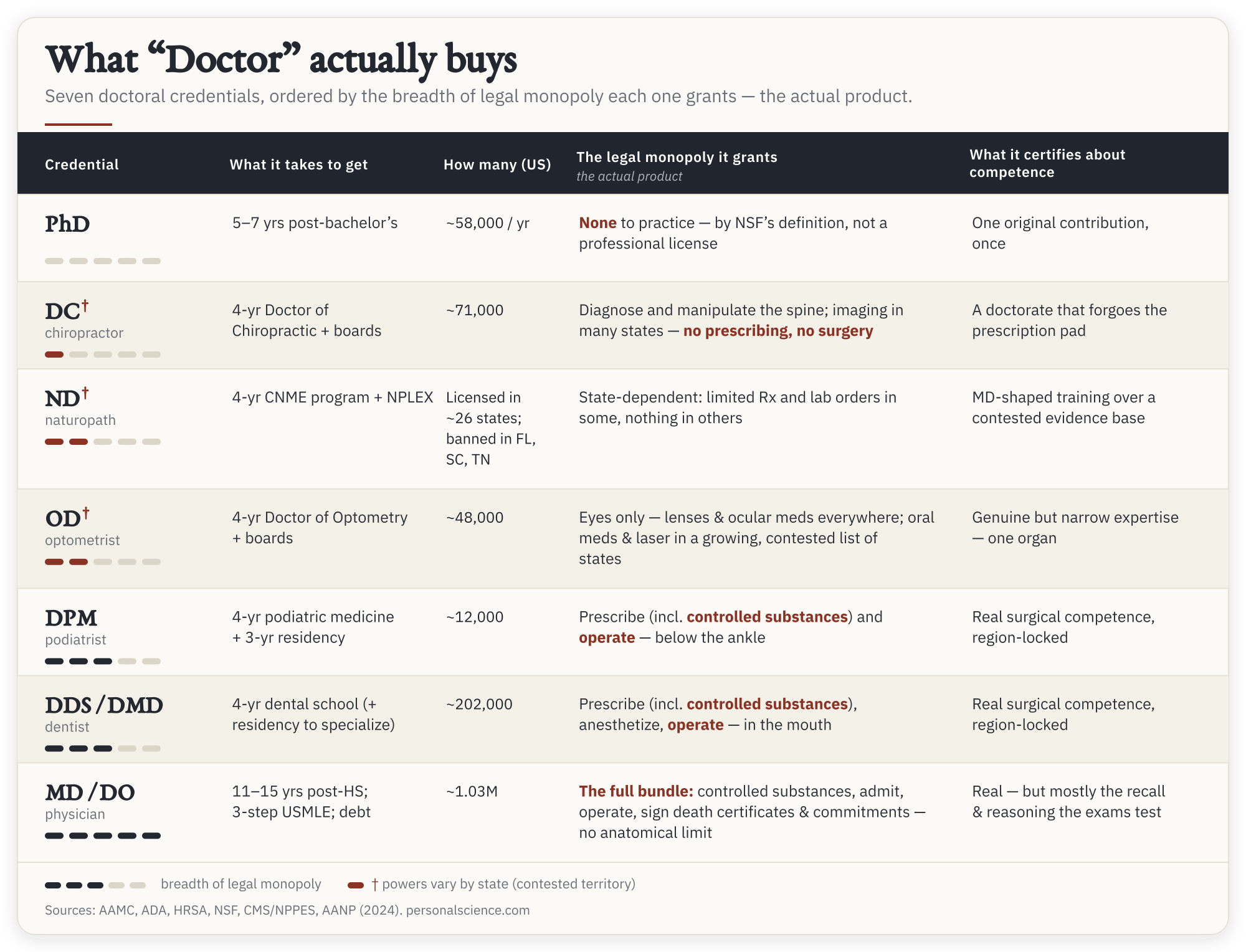
Read it down the “monopoly” column and the gated powers widen from nothing to everything. But read down “what it takes to get” and the years barely move across the middle five rows — yet the legal powers swing wildly. Effort, legal power, and certified competence are three separate things fused into one word.
Dentistry and podiatry are interesting for the fence placed around their practices: only one part of the body. The credential isn’t a rank. It’s a territory.
And notice the rows marked with the state-level caveat (dagger symbol). These professions — naturopathy’s very existence, optometry’s fight to hold a laser, chiropractic’s periphery — are exactly the ones whose boundaries are still being litigated. The core of medicine and dentistry don’t vary, because their territory was won a century ago and nobody’s contesting it. Jurisdictional variation is a turf-war tell: it marks the monopolies that aren’t settled yet.
So what does the title actually buy?
An old joke that is more true than we’d like:
“What do you call the dumbest, least competent graduate of medical school?”
Answer: “Doctor”
But strip away the title, and a clinical doctorate is a bundle of specific legal monopolies:
The prescription pad — the crown jewel. Controlled-substance authority, gated by a DEA registration that requires the license first. This single privilege is what puts the chiropractor below the naturopath.
Signature powers. Death certificates, involuntary psychiatric commitments, disability and medical leave certifications, DOT and FAA exams, medical-marijuana and disabled-parking sign-offs — documents only a licensed clinician can legally sign.
Billing and ordering. Diagnose as a billable act, order labs and imaging, admit to a hospital.
Underneath all of it sits the National Provider Identifier — and it’s the perfect anti-credential. There are over 9 million of them, and CMS states plainly that issuance “does not ensure or validate that the provider is licensed or credentialed.” It’s a free, ten-minute identity number that authorizes nothing. Registration is not authority; the NPI is just the floor the real monopolies are built on. (We talked about NPI in PSWeek260423 )
Incidentally, in some states it’s illegal to call yourself a “doctor” in a clinical setting, to stop patients inferring privileges the license doesn’t grant. Much as we can admire the First Lady for her academic achievements, I don’t recommend you call on “Dr. Jill” in a medical emergency.
The caveat
Before declaring it all a racket, it’s important to remember why that gate is there. Personal scientists love to experiment, but some things are best left to people who actually know what they’re doing. There are some very dangerous drugs out there; surgery is not for amateurs. Credentials don’t guarantee competence, but in this case it would be dangerously mistaken to think that gatekeeping is worthless. It’s that we’ve bundled a real safety function together with a legal monopoly and a status honorific, and then called the whole package “competence.” A personal scientist’s job is to keep the three separated.
Personal Science Weekly Readings
Speaking of people who fake credentials, remember that con-man character, Frank Abagnale, played by Leonardo DiCaprio in Catch Me If You Can? the guy who faked his way into all kinds of things, including a stint as a medical doctor? Turns out the whole story may itself be a con. A new, well-researched book claims he made up all his exploits in order to get work as a “reformed bad guy”. Which is itself a pretty good con, come to think of it.
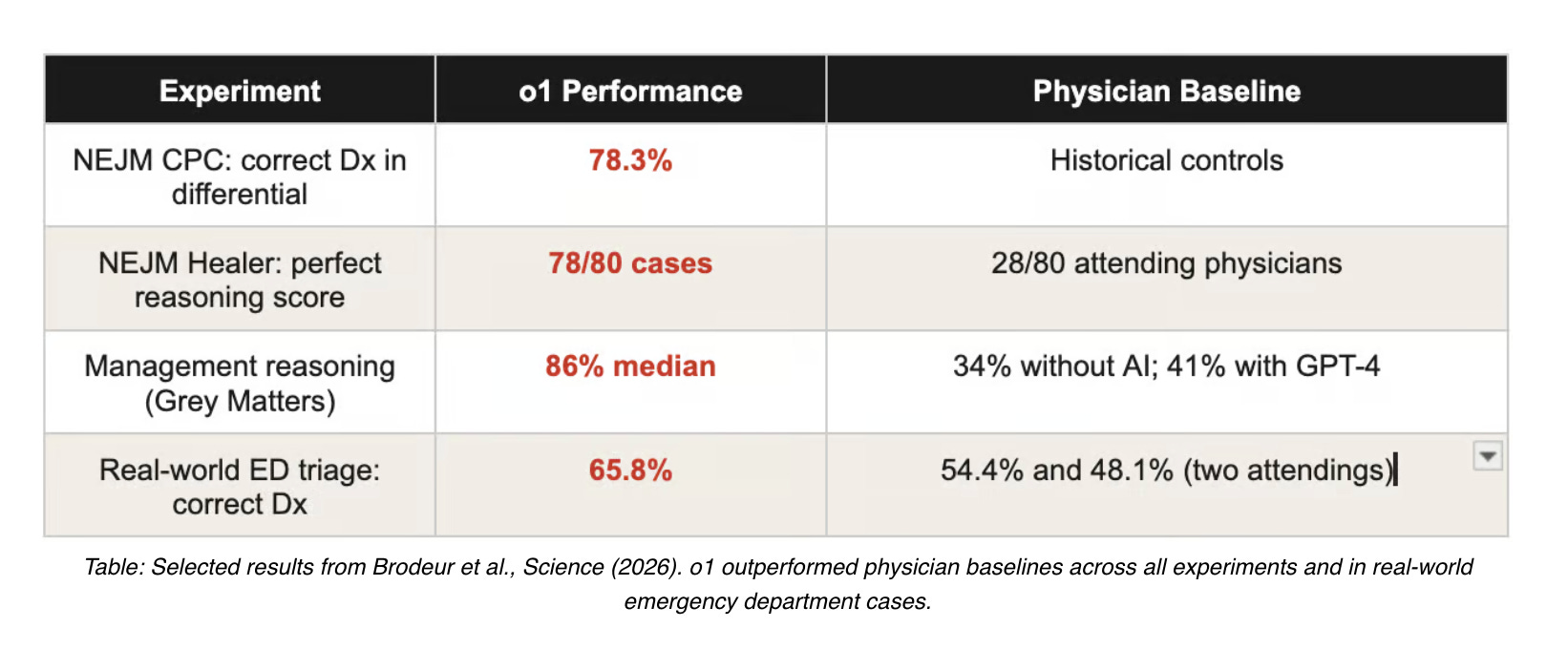
And if you’re convinced by that recent study in Science that concluded LLMs are better diagnosticians than most doctors, check out the counter-argument from GP and FDA Advisor Dr. Shantanu Nundy MD, MBA: Large Language Models don’t reason better than physicians - yet. He argues that the study evaluated LLM answers after the facts of each case had been determined. Real doctors earn their keep by asking the appropriate questions in the first place—before the LLMs are involved.
I’m in New York City this month where I’ve been meeting tons of personal science-minded people, including the CEO of Goodlabs, another low-cost blood testing company. They partner with blood donation centers to offer free blood testing when you donate. You can also order low cost tests (fulfilled by your local Quest Lab) at outrageously-cheap prices. Vitamin D: $14 , CMP: $5, OmegaCheck: $42. These are the lowest prices I’ve seen anywhere, ever. I’ll try them when I’m back in Seattle and let you know. (Note: be sure to select “Quest” in the drop-down on the price list or it will default to New York State prices, which are ridiculously high compared to the rest of the country).

About Personal Science
A credential is a permission slip — something the professional needs before the world will let them prescribe, operate, or sign. Personal science needs no such slip. Science is a set of tools anyone can pick up, not the private property of the credentialed, and the only examiner that matters in your own life is whether the thing actually works for you.
So we respect genuine expertise without mistaking the title for the competence beneath it. We listen to experts — then remember they routinely disagree, which leaves us, not them, on the hook for deciding which one to believe. Above all we run our own experiments and trust what we can measure firsthand, staying open-minded yet skeptical, and never forgetting that you are the easiest person to fool. Nullius in verba — take no one’s word for it.
Personal Science is delivered each Thursday to anyone who wants to use science for personal rather than professional reasons. If you have topics you’d like to see covered, let us know or leave a comment.
The use of titles outside of certain professional contexts seems outdated to me, but if we must, PhDs arguably have a better claim on the Dr. title than MDs... Also, in a typical medical emergency, I'd rather call on an RN than a "real" doctor like a psychiatrist or an ophthalmologist!
It's great that software development doesn't have artificial barriers. But if there is an argument that there should be, it's WordPress (which has become a security-nightmare to the point of being a public nuisance).