
Taking our assumptions for granted is one of the easiest mistakes to make in science, but we do it all the time.
This week we look at the problem of unspoken knowledge and what to do about it.
A U-Penn student once told me about volunteering with under-privileged mothers in Philadelphia. One mother explained she’d be stopping at the store on her way home to pick up dinner for her kids: a box of Oreos. Just Oreos. Nothing else.
Most of us hear this and assume it’s a joke. What mother would think that’s a normal meal? But the student insisted it was typical, and most of the mothers she worked with thought it was fine.
Here’s the uncomfortable question for a personal scientist: how do you know it isn’t? Where in your upbringing did you learn that Oreos aren’t dinner? Probably not from a 3rd-grade health class. Most likely you absorbed it the way humans have absorbed nutrition knowledge for millennia — from parents, siblings, peers, the smell of your grandmother’s kitchen. Nobody ever taught you “Don’t eat Oreos for dinner,” just like I’m sure that Philadelphia mother was never taught the opposite.

This is what Hungarian-British philosopher and physical chemist Michael Polanyi called tacit knowledge — the know-how that resists being written down. His slogan: “we can know more than we can tell.” His stronger claim, easy to miss: all knowledge sits on a tacit foundation. The explicit propositional stuff — textbooks, peer-reviewed papers, your favorite Substack — is the visible tip of an iceberg whose bulk is unarticulable.
Now invert the question. How do you know your way of eating is actually better? You could read a stack of nutrition books, become an “expert.” But here Polanyi would push back: book knowledge laid on top of a tacit foundation doesn’t replace the foundation. You picked the books. You picked the authors. Economist Arnold Kling puts it bluntly: we decide what to believe by deciding who to believe. Reading Michael Pollan instead of watching Food Network doesn’t escape that loop — it just dresses it up with better references.
This is the trap personal science is supposed to be a discipline against.
Back in PSWeek221229 we cited philosopher of science Michael Strevens: science is data + methods of data collection + logic that ties them together. That’s the only known procedure for stepping outside your inherited intuitions and your trusted sources and forcing yourself to face what’s actually true about you.
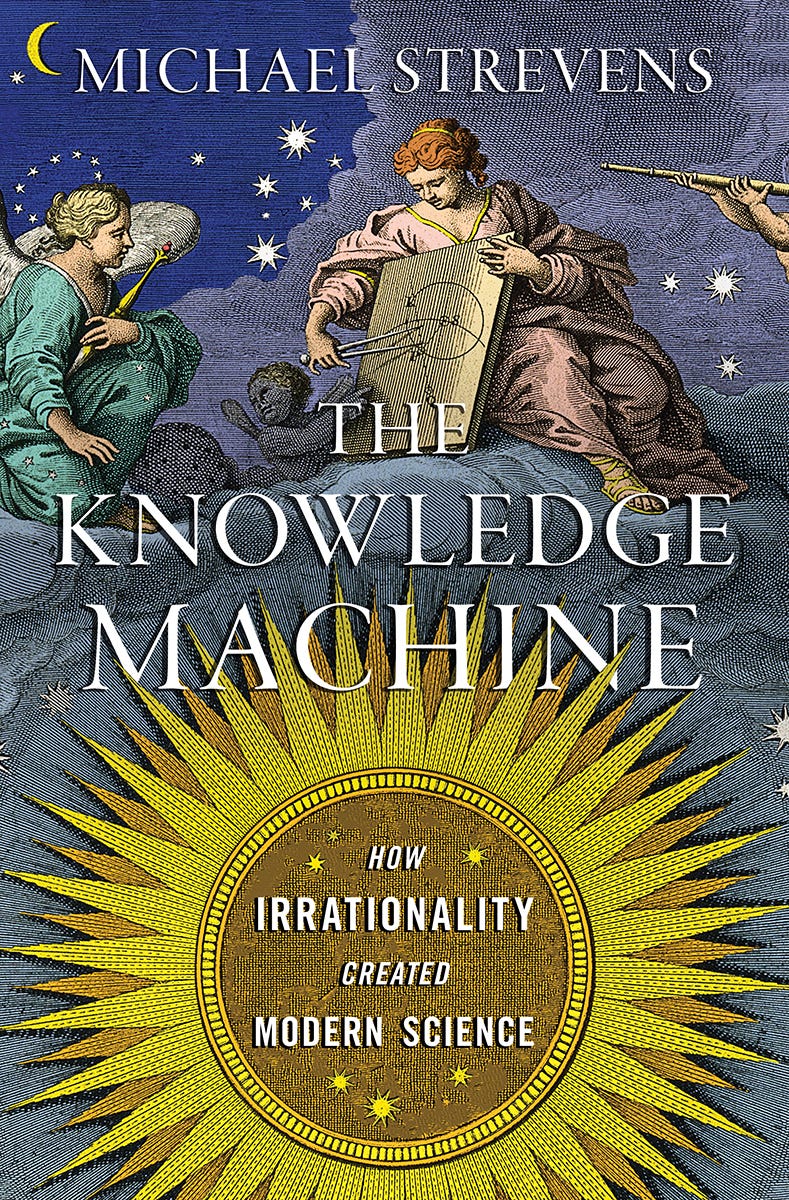
I want to update that older claim with what I’ve come to think since. Strevens isn’t an escape from Polanyi — nothing is. The tacit substrate is always there, in your choice of what to measure, your choice of which expert seems serious, even your sense that a result “feels right.” Personal science is not a way to transcend the tacit layer. It’s a discipline for refusing to be its prisoner.
That means asking, every time you think you “know” something: did I learn this by running the data + methods + logic gauntlet — or did I just pick it up? Most of what most of us “know,” even those of us who read a lot of papers, falls in the second bucket. That’s not shameful. It’s the human condition. But noticing it is the first move.
Including, of course, with this newsletter. Don’t take my word for any of it. Nullius in verba doesn’t go all the way down — Polanyi would say nothing does — but it goes further than anything else we’ve found.
Personal Science Weekly Readings
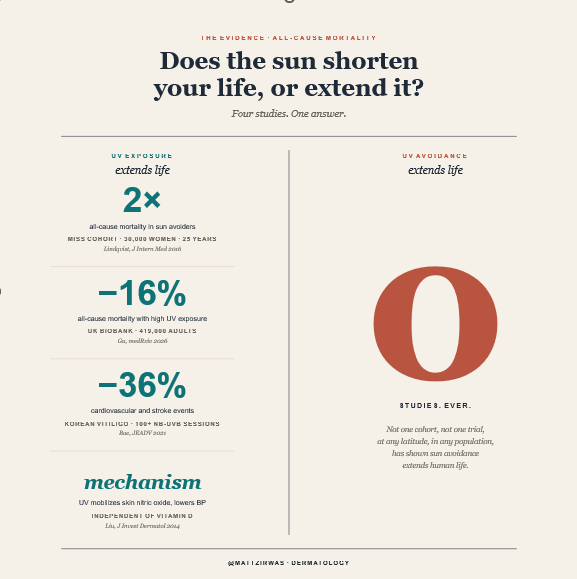
Speaking of tacit knowledge, nobody disputes that sunburn is bad for you. And common sense says it’s good to spend time outdoors. But how much sun is “good”? Matthew Zirwas is a dermatologist who wants to convince you that avoiding sun exposure is more likely to lead to problems. I double-checked the list of academic papers he cites, and it’s true that the underlying observational studies are real, though as always with this kind of epidemiology, sun exposure correlates with a lot of other healthy behaviors." He also claims that while Vitamin D is important, getting it from supplements may not work.
One way to tell how beholden you are to tacit knowledge is how easy it is to change your mind. Despite very high LDL-C numbers Nick Norwitz MD PhD was skeptical of cholesterol-lowing medication until recently he changed his mind. His thought process is classic personal science: be skeptical but open-minded, and recognize that everyone is different. (We mentioned him previously in PSWeek251127 as the guy who tried an all-sardine diet for a month.)
Speaking of Nick Norwitz, we’ve long been fans of Dave Feldman, a normal guy who has promoted the idea of “Lean Mass Hyper Responders” (LMHR), a specific class of people whose cholesterol shoots up on a ketogenic diet. Feldman’s “Cholesterol Code” concludes that high cholesterol isn’t relevant to LMHR people. So when recently Peter Attia strongly panned the LMHR idea, it’s worth noting both Attia’s case and the response from Feldman and Norwitz. Tldr; Feldman and Norwitz argue that Attia is misrepresenting the LMHR theory and cherry-picking results.
Oh, and speaking of Oreos, Nick is also the guy who published that study we wrote about in PSWeek240125 that showed how for LMHR people, Oreos lower cholesterol more than a statin.

Astral Codex Ten is always worth a read, especially the monthly list of interesting links. The links from April included
An entrepreneur’s dog got cancer, so he worked with ChatGPT to design a personalized mRNA vaccine, and it seems to have kind of helped (the dog still has cancer, but the tumors shrunk and she is feeling better). Here’s a comment with more info by the scientist involved, here’s a reminder that this kind of tumor changes size a lot for no reason; here’s the inevitable prediction market on whether we’ll still believe this is real a year from now (currently at 66%). I am less interested in the fact that one guy says his dog improved than in the comments by seemingly unimpressed scientists saying “Yeah, whatever, big deal, anyone can make a personalized MRNA cancer vaccine that works, the difficulty is studying it and scaling it up” (example).
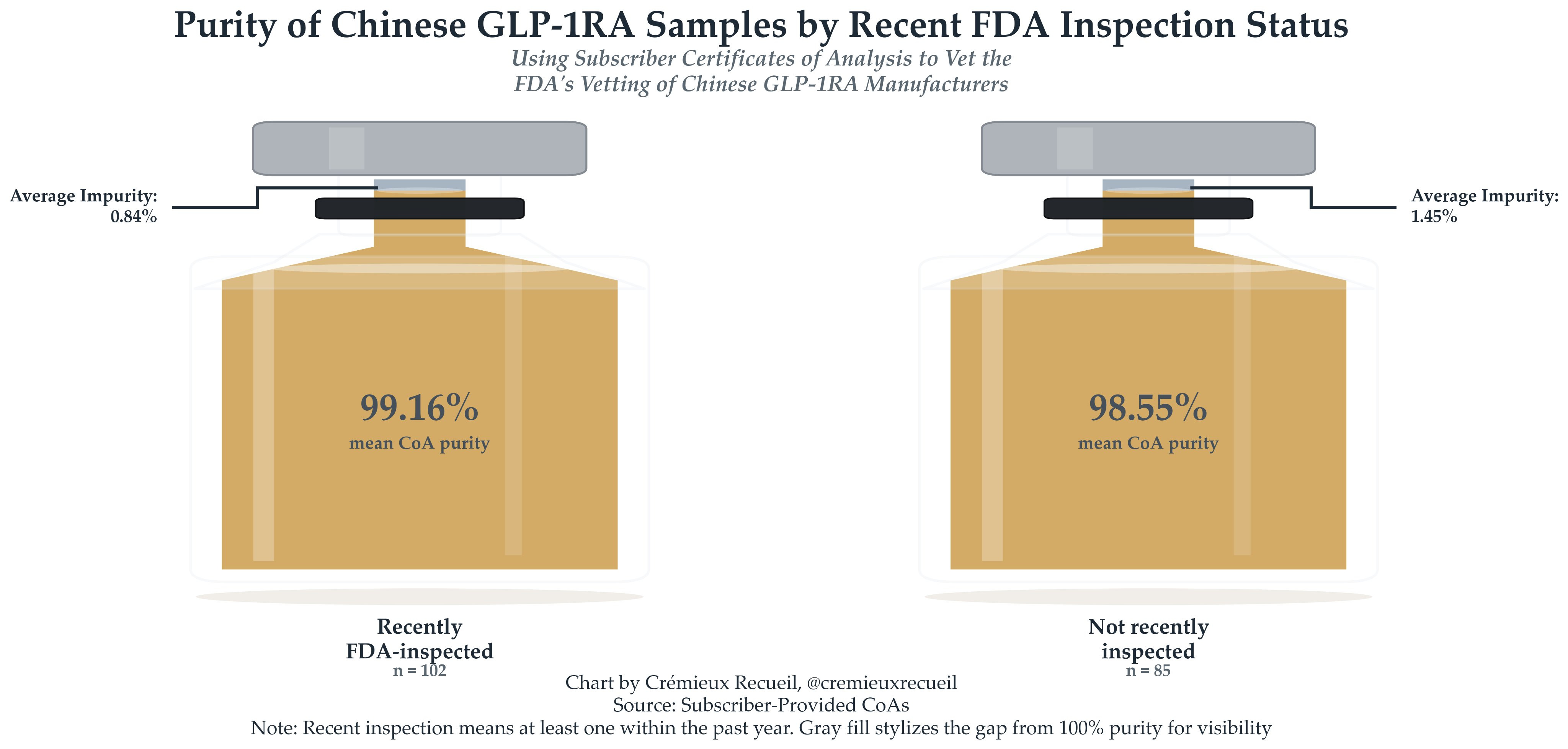
Finally, I don’t know who is behind the X pseudonomyous account Crémieux, but he often posts interesting content, like a summary of peptides quality that concludes most China-sourced GLP-1RA samples are actually fairly pure. But be careful: there is a lot of variability among vendors. That said, he claims you can get good quality semaglutide for around $15 a month and retatrutide for $30. If you try this yourself let us know.
About Personal Science
Our motto is the 1660 motto of the Royal Society: Nullius in verba — take nobody’s word for it.
That’s harder than it sounds. As this week’s post argues, most of what any of us “know” about how to live well wasn’t acquired through careful experiment — it was absorbed from parents, peers, books, and the experts we happened to trust. Personal science doesn’t pretend to escape that substrate. It’s the discipline of noticing it, and of putting as much as we can through the data + methods + logic gauntlet anyway. Skeptical of experts, skeptical of supplements, skeptical of our own intuitions — and, especially, skeptical of our own conclusions.
Personal Science Week is delivered each Thursday to people who use science for personal, rather than professional reasons. If you have topics you’d like to see covered — or experiments you’re running that deserve attention — let us know.
To be a genuine SME on a science topic requires training, lengthy study, an open-minded but skeptical quality, and an enormous amount of objectivity. The last seems to be the hardest to come by. I'm currently reading an anti-vaccine book where the author is presenting basically solid information, but to me, he is undermining his own credibility simply because of his extreme passion on the topic (however, if he didn't have some passion, he probably wouldn't have written the book).
I believe with my chemistry background and extensive reading over the last six years, I am an SME to a degree on diet vs health. I'm fairly knowledgeable on heart disease but not to the same degree. My lipid numbers currently are HDL 126, LDL 73, and triglycerides 75. I believe part of the reason they are that good is that I don't ever eat Oreo cookies, or similar foodstuffs. I tend to think people who do eat large quantities of such things are ignorant at the least, with a good chance of being genuinely stupid, but as I am not going to live forever on my Oreo-free diet and am going to be deprived of all that comfort and pleasure, perhaps it's me who is really the stupid one.
The pediatrician Robert Lustig relates in one of his books a migrant farm worker mother with a six year old son weighing 100 pounds who was as wide as he was tall. The child drank no soda but consumed a gallon of orange juice a day, in part because it was free as part of the WIC program. Dr. Lustig explains in technical detail why this practice is a bad idea, and his arguments are difficult to refute. But this is a case of simple ignorance on the part of the mother, not stupidity, and there are many, many others, some fairly well educated, who may believe the same thing as this mom did.
Great post! Love the TOK (theory of knowledge).
Related to LMHR, MasterJohn has written about the importance of dietary choline in regulating LDL. This makes sense mechanistically because choline is required to efficiently transport other fatty acids.
Anecdotally (personal-scientifically), I’ve always struggled with slightly high triglycerides and LDL and low HDL, despite healthy diet/exercise, and adding a choline supplement seems to have helped.
This could potentially explain the Oreo observation: Oreos contain a significant amount of lecithin, which contains choline.