
Natural Products Expo West is the world’s largest natural, organic, and healthy products trade show, with more than 2,500 exhibitors across categories including food & beverage, supplements, personal care, and ingredients. It’s the best annual snapshot of where the healthy-food industry thinks it’s heading.
This week I’ll summarize what I learned.
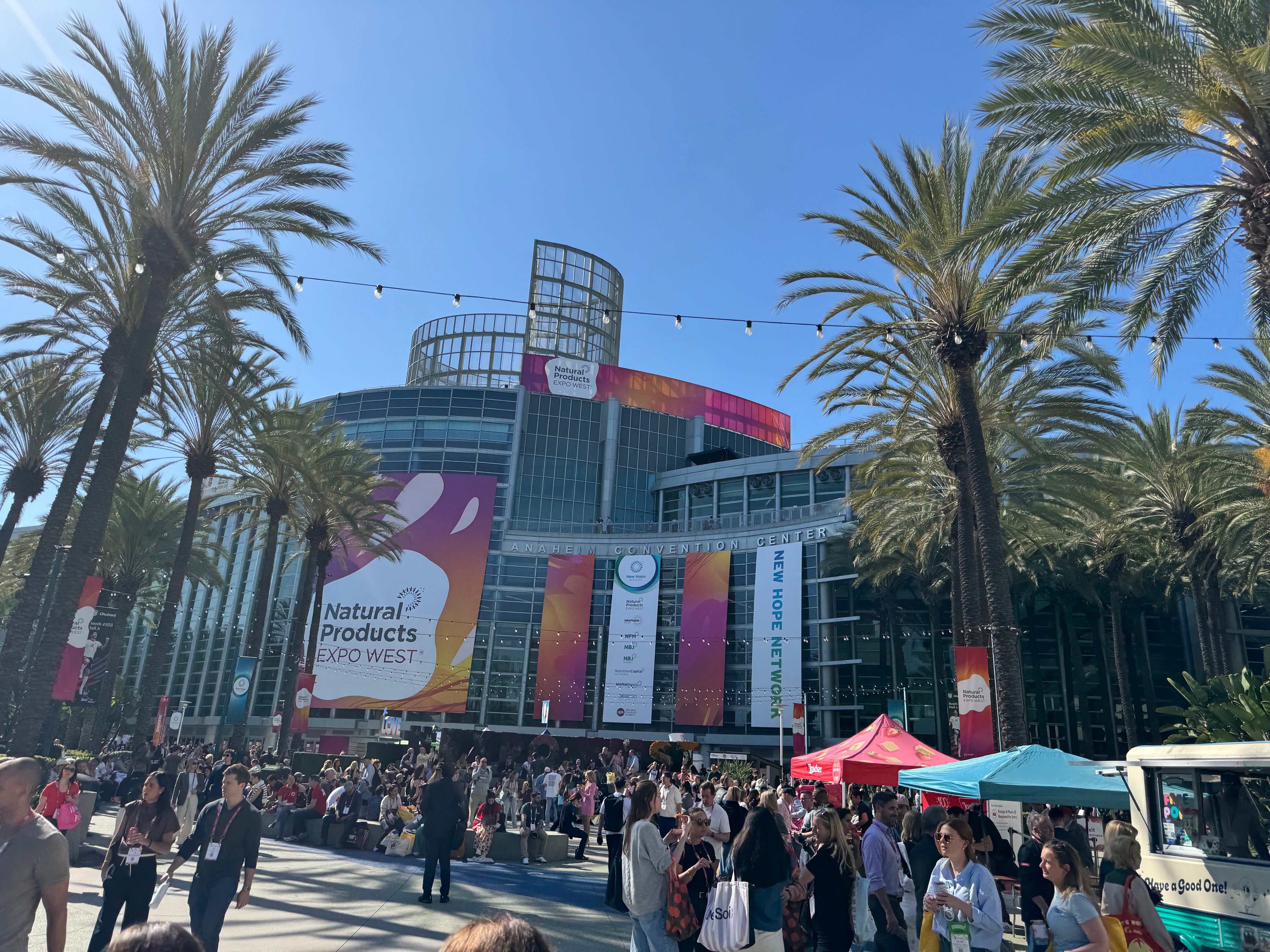
I attended the 2026 edition (March 3–6, Anaheim) as a guest of my friends at Tastermonial, whose $100+ experiment kits come with a clinical-grade continuous glucose monitor, food product samples, and an app that walks you through your own glucose-response experiment. I’ve learned a ton from my own Tastermonial experiments — with Biostrips (PSWeek250807), Apple Cider Vinegar (PSWeek240725), and CGMs (PSWeek230406) — so I was especially watching for products that could become the basis of new self-experiments.

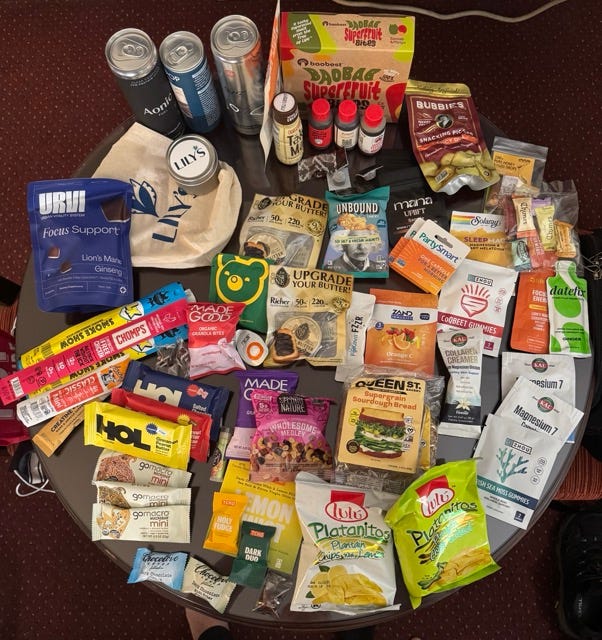
Expo West isn’t open to the public. Everyone there is in the industry — distributors, retailers, brand founders — so exhibitors give out a lot of samples to attract business partners. Walking the tightly-packed vendor aisles is like Trick-or-Treating on Halloween: you start with an empty bag and it fills up fast. Here’s a small selection from just one afternoon:
Trends Worth Testing
A few of my personal science takeaways:
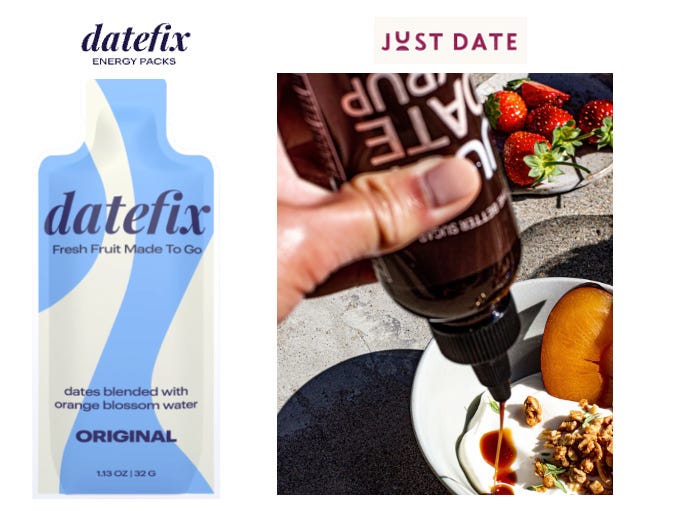
Dates as sweetener. Companies like Just Date and Datefix are pushing date syrup as a “whole food” sugar replacement. Their pitch is that because dates contain fiber, their glycemic impact is lower than refined sugar. I’m skeptical. Date syrup is still roughly 70% sugar by weight; the fiber content per serving is modest. But the glucose curve might genuinely differ from honey or table sugar, and that’s what matters for an n-of-1 experiment. It’s a testable claim — exactly the kind of thing a CGM experiment could answer.
Mushrooms in everything. Functional mushroom products were everywhere — in coffee (Four Sigmatic, Malama, MUD\WTR), in chocolate, in gummies. The claimed benefits (focus, immune support, adaptogenic stress relief) are mostly backed by in vitro or animal studies, not robust human trials. Lion’s mane has the most promising human evidence for cognition, but even there the studies are small and short-term. Still, the risk profile is low, and the products taste surprisingly good.

Protein on everything — fiber next? The “protein” label has been slapped on everything from boba tea (Boba Tea Protein) to chips and cookies. An industry insider told me the next wave will be fiber. I saw hints of this — Catalina Crunch had installed an airport billboard for the occasion — but it hasn’t fully arrived yet. As with most of these fads, protein labeling is often misleading (whey isolate added to junk food doesn’t make it health food), and fiber claims may follow the same pattern.
Manuka honey. Supposedly, this honey from New Zealand bees who pollinate the manuka bush has potent antibacterial properties, primarily due to its high concentration of methylglyoxal (MGO). Honey Droplets turns that into a throat lozenge that you can take any time. I can believe the claims for topical wound healing, but for oral consumption as a health food, I’m less certain. But I’m intrigued and would like to test it more.

Energy drinks and mixes. These were so abundant I couldn’t carry them all home — airport liquid restrictions did me a favor. Most are repackaged caffeine-plus-B-vitamins with varying amounts of nootropic pixie dust. A few interesting outliers existed, but the category as a whole felt saturated and undifferentiated.
What I Didn’t See
Where are the peptides? I had expected the supplements aisles to overflow with peptide-themed products, given the buzz in the biohacking community. The absence likely reflects the regulatory gap: most serious peptides require injections and don’t fit neatly into the “natural products” framing of Expo West. Or the industry just hasn’t figured out how to package and market them yet.
More broadly, I was disappointed by the lack of genuine innovation in supplements. Most booths offered variations on fish oil, magnesium, and concentrated vitamin drinks. The supplement aisle felt like it’s been in a holding pattern for years — lots of new packaging, not many new ideas.
The Ultimate Personal Science Tool
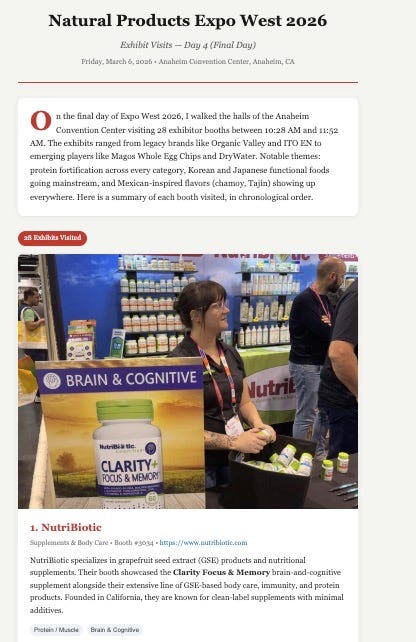
One thing that has changed dramatically is my workflow for processing trade shows. Rather than collect piles of brochures, I now take a few photos at each booth — hundreds over the course of the event. Later, I have Claude Cowork look through them, identify vendors from logos or signage, visit their websites, and generate structured summaries. I’ve written a custom “skill” that produces pages like this one:
(Also see Day 3 booth visits and the full exhibit summary.)
This is arguably the most personal science thing I did at Expo West. The photos → AI → structured web page pipeline turns an overwhelming trade show into a searchable, referenceable database. Claude Code has become such a large part of my daily workflow that very little of my personal science work doesn’t pass through an LLM at some point. Thanks to integration with Apple Health, I’m running near-daily experiments — more on that in future posts.
Personal Science Weekly Readings
People Science is on a roll with new studies. Sign up for tests with probiotics, joint health, women’s health and more.

Adam Kroetsch has an excellent analysis of Why clinical trials are inefficient. It’s not technology, or even regulation. One obviously wasteful practice: the policy of 100% source data verification (accounting for 25–40% of trial costs, which the FDA has publicly opposed for over a decade) persists because managers at Big Pharma happily overspend to minimize any chance of blame. Then there’s what the article calls the “sacred science” problem: treating trials as purely scientific endeavors rather than business processes makes it socially awkward to even discuss cost reduction, and reform proposals balloon into unfocused “everything bagel” agendas instead of targeting efficiency directly.
One initiative I’m optimistic about: THRIVE, led by Stanford’s Michael Snyder, secures up to $34.5M to develop the first FDA-grade “intrinsic capacity score” for ARPA-H’s PROSPR program. Includes our friends from OpenCures.
Finally, How Metrics Make Us Miserable: a conversation with philosopher C. Thi Nguyen forces journalist Derek Thompson to rethink his relationship with his Oura ring. If life is a game, who decides the objective and how it’s measured? (Listen w/transcript). I think this is a good reminder of the distinction between measurement attention vs. measurement precision — the Oura ring is useful not because its HRV numbers are gospel, but because it makes you pay attention.
About Personal Science
We’re open-minded and skeptical — that’s the guiding principle of personal science, where we apply the truth-seeking power of science to everyday situations.
If you’ve tried any of the products above, or have ideas you’d like to discuss, let us know.
"The Secret Life of Groceries" has a chapter about the uphill battle small companies at such shows face to get onto the shelves at Whole Foods. It's a brutal industry!
Methylglyoxal is mentioned in Robert Lustig's book Metabolical (2021), chapter 7, page 110, as being more associated with the breakdown of fructose and driving an unfavorable reaction associated with aging 250 times faster than glucose.
Specifically, it seems to be implicated in the formation of AGEs (Advanced Glycation End Products). Hemoglobin A1C would be one of the best examples of a harmful AGE. No doubt there may be some pluses associated with it, as well, but methylglyoxal seems to be something I'd be more inclined to avoid than seek out for any potential health benefits, based on my present knowledge.