
I’m not a big fan of most food labels, as you saw in PSWeek241212 where we looked at how labels are less accurate than you think (the FDA allows a 20% margin of error!) and why app-based alternatives like Sift and Fig are usually better.
This week I experimented with another one: Yuka.

Yuka is a French-made app (60 million users worldwide) that scans barcodes and instantly rates food from 0 to 100. Green means “Excellent” (75+) or “Good” (50-75), orange is “Poor” (20-50), and red is “Bad” (below 20). It also does cosmetics, but I only tested the food side. The free version gives you unlimited scans; a paid tier ($10-20/year) adds search and offline use.
The scoring formula is straightforward: 60% nutritional quality (based on Nutri-Score, a European front-of-pack labeling system), 30% additives (each one classified by risk level), and 10% organic bonus. Nutri-Score itself penalizes calories, sugar, saturated fat, and sodium, while rewarding fiber, protein, and fruit/vegetable content. If a “high-risk” additive is present, the score is automatically capped at 49 regardless of nutritional quality.
Simple. Fast. And sometimes baffling.
My Kitchen Test
I grabbed a handful of items from my kitchen and scanned them all:
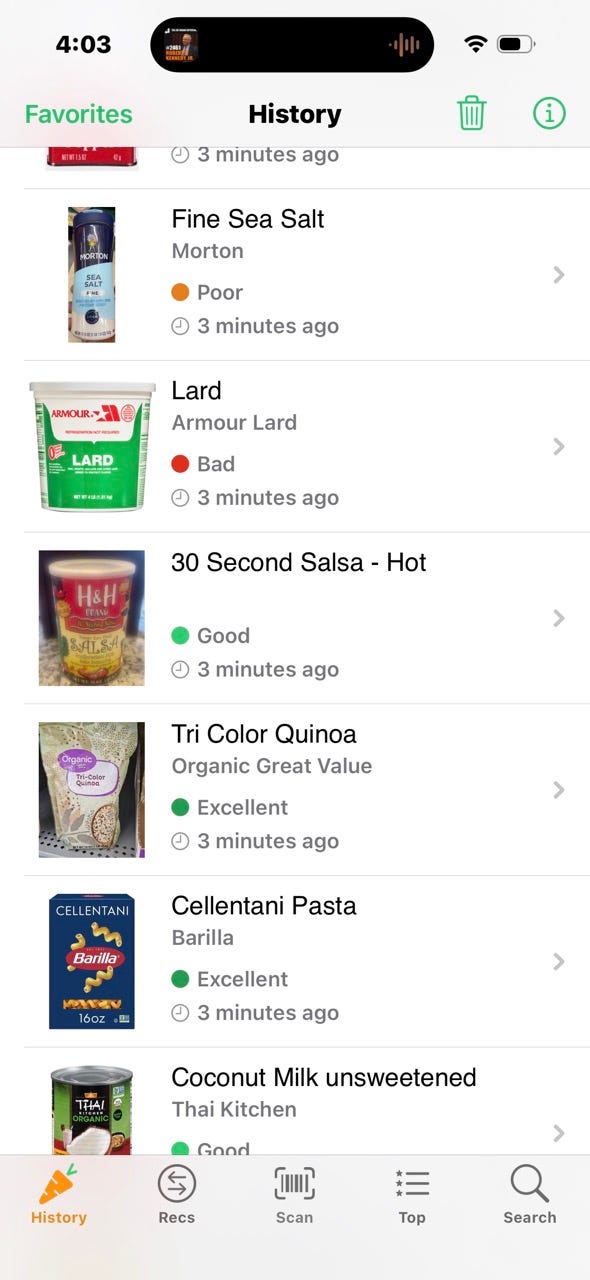
Most of these are reasonable enough. Quinoa and coconut milk landing in the green? Fine. Salt getting dinged? Understandable (it’s literally sodium).
But then there’s the pepitas.
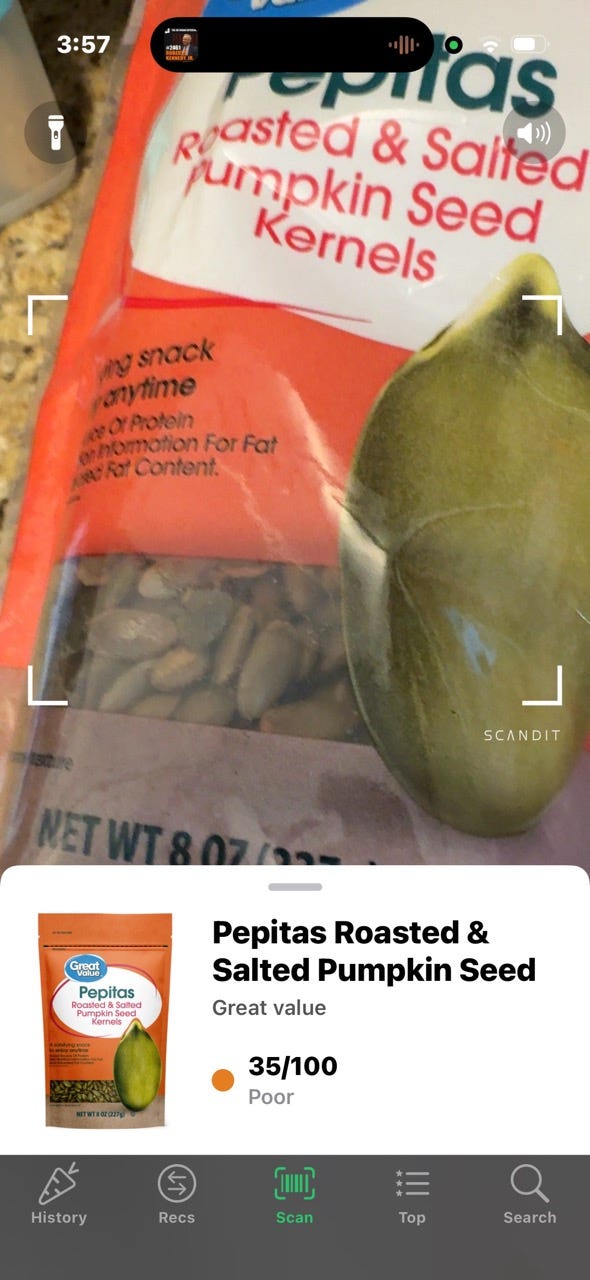
Pumpkin Seeds: “Poor”?
Great Value Pepitas—roasted and salted pumpkin seed kernels—scored 35/100. That puts them in the same “Poor” tier as Morton sea salt.
Meanwhile, Barilla Cellentani Pasta scored “Excellent.”
Think about that for a second. Pumpkin seeds are one of nature’s most nutrient-dense foods: roughly 30% protein by weight, rich in magnesium (one of the hardest minerals to get enough of), high in zinc, iron, and healthy fats. They’ve been a dietary staple across Mesoamerican civilizations for thousands of years. If you had to pick one food to survive on, pepitas would be a far better choice than refined wheat pasta.
So what happened? The problem is Nutri-Score’s fat penalty. The algorithm dings foods for total calories and saturated fat content per 100g. Seeds and nuts are calorie-dense by nature—that’s what makes them nutritious. A 100g serving of pepitas has roughly 550 calories and 5g of saturated fat (alongside about 19g of polyunsaturated fat, which Nutri-Score mostly ignores). The “roasted and salted” part adds a sodium penalty too. Add in the fact that seeds don’t benefit from the same “fruit, vegetables, and legumes” positive score that nuts sometimes get (Nutri-Score’s own categorization here is fuzzy), and you end up in “Poor” territory.
This is a known weakness. European researchers have published peer-reviewed papers specifically documenting how Nutri-Score underrates nuts and seeds, and the Nutri-Score Scientific Committee has been trying to fix it since 2022. The updated algorithm moved nuts into a dedicated “fats, oils, nuts and seeds” category—but whether Yuka has adopted these revisions is unclear.
The pasta, by contrast, sails through: low fat, low sodium, modest calories per serving, no additives. Never mind that it’s essentially refined carbohydrate with minimal micronutrient content. Nutri-Score rewards absence of “bad” things more than presence of good ones.
The Deeper Problem
This pepitas-vs-pasta absurdity illustrates a pattern that registered dietitians and nutrition researchers have been pointing out:
Yuka’s scoring conflates “low in things to avoid” with “healthy.” Cheese gets dinged for saturated fat despite being an excellent source of protein and calcium. Natural peanut butter scores poorly because it’s “high in fat”—which is the whole point of peanut butter. Grass-fed beef jerky with three ingredients (beef, salt, vinegar) scores 43/100 while Chef Boyardee ravioli gets 63/100.
The 10% organic bonus is also questionable. Being organic says nothing about a food’s nutritional value—it’s a production method, not a health indicator. Giving automatic points for an organic label is a values judgment dressed up as science.
And the additive scoring, while well-intentioned, applies a precautionary principle that doesn’t account for dosage. A trace amount of a “moderate risk” additive caps your score at 50, even if the actual quantity is far below any level shown to cause harm.
What Yuka Gets Right
I don’t want to be entirely negative. Yuka has some genuine strengths for the personal scientist:
It’s free, fast, and frictionless. Point your phone at a barcode and you get an instant result. The UI is beautifully designed. Compared to apps like Sift or Fig that limit you to 5 free scans per month, Yuka’s unlimited free scans lower the barrier to entry dramatically.
It flags additives you’d never notice. This is where the app genuinely adds value beyond the nutrition label. Even if you disagree with the risk weighting, having someone highlight the dipotassium phosphate in your oat milk or the BHT in your cereal is useful information.
It’s independent. Yuka claims to take no money from food companies, funding itself through premium subscriptions. In a world where most “nutrition” apps are basically advertising platforms, that matters.
It’s changing industry behavior. In France, supermarket chain Intermarché reportedly removed 140 additives and reformulated over 900 products in response to Yuka scores. Chobani has done similar reformulations in the US. Even if the scoring is imperfect, the competitive pressure to improve ingredients is real.
About Personal Science
Here’s how I think about Yuka, and food-scoring apps in general: they’re useful as one signal among many, but dangerous as a sole authority.
As we discussed back in PSWeek241212, the whole premise of one-size-fits-all food scoring has the same fundamental flaw as mandatory nutrition labeling: it assumes everyone has the same dietary needs. A 35/100 for pepitas is meaningless for someone tracking their magnesium intake. A pasta score of “Excellent” is misleading for a diabetic monitoring blood sugar spikes.
The more interesting apps—like Zoe, which we covered in PSWeek250515—try to account for individual variation by scoring foods in the context of your whole meal and your personal biology. That’s harder to build, but it’s the direction that actually serves personal scientists.
In the meantime, Yuka is worth downloading for the additive-flagging alone. Just don’t let it convince you that pumpkin seeds are bad for you and refined pasta is health food. Your grandmother already knew better than that.
Context definitely matters! Salt may be bad if it causes you hypertension, or good if you were sweating a lot. Eating a lot of pasta may be good if you depleted your glycogen stores by running all day, or not so great if you are trying to lose weight.
Nutri-Score et al can still be useful 1. to nudge manufacturers to reduce or avoid things like trans fats or added sugars (don't want to have a lower score than your competitor), and 2. to flag products that you assumed were healthy for closer inspection (few people are going to read all the labels on everything they buy).
An app like this is only as good as the beliefs informing its creation - obviously, there is an anti-fat bias here that you've perceptively identified. Eric is absolutely right that context matters.
As a chemist, I'm less scared by chemical names. Both potassium and phosphorus are essential - the latter is a major constituent of your bones. A potassium salt will be highly soluble, and you'll be able to absorb both parts of the compound, neither of which I believe can hurt you. However, the average person doesn't have that kind of understanding. It looks like a "chemical." Beware!
I do avoid anything with bromine, either as bromide or bromate. This is a nonessential element that tends to displace the much more vital iodine, which you can't be healthy without. Fortunately, it's use has been largely discontinued in food production in the US.