
When we first wrote about hearing tests back in PSWeek221103, the best options were a handful of web-based tone generators and a fun UK site that guessed your age from your high-frequency cutoff. Three years later, the landscape has improved. Your phone is now an FDA-authorized audiometer, a major university has launched a free hearing metric designed to be tracked like blood pressure, and the scientific case for why you should care about your hearing has gotten a lot stronger.
This week I retake my hearing test and explore what’s new.
My Updated AirPods Hearing Test
Back in PSWeek241114 I showed how easy it is to run the AirPods Pro audiogram test (it’s built into every iPhone with Airpods) and noted that my left ear looked worse — probably because I forgot to shut the door. This time I did it properly: quiet room, door closed, late at night with minimal ambient noise.
And I guess there’s been no change: my right ear is slightly better—in fact, even better than last time.
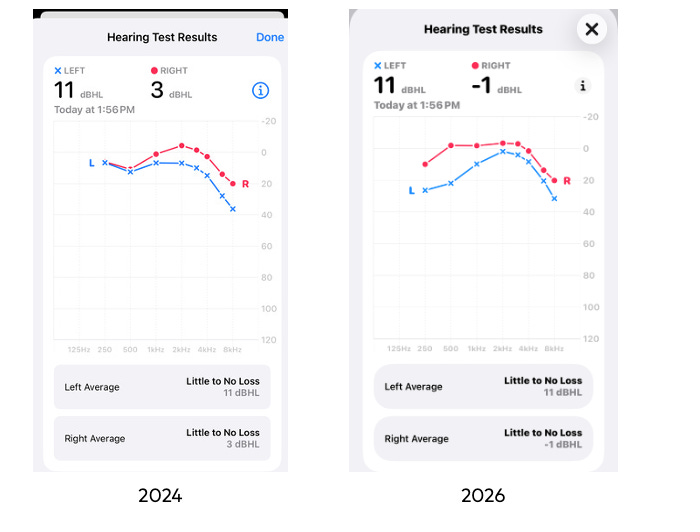
The test itself has improved since my last attempt. Apple’s hearing features received FDA authorization in late 2024, and the clinical validation data is impressive: the median deviation between AirPods and professional audiometry was just 1.8 dBHL for the standard 4-frequency pure tone average. Classification agreement with professional audiologists was 86% for identical WHO grade and 100% within ±1 grade. That’s remarkably close to what you’d get in a sound booth.
More importantly, the AirPods now function as an over-the-counter hearing aid for mild-to-moderate loss. Take the test, and if the results suggest you need help, your personalized hearing profile automatically boosts frequencies in real time — during conversations, music, phone calls. No audiologist visit required.
Know Your Number
Now from the Johns Hopkins Bloomberg School of Public Health there’s a more sophisticated way to test: Hearing Number app. It’s free (iOS and Android) and takes about five minutes: after double-checking that your headset is working properly, it plays a series of tones at different volumes and you tap the screen when you hear something.
The result is a single trackable metric: your 4-frequency pure tone average (PTA4) in each ear.
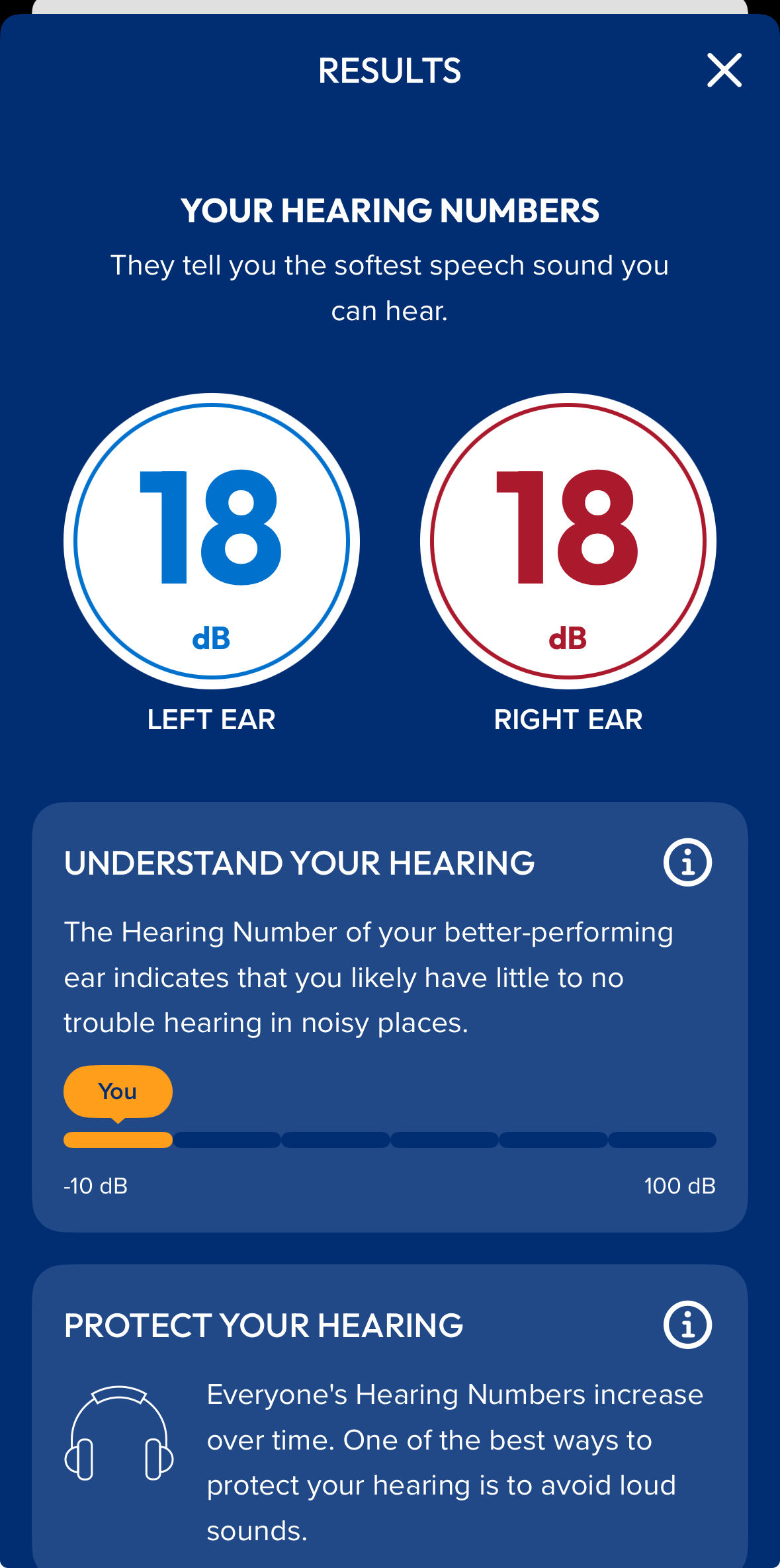
The PTA4 is the average of your hearing thresholds at 500, 1000, 2000, and 4000 Hz — the frequencies most important for understanding speech. Children and young adults with healthy hearing score as low as -10 dB. The number creeps up with age. The WHO uses these same thresholds to classify hearing loss:
< 20 dB: Normal ← That’s me
20–34 dB: Mild loss
35–49 dB: Moderate loss
50–64 dB: Moderately severe
65+ dB: Severe to profound
The app was created by Frank Lin, MD, PhD, who also led the landmark ACHIEVE trial on hearing and cognitive decline (more on that below). His pitch is simple: you know your blood pressure, your weight, your step count. Why don’t you know your hearing number?

Hey Wait a Minute!
The Apple test and the Hearing Number tests disagree! There’s a gap of 7–19 dB depending on the ear, and the two tests don’t even agree on which ear is better. What’s going on?
The most likely culprit is calibration. Apple has an enormous advantage here: they control both the hardware (AirPods Pro) and the software, so they can calibrate precisely for that exact transducer. The Hearing Number app, built by Mimi Hearing Technologies under contract to Johns Hopkins, has to work across many headphone models. This seems to be a problem noted in all the research studies. Even among devices of the same model, studies find reference sound levels can vary by about 4 dB — and that compounds with other error sources.
Testing method matters too. Apple uses a dynamic adaptive algorithm that samples across the entire frequency and decibel range simultaneously — a departure from the traditional one-frequency-at-a-time approach. The Hearing Number app likely uses a more conventional ascending method. Different methods can produce systematically different thresholds.
Then there’s the asymmetry question. My Apple test shows a 12 dB gap between ears; Hearing Number shows them equal. Either one test caught a real difference the other missed, or environmental noise was affecting one ear more than the other — and Apple’s active noise cancellation may have handled that better. (Both apps warn that ambient noise is the biggest confounder.)
Here’s what matters, though: both tests classify me as normal (< 20 dB). The clinical category agrees even when the specific numbers don’t. And this is actually the more important insight for personal science. A single hearing test number, like a single blood test result, is less meaningful than most people assume. What you want is a trend line: the same test, under the same conditions, repeated over time. If my Apple PTA4 creeps from 11 to 15 to 20 over the next few years, that’s a signal. If it bounces between 8 and 14, that’s noise.
This is a theme we keep returning to in PSWeek: measurement precision matters less than you think, but measurement consistency matters more than you think. Pick one test, standardize your conditions (quiet room, same headphones, same time of day), and track over time. The absolute number is less important than the trajectory.
Hearing and Dementia
And speaking of hearing, a major study on dementia prevention says that the biggest single modifiable risk factor from mid-life is hearing loss, with an estimated 37% increased risk of incident dementia and a dose-response relationship of roughly 16% increased risk per 10 dB of worsening hearing.
The 2024 Lancet Commission on Dementia Prevention, led by psychiatrist Gill Livingston at University College London, is the most comprehensive review of modifiable dementia risk factors ever assembled. They list 14 modifiable risk factors that together account for roughly 45% of all dementia cases worldwide, of which hearing is the most important.
That’s what interests Frank Lin at Johns Hopkins (the same researcher behind the Hearing Number app). His ACHIEVE trial, published in The Lancet in 2023 was the first large randomized controlled trial to show that actually treating hearing loss slowed cognitive decline over three years. Lin and Livingston are independent researchers at different institutions, arriving at the same conclusion from different directions: Livingston through epidemiological meta-analysis of hundreds of studies, Lin through a prospective intervention trial. When independent teams converge, the signal gets harder to dismiss.
Other Hearing
Speaking of hearing tests, here are a couple more worth checking out (see PSWeek240818 for more)
Soundly Online Hearing Test — Web-based, works with any headphones in a quiet room. Pure-tone test with visual audiogram. Free. Good option if you don’t have AirPods or a compatible phone. (See PSWeek221103)
How Old Is Your Hearing? — The fun one. Plays tones of increasing pitch and guesses your age based on your high-frequency cutoff. Not clinically useful, but surprisingly accurate and a great conversation starter.

About Personal Science
Testing your hearing is part of a broader theme in personal science: using acoustic measurements to understand your own body.
Here's the thing about hearing: it declines so gradually that most people don't notice until they've already lost decades of data they could have been tracking. The measurement itself may be the intervention. Once you know your number, you start noticing — the restaurant where you can't follow conversation, the ear you favor on phone calls, the volume creep on your headphones. That structured attention is what personal science is for. Not to replace your audiologist, but to make you a better-informed patient when you finally visit one.
For more on acoustic self-measurement see PSWeek221103 and PSWeek240418, the AirPods audiogram in PSWeek241114, and voice analysis with Praat in PSWeek251023.
If you have other hearing-related tests, let us know.